Sunflower ovoid
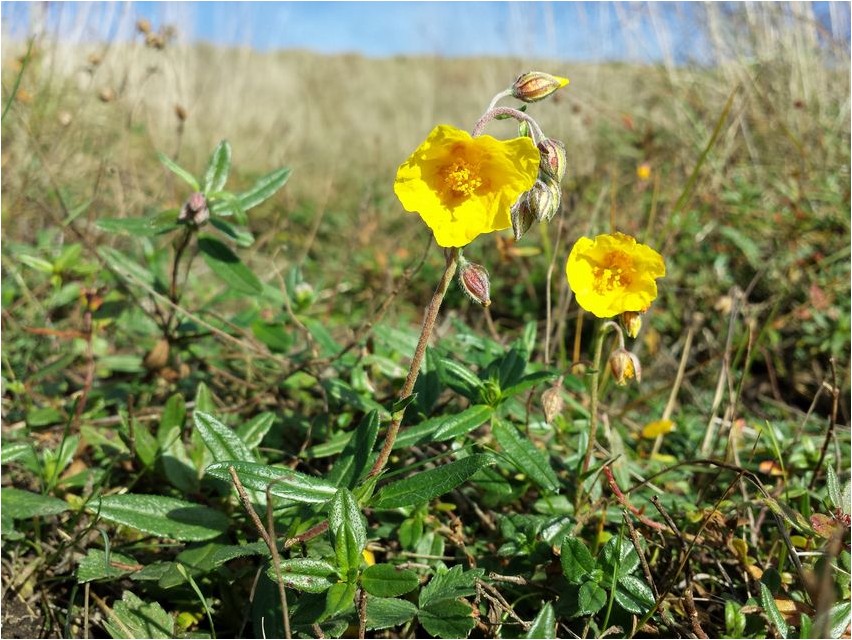
The ovate sunflower is one of the plants of the family called Cistaceae; in Latin the name of this plant will be as follows:
Helianthemum ovatum (Viv.) (H. hirsutum Thunb.) Merat. (H. vulgare auct PP., Cistus hirsutus Thunb.). As for the name of the ovate sunflower family itself, in Latin it will be like this: Cistaceae Juss.
Description of the ovoid sunflower
The ovoid sunflower is a subshrub, the height of which will fluctuate between ten and forty centimeters. The shoots of this plant can be either erect or erect; they will be covered with more or less thick felt. Sunflower ovate leaves are linear-lanceolate to broadly ovate in shape, their length is about ten to thirty millimeters, and such leaves will also consist of four to fifteen flowers. The petals of this plant are colored in orange-pink tones, their length is twelve to eighteen millimeters, and they will also be endowed with a lemon spot located at the very base. The seeds of the ovoid sunflower are colored in dark brown tones, their length will not exceed one or two millimeters, and such seeds will also be endowed with a finely pitted surface.
The ovoid sunflower blooms from May to July. Under natural conditions, this plant is found in the Caucasus, Crimea, Carpathians and Dnieper region in Ukraine. As for the general distribution, the ovoid sunflower can be found in Central Europe and Altai. For growth, this plant prefers shrubs, dry lawns, sandy, rocky and limestone hills up to the mid-mountain zone.
Description of the medicinal properties of sunflower ovoid
The ovoid sunflower is endowed with very valuable healing properties, and it is recommended to use the herb of this plant for medicinal purposes. The concept of grass includes stems, leaves and flowers.
The presence of such valuable healing properties should be explained by the content of ellagic acid, tannins, polysaccharides, gallic acid, diterpenoids and flavonoids in the composition of this plant, while vitamin E will be present in the flowers.

It should be noted that the medicinal properties of the ovate sunflower are similar to those of the coinifolia sunflower. An infusion prepared from the herb of this plant is indicated for use as a very effective antiepileptic drug.
As a wound-healing agent, it is recommended to use the following very effective medicinal remedy based on this plant: to prepare such a medicinal product, you will need to take ten grams of crushed dry leaves of the ovate sunflower per one full glass of boiling water. The resulting medicinal mixture should first be left to infuse for about two hours, after which this mixture must be filtered very carefully. In the form of lotions, the resulting infusion based on sunflower ovoid should be used as a wound healing agent. In addition, for colitis and dysentery, you can also use the resulting medicine based on this plant: it is recommended to use this infusion as an astringent, one third or one fourth of a glass, regardless of food intake.
For epilepsy, take two tablespoons of chopped herbs per glass of boiling water, leave for two hours and filter. Take this remedy based on the ovoid sunflower three times a day, one-third or one-fourth of a glass.





