Granadilla giant
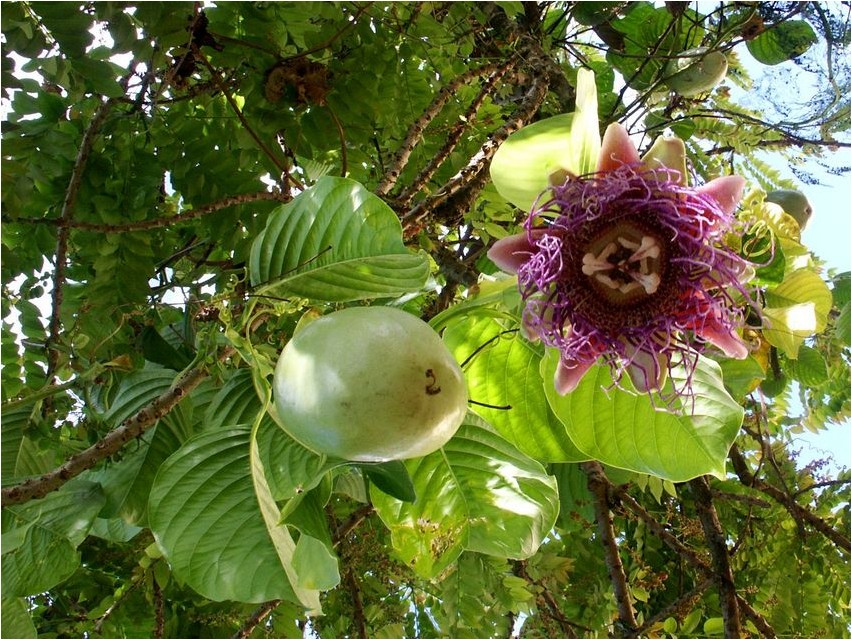
Giant granadilla (lat. Passiflora quadrangularis) is a fruit crop representing the Passionflower family. Its unusual name is due to its truly impressive size — it is the largest plant of the entire Passiflora genus.
Description
Giant granadilla is a tree-like vine that produces edible fruits. The average length of these vines, entwined around vertical supports, reaches ten to fifteen meters, and sometimes there are specimens up to forty-five meters long. And the diameter of the flowers of this plant can reach twelve centimeters.
The fruits of the giant granadilla are characterized by an elliptical shape and reach from eight to twelve centimeters in width and from ten to thirty centimeters in length. The color of the fruit can vary from green to yellow, and inside each fruit it is not difficult to find pinkish or white sweet and sour pulp with a mealy consistency. In addition, this pulp boasts a rather strong and very pleasant aroma.
Where does it grow
The giant granadilla came to us from tropical America, and in 1750 it was successfully brought to Barbados, as well as to a number of islands of the Bahamas and Antilles archipelagos. And currently it is successfully cultivated in the Amazon and in all countries of Central America. Individual plantations of this crop can be seen in South Vietnam, India, Malaysia and Indonesia, as well as in the Philippines, Sri Lanka, Australia and a number of tropical African countries.
Application
The fruits of the giant granadilla can be eaten fresh, or you can make a wonderful jelly from them. Quite often they are added to all kinds of fruit salads, ice cream or drinks. And the juice from these fruits is also excellent.
By the way, not only the fruits of this crop are edible, but also tubers that taste like sweet potatoes, the weight of which can reach four kilograms.

These bizarre fruits are also endowed with some healing properties — they will be excellent helpers for diabetes and high blood pressure. Their pulp is rich not only in fiber and vitamins, but also in iron, calcium and serotonin, which has a beneficial effect on the central nervous system — it helps reduce anxiety, has an excellent calming effect and relieves neurasthenia, insomnia and headaches. One cannot fail to mention its ability to prevent asthma attacks.
Giant granadilla is an excellent remedy both for the prevention of a great variety of ailments and for healing from them. Its fruits are a powerful gastric and antiscorbutic remedy. They help just as well with dysentery and diarrhea. A decoction of giant granadilla leaves is an effective anthelmintic. The roots of the plant are also used in this capacity; in addition, they are endowed with a powerful diuretic effect and the ability to induce vomiting.
And since these fruits spoil very quickly, they are almost never exported outside the countries where they grow.
Contraindications
The main contraindications against the use of giant granadilla include pregnancy and lactation, hypotension, severe atherosclerosis, myocardial infarction and angina. And drugs based on these fruits cannot be combined with antidepressants-monoamine oxidase inhibitors.
Growing and care
The giant granadilla is characterized by absolute unpretentiousness and the ability to easily adapt to unfamiliar conditions during the transplantation process. However, it will feel best in sunny areas, and the most optimal temperature regime for it will be a temperature range from eighteen degrees at night to twenty-eight degrees during the day. This crop especially loves slightly acidic and well-drained soils — if the soil becomes alkalized, the giant granadilla can easily get sick, grow extremely slowly and completely stop producing fruit.





