Patisson
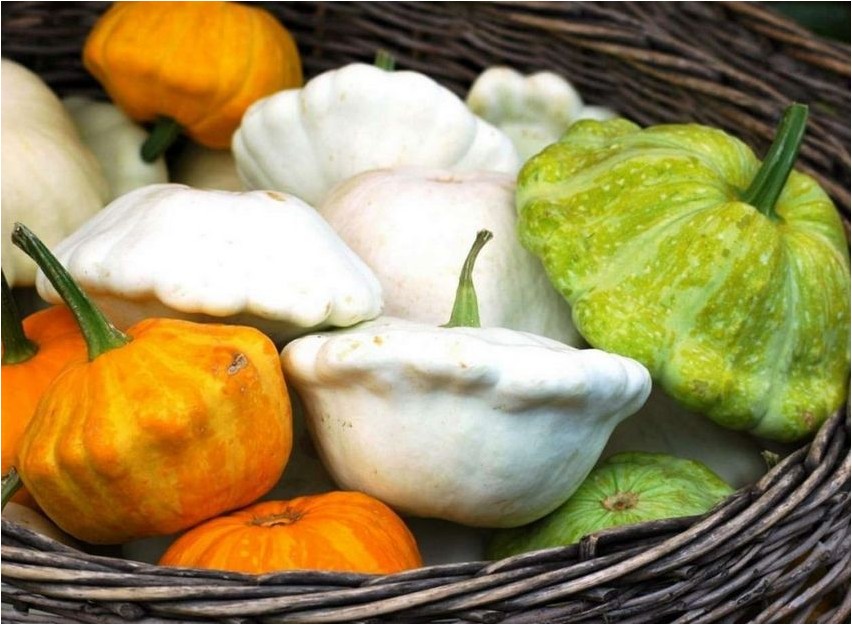
Patisson is an early ripening vegetable crop; an annual herbaceous plant considered one of the many varieties of pumpkin.
History
The squash came to Europe in the 17th century from America. This interesting fruit immediately gained unprecedented popularity in a number of European countries. And some time later, this crop began to be cultivated in the southern regions of Russia and Ukraine. However, in the 19th century, squash began to be found in Siberia.
As for the name of such a unique vegetable, it comes from the French “pate” (pie), which is due to its rather bizarre shape.
Description
Squash is a herbaceous plant that can have either a semi-bush or a bush form. The leaves of this plant are quite hard and very large, and its monoecious, unisexual and single flowers are distinguished by a rich yellow color.
The fruits of the squash have the appearance of a pumpkin. Their color, as well as their shape, can differ noticeably — the fruits can be green, yellow or white, and sometimes you can even notice stripes with spots on them. As for the shape, it is most often dish-shaped or bell-shaped and vaguely resembles a star or a flower. By the way, for such an original shape, the unusual vegetable is often called a plate pumpkin.
The diameter of adult fruits often reaches about thirty centimeters. True, those specimens whose diameter does not exceed ten centimeters are considered the most delicious.

Squash is not found in the wild in nature, but this in no way affects their popularity.
In color, taste and composition, squashes are in many ways similar to zucchini, however, these interesting vegetables are quite different from the latter in shape. Also, the pulp of squash is denser compared to the pulp of zucchini.
Composition
Squash is very rich in fiber, carbohydrates (including sugars — fructose and glucose) and B vitamins. They also contain a lot of vitamins A and C. And these fruits contain much more beneficial vitamin E than pumpkin or zucchini. These nutritious vegetables are not devoid of fats, pectin, protein and all kinds of micro- and macroelements. And the calorie content of squash is no more than 200 kcal for every 100 g — accordingly, they are an excellent dietary product.
Application
Squash is used in much the same way as its cousins, zucchini. These nutritious fruits are stewed, boiled, salted, fried and pickled. In addition, their unusual shape is ideal for preparing various stuffed dishes.
Agricultural technology
Patisson is a fairly heat-loving crop (though more cold-resistant compared to watermelons or cucumbers) and is very demanding on soil and moisture. Squash reproduces both by seedlings and by seeds, and it is best to plant them at a distance of seventy to eighty centimeters from each other. The most optimal temperature for seed germination is considered to be twenty-six to twenty-seven degrees. And in order to harvest as early as possible, squash are often planted in protected soil.
Caring for squash plantings consists mainly of fertilizing, watering and loosening the soil between the rows.
Diseases and pests
Squash are attacked by the same pests and diseases that can be found on cucumbers. As a rule, the main cause of the development of various ailments is watering with cold water or too sharp temperature fluctuations. Most often, squash is affected by gray, root or white rot, powdery mildew, anthracnose, mosaic, black leg, fusarium or downy mildew.
And among the main pests of squash are mole crickets, whiteflies, sprout flies, cutworms, spider mites and naked slugs.