Coptis trifolia
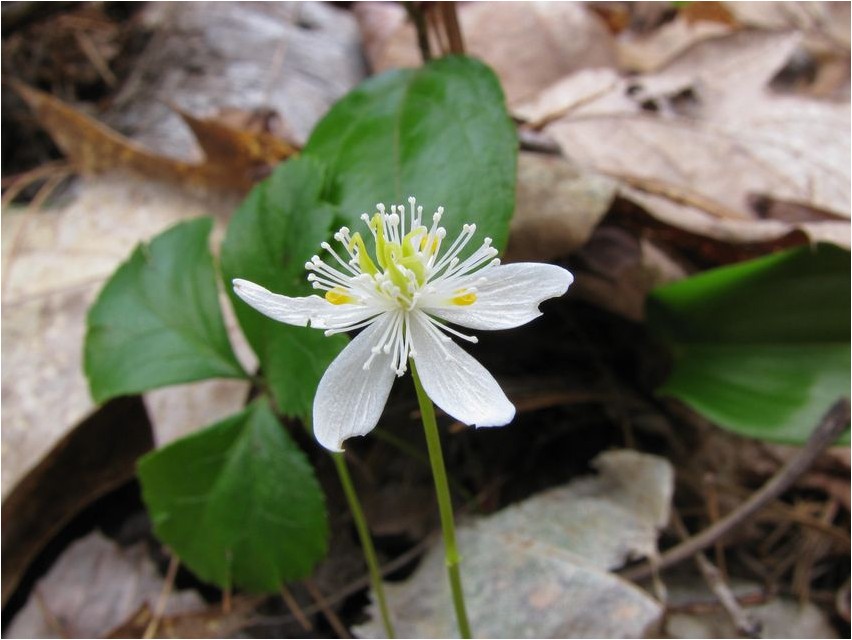
Coptis trifolia is one of the plants of the family called Ranunculaceae; in Latin the name of this plant will be as follows: Coptis trifolia (L.) Salisb.
As for the name of the Coptis trifolia family itself, in Latin it will be: Ranunculaceae Juss.
Description of Coptis trifolia
Coptis trifolia is a perennial herbaceous plant whose height can reach fifteen centimeters. This plant will be endowed with trifoliate leathery leaves. The rhizome of Coptis trifolia is thin and creeping, and in the upper part it will be covered with the remains of dead leaves. All leaves of this plant will be basal, they are on fairly long petioles and are trifoliate. The flower arrows of Coptis trifolium will be single, sometimes there may be two in one arrow, and their diameter will be about one to one and a half centimeters. This plant has only five sepals, they are ovoid and painted in pale yellow tones, and towards the base on the outside their shade will be lilac. The fruits of Coptis trifolia are membranous leaflets, almost lanceolate in shape, and at the top such leaflets will gradually turn into a spout. The seeds of this plant are oblong in shape and are colored brown.
Under natural conditions, Coptis trifolia is found in the Far East and in the Leno-Kolyma region of Eastern Siberia. For growth, the plant prefers moss swamps in the north, as well as coniferous mossy forests.
Description of the medicinal properties of Coptis trifolia
Coptis trifolium is endowed with very valuable healing properties, and it is recommended to use the grass and rhizomes of this plant for medicinal purposes.
The presence of such valuable healing properties should be explained by the content of alkaloids, coptine and berberine in the rhizomes. Also, alkaloids will also be contained in small quantities in the grass of this plant. In addition, Coptis trifolium also contains ranunculin.

A decoction prepared from the rhizomes of this plant is recommended for use as a gargle for ulcers and abscesses in the larynx and oral cavity, as well as for stomatitis. In addition, this decoction should be drunk for colitis, dysentery, gastric ulcers, dyspepsia, enteritis and as a stomach tonic and bitterness. A decoction of the rhizomes of Coptis trifolium will also be effective as an anthelmintic against roundworms and pinworms, and the decoction also has a positive effect on improving digestion and increasing appetite, and can be used as a general tonic, which especially applies to the period of recovery after illnesses.
It is noteworthy that a tincture of the rhizomes of this plant can cause loss of interest in alcoholics in alcoholic beverages, and this remedy is also recommended for internal bleeding.
The rhizomes of Coptis trifolium are used for erysipelas of the skin, and are also considered very effective anti-inflammatory, antidiarrheal and anti-cold agents.
The fresh juice of the grass and rhizomes of this plant is a very valuable hemostatic agent, which is widely used in the treatment of bruises and cuts. As for traditional medicine, an infusion prepared from the herb Coptis trifolia, which is used as a stomach tonic, has become widespread. It should be noted that if all standards of intake are observed, the positive effects of such drugs will be noticeable quite quickly.