Jaboticaba
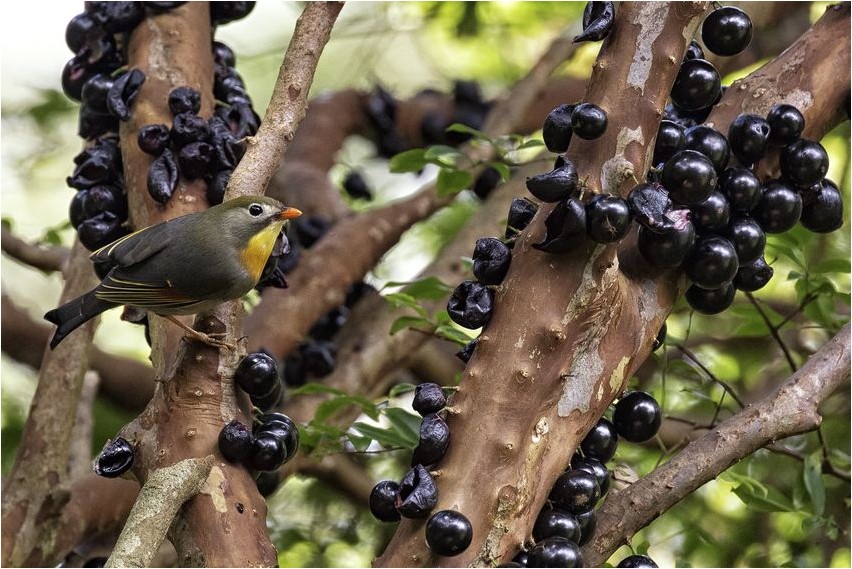
Jaboticaba (lat. Myrciaria caulifloria) is a fruit crop; tree of the Myrtaceae family. Another name is Brazilian grape. Homeland — Southern Brazil.
Today the crop is widely cultivated in Paraguay, Bolivia, Peru, Uruguay, Colombia, Panama, Argentina, Cuba and the Philippines.
Characteristics of culture
Jaboticaba is a slow-growing evergreen tree up to 12 m tall with pinkish bark covered with gray spots. The leaves are leathery, oval, up to 10 mm long, have a rich odor, characteristic of most representatives of the Myrtaceae family. With the onset of winter, some of the leaves fall off, and with the onset of spring, young pink leaves appear in their place, which over time acquire a dark green color. The flowers are white, four-petaled, located on the main branches and trunk of the tree. This phenomenon is called cauliflory, and jackfruit and cocoa plants have the same feature.
The fruit is an elliptical or round drupe with a diameter of up to 4 cm. The skin of the fruit is glossy, dark purple or almost black. The fruit pulp is white or pinkish, has a jelly-like consistency and a sweet taste with a slight bitterness. Full ripening of the fruit occurs in 3-4 weeks. Jaboticaba bears fruit several times a year, usually from early spring to late autumn, but under optimal growing conditions it bears fruit even in winter.
Growing conditions
Jaboticaba develops well and bears fruit abundantly in light, well-drained, slightly acidic or neutral soils. The culture does not accept salinity, compacted and highly acidic soils. For home growing, a humus-free soil substrate based on coconut fiber or peat is used. In this case, high-quality drainage is also required. Jaboticaba is a photophilous and heat-loving plant, loves intensely lit places, and is sensitive to frost.
Growing
Jaboticaba is propagated by seeds and grafting. The second method allows you to get the first fruits in 3-4 years, with the seed method only for 10-12 years. Jaboticaba seeds are known to store poorly and must be sown immediately after collection. It is for this reason that jaboticaba is a rare guest in Russia and European countries, and is grown exclusively at home. Culture entries appear on the 30-40th day.

During the first 10-12 months of life, the plant develops very slowly. To speed up the process, regular watering and fertilizing with complex mineral fertilizers are necessary. Young plants require light shade. As they grow, the jaboticaba can be repotted into larger containers. If this is not possible, the plant”s roots can be shortened by 1/3.
Care
Water regularly and do not allow the plant to dry out. Fertilize monthly, starting in spring and ending in fall. Fertilizing accelerates plant growth. Iron supplements and other micronutrients are also necessary to prevent chlorosis. Although jaboticaba tolerates this procedure well, it is not pruned. It is important to promptly remove heavy branches located at the top of the crown, as well as dead and crowded branches. Pruning does not reduce the plant”s yield, as fruit is formed primarily on the trunk and main branches. Harvesting
The harvest is carried out every 2-3 days (as it ripens). For transportation and longer storage, jaboticaba fruits are picked unripe. Due to their rapid spoilage, the fruits are sold only in their native habitats.
Uses
Jaboticaba fruits contain a wealth of vitamins, pectin, minerals, and organic acids. Jam, jellies, preserves, marmalades, and juices are made from the fruits. Jaboticaba fruits are also used to make red wine and food coloring. The fruits have a very short shelf life (no more than 3 days), after which they begin to ferment. Jaboticaba has a number of beneficial properties and is often used to treat tonsillitis, asthma, and diarrhea.
Jaboticaba — Paraguayan Currant Tree





