Pondweed floating
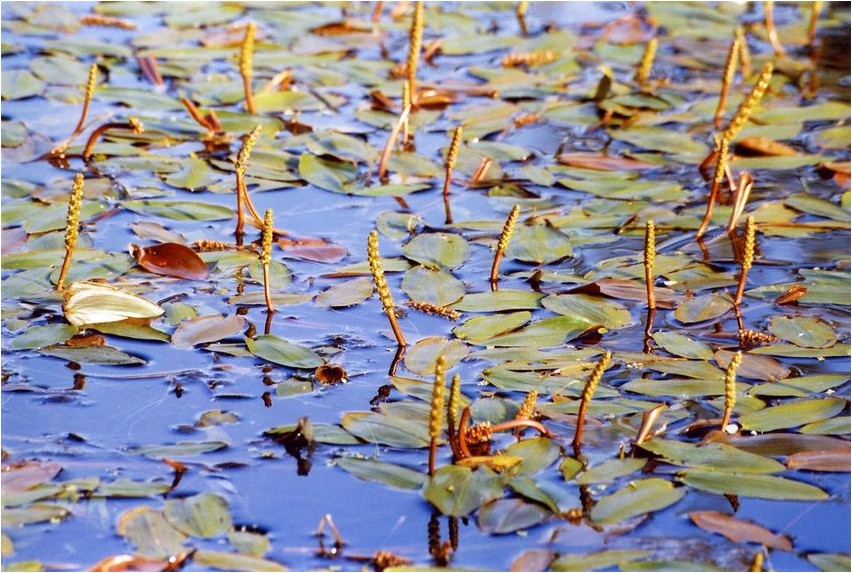
Floating pondweed is one of the plants of the family called pondweed; in Latin the name of this plant will be as follows: Potamogeton natans L.
As for the name of the floating pondweed family itself, in Latin it will be: Potamogetonaceae.
Description of floating pondweed
Floating pondweed is known by its popular names: water cabbage and floating pondweed. Floating pondweed is a perennial herbaceous aquatic plant endowed with tuberous rhizomes that will thicken in the fall. The stems of this plant will be round, finely branched or simple, and the leaves will be of two types. Those leaves of floating pondweed that float on the very surface of the water are oblong or ovoid. The length of the leaves of this plant will be about five to twelve centimeters, and the width will be approximately two to five centimeters. At the base, such leaves will be heart-shaped, they will be sharp or blunt, entire-edged and are on fairly long petioles, which can be either equal in length to the plate or slightly longer than it. The length of the stipules of floating pondweed reaches ten centimeters, and such stipules will fall off early. Those leaves that are immersed in water will usually collapse early, they are entire-edged, few in number, dense, narrow-linear and opaque, and such leaves are endowed with an underdeveloped petiole-like plate, and their length can reach fifty centimeters. The flowers of this plant are quite small in size, they are bisexual and inconspicuous, are not endowed with a perianth and are collected in ring-shaped cylindrical inflorescences. There are only four stamens of floating pondweed, there will also be four pistils and they are equipped with sessile stigmas. The fruits of this plant have a short nose and are oblique.
This plant blooms in the summer. Under natural conditions, this plant will be found in Western Siberia, Ukraine, Belarus, the European part of Russia, Central Asia and the Far East. As for the general distribution of this plant, it is found in Iran, North Africa, Turkish Armenia, Western Europe, Scandinavia, Japan, Mongolia, China, North America and Asia Minor. For growth, floating pondweed prefers swamps, lakes, ponds, ditches and oxbow lakes.
Description of the medicinal properties of floating pondweed
Floating pondweed is endowed with very valuable healing properties, and it is recommended to use the entire plant, including its leaves and stems, for medicinal purposes. Such medicinal raw materials should be prepared over the period from June to August. The presence of such valuable healing properties is recommended to be explained by the content of ascorbic acid in the composition of this plant; alkaloids will be present in the seeds, and the brown leaves, in turn, contain the carotenoid rhodoxanthin.
The leaves of this plant are endowed with antiscorbutic, anti-inflammatory, astringent and soothing itching effects. It is noteworthy that even ancient authors have indications that an infusion based on the leaves of this plant was used for gastrointestinal colic.

A decoction prepared from the leaves of floating pondweed is recommended for use for diarrhea. As for traditional medicine, an aqueous infusion based on the leaves of this plant is indicated for use for ulcers that will be complicated by inflammatory processes, and is also used for itchy skin rashes and is used as an antiscorbutic agent. When used correctly, such healing agents are very effective.