Corylopsis
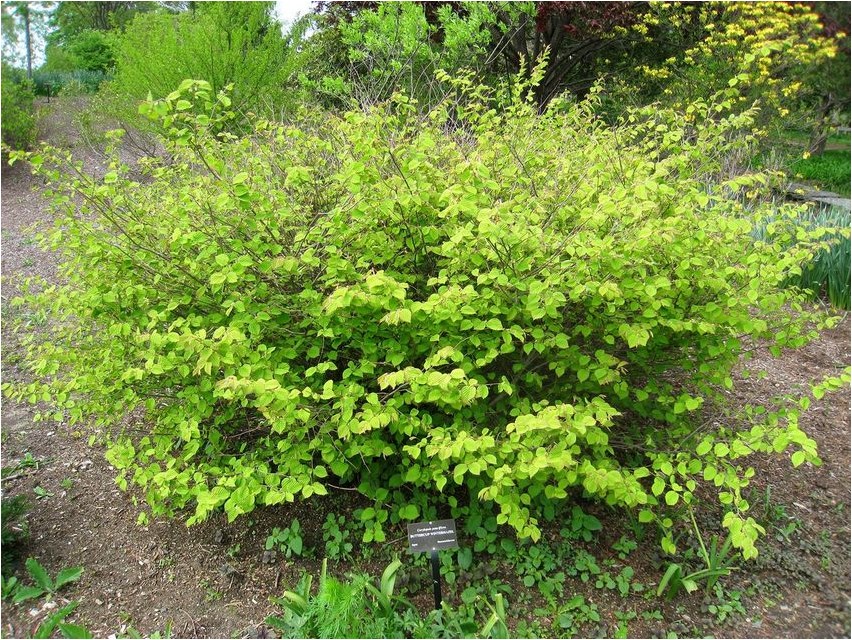
Corylopsis (lat. Corylopsis) is a dicotyledonous flowering plant belonging to the Witch Hazel family.
Description
Corylopsis is a small deciduous tree or shrub with pubescent young branches, while the height of the shrubs rarely exceeds one meter, and the height of the trees ranges from one to two meters. The simple serrated leaves of this plant are very similar to those of hazel. All of them are alternately located on petioles, endowed with heart-shaped bases and have an ovoid or round shape. And the falling stipules of Corylopsis are quite large in size.
The flowers of this plant, surprisingly, bloom even before the leaves appear on the corylopsis. All flowers form racemose axillary inflorescences, with each inflorescence framed by membranous brownish bracts. And those bracts that are located directly next to the flowers are always fleshier, have a curved shape and are colored either greenish or light brown. The flower calyxes are formed by five almost invisible sepals, which quite often grow together. The pale yellow or yellowish corollas are divided into five obovate or spatulate petals (however, such a division may sometimes not exist). Corylopsis flowers have five stamens, and two pistils equipped with capitate stigmas. This plant usually blooms from April to June.
The fruits of Corylopsis are almost spherical woody boxes. Just like the leaves, these fruits are also very similar in appearance to hazel fruits. And the oblong shiny seeds are painted black.
In total, the Corylopsis genus has about ten species. This genus was first described in the nineteenth century.
Where does it grow
Under natural conditions, Corylopsis can be found in East Asian territories: Taiwan, China, the Eastern Himalayas, as well as in Korea and Japan. And on the territory of Russia, Corylopsis pauciflora is most often found.

Usage
Corylopsis can be safely grown both as a tapeworm and in luxurious group plantings. It will look no worse in containers installed on balconies. And sometimes corylopsis is also grown as a bonsai indoors. By the way, if the plant is grown as a bonsai or in containers, it will need to be replanted annually. If the plant has grown too large, instead of replanting, you can limit yourself to updating the top soil layer.
Growing and care
Corylopsis will feel best in partial shade, in areas with well-drained, rich soils characterized by a fairly low pH. Garden soils are especially suitable for growing it. It is also important to take into account the fact that Corylopsis is a calcephobe, that is, it will grow extremely poorly on lime-rich soils.
Corylopsis requires quite abundant watering, and it should be watered two to three times a week. This beauty is usually fertilized only at the stage of active growth (during the dormant period, fertilizers are applied at a minimum), and for the winter this plant must be provided with proper shelter. In general, Corylopsis is very easy to care for.
Corylopsis is very resistant to various pests and ailments, so you don’t have to worry too much about this. This beautiful plant is propagated by layering or cuttings, while the cuttings for subsequent propagation are cut in the summer, doing this in such a way that the lower sections are under the buds, at a distance of about one or two centimeters.





