Eastern salsify
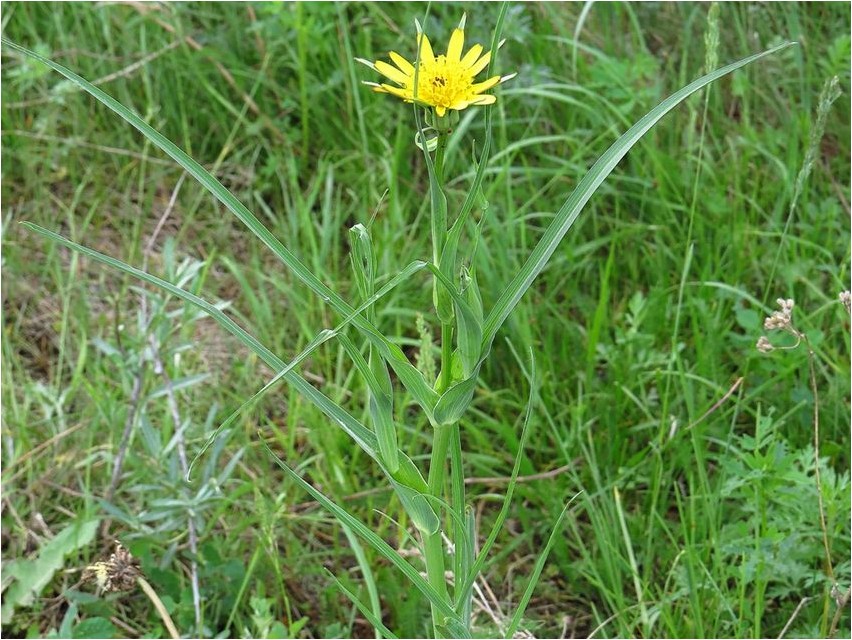
Oriental salsify is one of the plants of the family called Asteraceae or Asteraceae; in Latin the name of this plant will be as follows: Tragopogon orientalis L.
As for the name of the eastern salsify family itself, in Latin it will be: Asteraceae Dumort.
Description of the eastern salsify
Eastern salsify is a biennial herbaceous plant whose height will vary between fifteen and eighty centimeters. The root of this plant is vertical and cylindrical, and the stem of eastern salsify will be straight and furrowed, as well as glabrous with occasional ragged tomentose flakes. The leaves of this plant are light, linear and sharp; such leaves will be colored in bluish-green tones. The baskets of this plant are large, and the flowers are painted in bright golden-yellow tones. It is noteworthy that the peduncles under the baskets are not thickened. The length of the involucre leaves will be about eight to ten millimeters, and they will be much shorter than the bright yellow flowers.
Eastern salsify blooms from May to August. Under natural conditions, this plant is found in the European part of Russia, the Far East, Ukraine, Belarus, Central Asia, Moldova, Western and Eastern Siberia. For growth, this plant prefers edges, dry slopes, meadows, forest clearings, forests and fallow lands.
Description of the medicinal properties of eastern salsify
Oriental salsify is endowed with very valuable healing properties, and it is recommended to use the roots of this plant for medicinal purposes. The presence of such valuable healing properties should be explained by the content of tannins, rubber and fatty oils in the plant. At the same time, the flowers contain glucose, nectar, sucrose and fructose, while the seeds will contain fatty oil.
As for traditional medicine, a decoction prepared from the roots of this plant is quite widely used. A decoction of the roots of oriental salsify is used for leucorrhoea, hysteria, gonorrhea and rheumatism. The roots and young shoots of this plant are edible when boiled, and fresh roots and shoots can be eaten as a salad. It is noteworthy that the leaves of the eastern salsify will be quite suitable for feeding silkworms.

In case of stress, it is recommended to use the following remedy based on oriental salsify: to prepare such a remedy, you will need to take one tablespoon of crushed dry roots of this plant per glass of water. The resulting mixture should be brought to a boil, and then boiled over fairly low heat for ten minutes, then this mixture should be cooled, after which this mixture based on oriental salsify is very carefully filtered. Take the resulting healing remedy three times a day for stress, two tablespoons. It should be noted that in order to achieve the greatest effectiveness when using such a remedy based on oriental salsify, it is important to strictly follow not only all the standards for preparing such a remedy, but also carefully follow all the rules for its administration.
In folk medicine, oriental salsify is used as a diuretic and choleretic agent, as well as an antiseptic and a means of accelerating wound healing. A decoction of the roots of oriental salsify is used to remove stones from the liver and kidneys, to treat scrofula and cough, skin irritation and a variety of skin diseases. Fresh crushed leaves of Oriental salsify are applied to ulcers, swelling and purulent wounds.





