Вероника колосистая
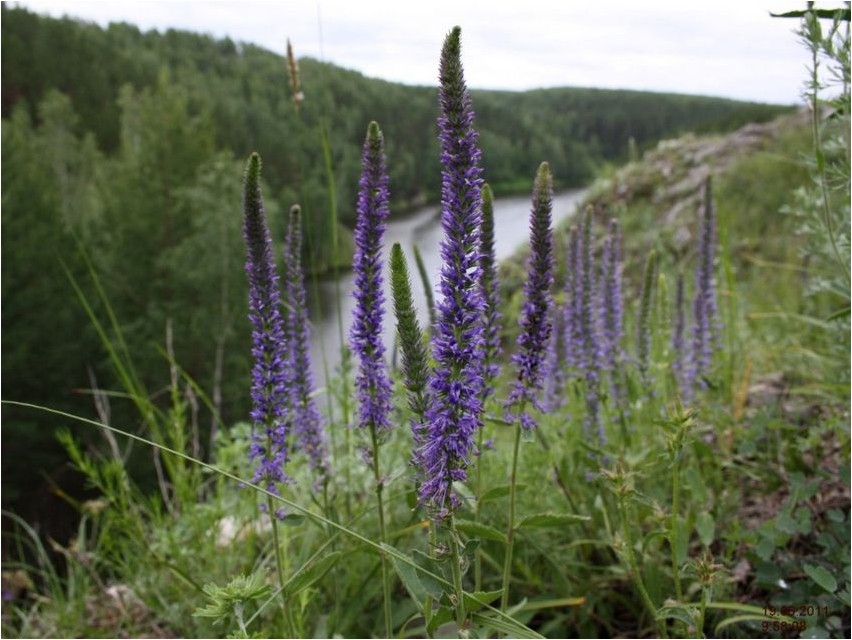
Veronica spicata is part of the family called Noricaceae; in Latin the name of this plant is as follows: Veronica spicata L.
As for the name of the family itself, it sounds like this: Scrophulariaceae Juss.
Description of speedwell
Veronica spica is a herbaceous perennial plant whose height can vary between ten and seventy-five centimeters. The rhizome of the plant is quite thin and horizontal. As for the stems of Veronica spica, they are found either in small quantities or in a single variant; the stems can be either straight or ascending. The stems of the plant are quite strong, they are simple and quite abundantly pubescent. The apical inflorescences are single; the thick raceme is about five to thirty centimeters in length. It is noteworthy that sometimes this plant is also endowed with lateral racemes; the flowers of this plant are on hairy pedicels; the flowers can be either sessile or slightly shorter than the calyx itself. The color of the corolla of speedwell can be bright blue, blue, purple, white and even pinkish. The length of such a corolla will be about seven millimeters, and the seeds of this plant are blunt, smooth, broadly ovoid and flat-convex. Veronica spica blooms from July to October.
Under natural conditions, this plant is found in Ukraine, Belarus, the European part of Russia, as well as in the east of the European Arctic, the Caucasus, Central Asia and the Yenisei region of Eastern Siberia. Speedwell spicata chooses pine forests, gravelly slopes, steppes, and also forest lawns for growth. It is noteworthy that this plant is decorative; various garden forms and varieties of speedwell are often used in culture.
Description of the medicinal properties of Veronica spicata

The leaves, stems and flowers of Veronica spicata are used for medicinal purposes. The roots of this plant contain iridoids, and the following substances were found in the herb: flavonoids, phenolcarboxylic acids and their derivatives, as well as numerous tannins, coumarin, carbohydrates, mannitol, quinic acid, saponins, choline, iridoids and cardenolides.
The stems of Veronica spica contain an impressive amount of iridoids, while the leaves contain both iridoids and flavonoids. Flavonoids were also found in the flowers of the plant, and alkaloids were found in the seeds.
In folk medicine, an infusion prepared from the herb of this plant is actively used for various respiratory infections, as well as as a wound-healing, cardiotonic and detoxifying agent. It has been experimentally proven that an infusion of the herb can increase the rate of blood clotting, as well as increase the amplitude of heart contractions and slow down their rate. When administered intravenously, such an infusion can enhance cardiac activity and increase blood pressure. It is noteworthy that the infusion is capable of exhibiting antibacterial activity.
For the flu, you should use an infusion of Veronica spicata, half a glass three times a day. To prepare such an infusion, you will need to take two tablespoons of dry crushed plant herbs into two glasses of boiling water, after which the resulting mixture is infused for two hours, and then filtered.
For flu, bronchitis and various respiratory diseases, it is recommended to take the infusion half a glass warm and in small sips. To prepare, you will need to take three tablespoons of coltsfoot leaves, tripartite herb and veronica spicata collection, these ingredients should be poured with 500 milliliters of boiling water, then left for two hours, and then the resulting mixture should be strained.


