Zhoster Dahursky
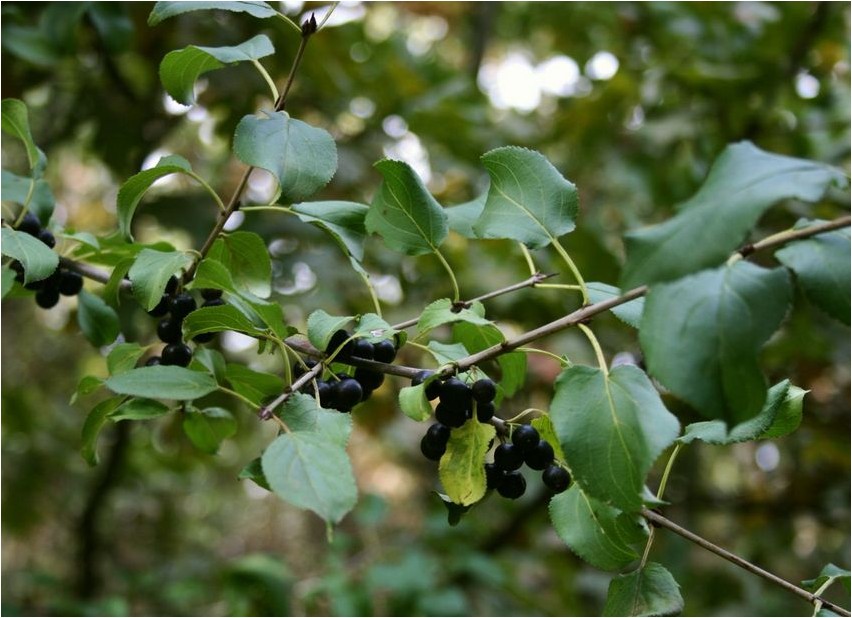
Dahurian jockstrap is one of the plants of the buckthorn family; in Latin the name of this plant will be as follows: Rhamnus dahurica Pall.
As for the name of the Daurian joster family itself, in Latin it will be: Rhamnaceae Juss.
Description of the Daurian zhoster
Dahurian zhoster is a tree whose height can reach up to ten meters. The bark of this plant is quite dark and colored in black-brown tones; in the oldest specimens, such bark will be cracking. The branches of the zoster are opposite, the young shoots will mostly be pubescent and green in color. Over time, the color changes to gray and then light brown. Most often, the shoots end in rather large buds, the length of which will reach twelve millimeters. The leaves on the shoots can be either alternate or opposite. These leaves are found on shortened branches and are often curled into tufts. The leaves are thin, bright green above and gray-green below. They will be oval or oblong-oval in shape, their length is five to ten centimeters, and they are also uniformly crenate-toothed. The flowers of the Daurian joster are green and yellow, they are bell-shaped, and their length will be about four to six millimeters. The fruit of this plant is a spherical drupe, usually equipped with two seeds. The color of this fruit is black and blue, and the diameter is five to seven millimeters. The pulp of such fruits has an astringent taste and is colored yellow-green.
The flowering of the Daurian joster occurs from the end of May to June, while the ripening of the fruits occurs in September. Under natural conditions, this plant is found in the Amur Region, Primorsky and Khabarovsk Territories, as well as in Trans-Balkalia. As for the general distribution of the plant, it can be found in Korea, China and Mongolia. For growth, the plant prefers places on adjacent slopes, along valleys and near rocks. It is worth noting that the Daurian zoster is not only an ornamental plant, but is also a honey plant.
It is important to remember that the plant is poisonous and can inhibit lactation.
Description of the medicinal properties of joster dahurian
Dahurian zhoster is endowed with very valuable healing properties, and it is recommended to use the fruits, fruit juice and bark of this plant for medicinal purposes. The presence of such valuable healing properties is explained by the content of flavonoids in the plant, while quinones are present in the fruits and bark. It is noteworthy that the fresh fruits of joster dahurian contain emodinantrone and chrasaborine.

As for traditional medicine, here this plant is used as a diuretic, strong laxative, and is also used for various gastrointestinal diseases. For pancreatitis, a therapeutic effect is observed, and membrane-stabilizing and anti-inflammatory properties have also been identified. In addition, the plant normalizes enzymatic activity and has a positive effect on the hemostatic system. It should be noted that extracts of the bark and fruits of joster dahurian are recommended for use as an anticancer agent.
It is important to remember that a decoction of the wood of this plant is often used to stop bleeding of various kinds. As for fresh bark, it is quite acceptable to use it as an emetic. It is noteworthy that the use of this plant for medicinal purposes is always characterized by a high degree of effectiveness.





