Randiya
Randia (lat. Randia) is a fruit plant from the Rubiaceae family.
Description
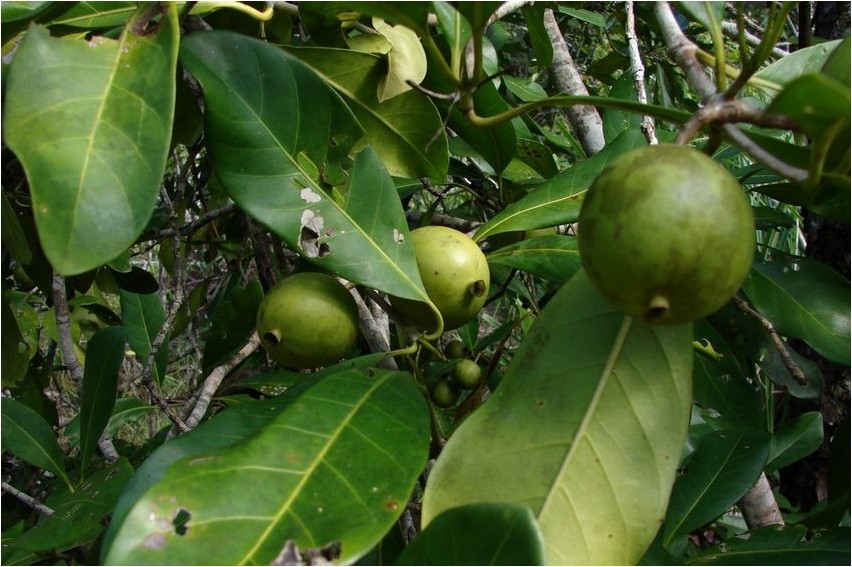
Randia is a small, dense, thorny tree whose white, star-shaped flowers have a distinct gardenia scent—this scent invariably attracts numerous moths. The height of the trees can vary from three to six meters. And the glossy leaves of randia are quite large in size.
Randia blooms for several months — new flowers are formed even when the fruits from other ovaries have not had time to ripen. Gardeners greatly value this crop for its so-called continuous “production” — randia fruits can be harvested all year round.
The pale yellow oblong fruits are equipped with numerous brownish specks and have an external resemblance to feijoa. As a rule, their length does not exceed two and a half centimeters, and their width does not exceed one centimeter. All fruits break quite easily.
The taste of the black, jelly-like pulp of the randia fruit is very reminiscent of the taste of blackberry jam. You can also find tiny, flat seeds inside each fruit.
Where does it grow
Randia is native to South and Central America. And now this plant is also cultivated in Southeast Asia.

Application
Randia fruits are consumed fresh or made into wonderful compotes, preserves and jams. These fruits are very rich in vitamins and many other biologically active substances. If you use them regularly, you can significantly improve the condition of your nails, skin and hair, as well as normalize the functioning of the gastrointestinal tract.
Randia brings enormous health benefits — it significantly improves metabolism, stops bleeding, strengthens the immune system, relieves fever and inflammation, cleanses the body, treats skin diseases, prevents cancer and cures dysentery. In addition, randia is widely used to lower blood pressure, lower cholesterol levels and improve appetite and digestion in general.
By the way, randia has long been a favorite delicacy for children of indigenous peoples of those countries where this crop is grown.
Due to its pronounced antiseptic and anti-inflammatory properties, randium is quite actively used in cosmetology. Among other things, it perfectly relieves flaking and itching. No less valuable are its tonic and analgesic properties.
Randia is also highly valued for the decorative qualities of its crown — this feature has led to its widespread use in gardening.
Contraindications
There are no special contraindications for the use of randium, but in some cases extremely unpleasant allergic reactions are possible.
Growing
Randia will feel equally good both in greenhouse conditions and as a houseplant — it has excellent shade tolerance. And this crop is completely undemanding to the soil — even on soils with high acidity it will grow and develop well.
Randia will develop and bear fruit best in diffused light. This plant does not tolerate floods, but it can withstand frosts down to minus three degrees.
Randia is propagated by both cuttings and seeds. This crop begins to bear fruit after reaching one or one and a half years — this also applies to ungrafted forms grown from seeds. From twenty-five to thirty fruits are collected from each tree per season. By the way, when kept in pots with a volume of three to eleven liters, randium begins to bear fruit as soon as its height reaches sixty centimeters.