Currant bristly
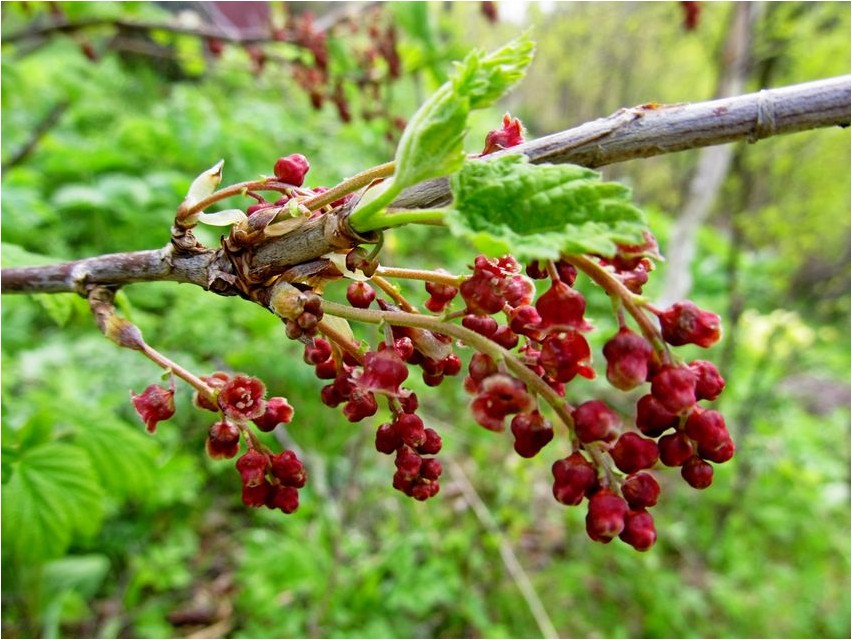
Bristle currant is one of the plants of the family called Saxifragaceae; in Latin the name of this plant will be as follows: Ribes hispidulum (Jancz.) Pojark.
As for the name of the bristly currant family itself, in Latin it will be: Saxifragaceae Juss.
Description of bristly currant
Currant bristlecone is a shrub whose height can reach two meters. Such a plant will be endowed with rather pale shoots, most often hairy and dotted with stalked glands. The leaves of currant bristles are wide, they have a cut or shallow heart-shaped base, and will also be dull, three-lobed or five-lobed; on top, such leaves can be either endowed with sparse hairs or bare; below, the leaves are mostly fluffy, but sometimes they can be bare. Initially, the brushes of this plant are directed obliquely upward, then they become drooping, they will be quite thick, their length is three to seven centimeters, such brushes are six to twelve flowered. The flowers of currant bristles are colored yellowish-green, they will be quite small in size, and the diameter of the berry will be about eight to ten millimeters.
This plant blooms from May to June, while fruiting occurs in July. Under natural conditions, bristly currant is found in Central Asia, Western Siberia, the west of the Angara-Sayan region of Eastern Siberia, the east of the European Arctic, as well as the following regions of the European part of Russia: Dvina-Pechora, Zavolzhsky, Volga-Kama and Volga-Don. Bristle currant is also found in Mongolia. For growth, this plant prefers the outskirts of swamps, damp forests, banks of rivers and streams, as well as bushes. It should be noted that bristly currant is a very ornamental plant.
Description of the medicinal properties of bristly currant
Bristle currant is endowed with very valuable healing properties, and it is recommended to use the fruits, leaves, bark and flowers of this plant for medicinal purposes.
A tincture prepared from the leaves, fruits or flowers of currant bristles is used in the Republic of Koma for anemia and dyspepsia, and is also used as a very effective vitamin remedy. It is noteworthy that the fruits of this plant are edible and can be used for making jam, drinks, jelly, and also as candy fillings.

As a diaphoretic, choleretic, anti-inflammatory, antipyretic, mild laxative and hemostatic agent, it is recommended to consume two tablespoons of currant fruit juice three times a day before meals. In addition, the juice of this plant is also indicated for use for fever.
It is known that the fruits of this plant contain carotene, flavonoids, ascorbic acid, sugar, pectin, thiamine, ribofaflavin, malic, nicotinic, citric and succinic acid. As for traditional medicine, bristly currant is used most actively. Traditional medicine recommends using both the fruits and the juice of this plant in order to effectively and fairly quickly reduce the temperature. In addition, such elements of currant bristles are effective for various febrile diseases of varying degrees of intensity and for regulating intestinal motility. Also, the fruits and juice of currant bristles can act as a mild laxative.





