Sycamore Maple
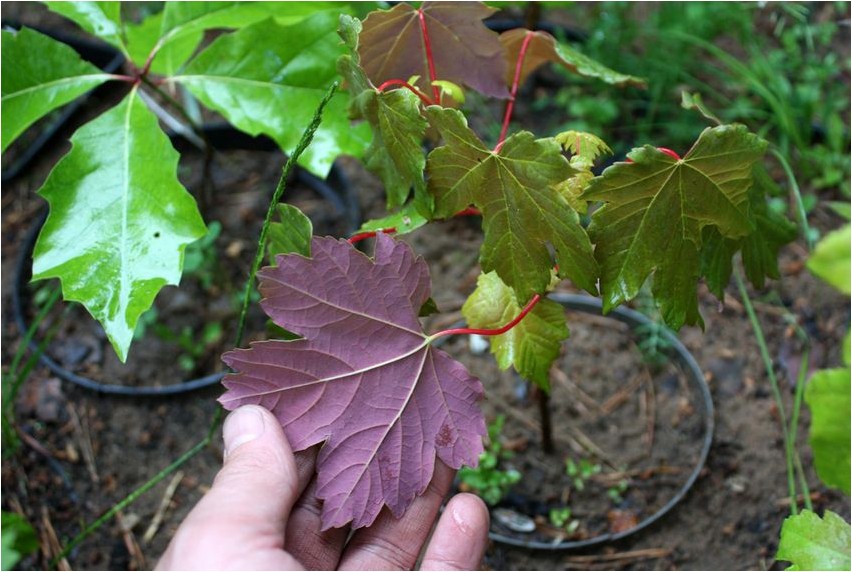
The sycamore maple is a member of the maple family, and its Latin name is Acer pseudoplatanus L.
The sycamore maple family itself is Aceraceae Juss.
Description of the Sycamore Maple
The sycamore maple is a tall, slender tree, reaching a height of forty meters and a circumference of about one and a half meters. This plant has a fairly dense, pyramidal-spherical crown. The bark of the sycamore maple is brownish-gray. It is noteworthy that in older trees, the bark will crack and peel, revealing the younger, lighter bark. This is precisely why the trunks appear either light gray or whitish. The leaves are quite large, measuring seventeen centimeters in length and width, and are rounded-heart-shaped. They are dark green above, dull in color, and glaucous or whitish beneath. The leaf blade of this plant is usually five-lobed and dissected. The inflorescence of the sycamore maple is a long-stemmed, narrow, multi-flowered raceme, reaching sixteen centimeters in length. The flowers reach eight millimeters in diameter and are yellowish-green in color. The samaras reach six centimeters in length. Mature flowers are brownish in color and bear round, convex nuts.
The sycamore maple blooms from May to June, while fruiting occurs in September. In the wild, this plant is found in Moldova, the Ciscaucasian and Western Caucasus regions of the Caucasus, the southwest Baltics, the Black Sea region of Russia, and the Carpathian Mountains and Dnieper region of Ukraine. It prefers mountain forests, scree slopes, rock crevices, river and stream banks, and rocky slopes at altitudes up to 1, 800 meters above sea level. Sycamore maple can grow singly or in small groups. It should be noted that this plant is a highly valuable honey plant and is also an ornamental plant.
Description of the medicinal properties of Sycamore maple
Sycamore maple possesses valuable medicinal properties, and its bark and sap are recommended for medicinal purposes. These valuable medicinal properties are attributed to the roots’ content of allantoin, xylem sap, cycloitol quebrachite, the lipid suberin, carbohydrates, phloem and cambial sap, and the following organic acids: citric and malic. The leaves of this plant contain the tannin geranin, cyclitols and their derivatives, leucoanthocyanin leucocyanidin, carotenoids, as well as caffeic, gallic, synanoic, ellagic, and p-coumaric acids. The flowers and seeds of this plant contain quebrachite, and the seeds contain fatty oil.
A decoction made from the bark of the sycamore maple is recommended as a valuable astringent. The sap of this plant is used as a diuretic and also for scurvy. Both syrup and sugar substitute are produced from the sap of the sycamore maple. The wood of this plant is used in furniture making and also for wood carving.

For diarrhea and enterocolitis, the following remedy based on this plant is recommended: to prepare this remedy, take one tablespoon of sycamore maple bark per 300 milliliters of water. Boil this mixture for five minutes, let it steep for one hour, and then strain thoroughly. Take two tablespoons of the resulting remedy three times daily.





