Antennary
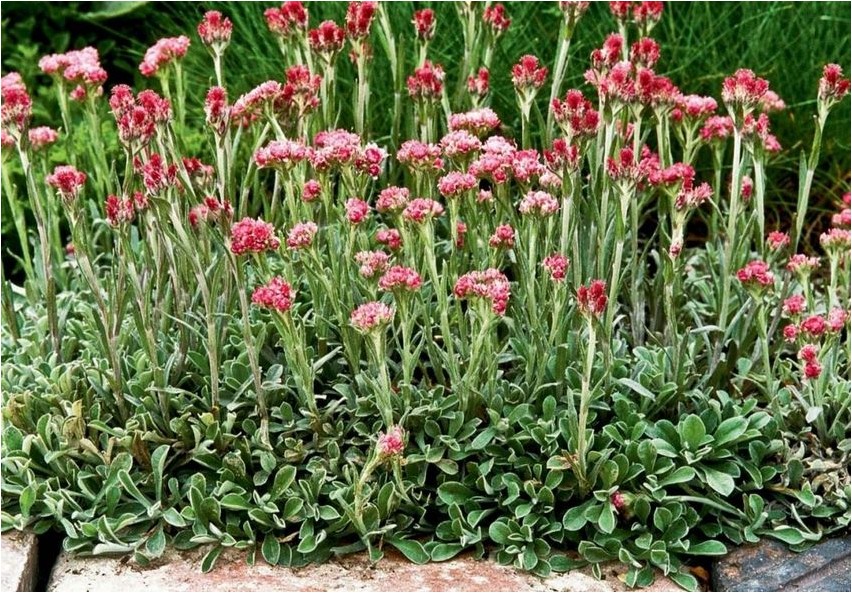
Antennaria (lat. Antennaria) is a small genus of perennial herbaceous and subshrub plants belonging to the Asteraceae, or Asteraceae, family.
South America is considered to be its homeland. In nature, the genus is distributed mainly in its homeland, as well as in some European countries and Russia. Includes more than one hundred species. Another name is cat’s paw.
Characteristics of the Antennaria culture is represented by perennial white-tomentose herbs and subshrubs up to 50 cm high with creeping shoots, basal foliage and basket-like inflorescences, characteristic of all representatives of the Asteraceae family. The inflorescences reach a diameter of no more than 1 cm. The inflorescences, in turn, are collected in round shields or small heads. The fruit is represented by a smooth achene equipped with a bristly tuft.
Antennaria is a hardy plant, it is characterized by high resistance to cold, pests and diseases. It is not afraid of mountainous areas, it develops actively in mountainous areas, the same can be said about flowering. Externally, Antennaria looks very attractive; it will outshine many representatives of the flower world with its beauty and will captivate flower growers with its unpretentiousness to growing conditions and care.
Among the species used in gardening, we can note the alpine antenna (lat. Antennaria alpina). It is represented by low-growing ground-blooded perennials, strewn with small bluish foliage, above which rise white inflorescences equipped with brown bracts. Inflorescences of up to 5 pieces are collected in small brushes. As plants grow, they form dense carpets, although this aspect largely depends on the location. And sunny, rocky areas are best suited for the culture.
Another equally attractive representative of the genus is Antennaria plantaginifolia. It is characterized by large perennial plants reaching a height of 35-40 cm. The foliage of the species in question is oval-shaped, quite wide, and looks very similar to plantain leaves, hence the name of the species. The flowers, in turn, are larger than those of other species of the genus Antennaria.

Subtleties of cultivation
As already mentioned, Antennaria does not belong to the category of fastidious plants. However, it thrives best in poor soils with a slightly acidic pH. It is better not to plant it on fertile soils, otherwise the plants will lag in growth, stretch out, and in addition, the flowering will not please you with abundance, and perhaps not at all. All species grow and thin out quite quickly, and accordingly, lose their decorative effect. To eliminate this drawback, it is necessary to regularly divide the bush – at least once every 3 years.
Caring for antennaria comes down to standard procedures. It tolerates bad weather conditions easily. There is no need to cover the cat’s paw for the winter, although in snowless winters it is better to cover it with a layer of fallen leaves. The main thing is to provide the culture with a sufficient amount of sunlight; shadow destroys it, even a slight one. Watering should be regular, but the plants will tolerate a short drought calmly.
Representatives of the genus Antennaria are extremely rarely affected by pests and diseases. As a rule, the pests are nematodes, aphids and spider mites. In this case, it is necessary to process the plants and soil in a timely manner, otherwise death cannot be avoided.
Antennaria can be combined with many flower crops, including purslane, dorotheanthus, tenacious, etc. Cereals will also form a harmonious tandem. Another special feature of Antennaria is that it is suitable for creating winter bouquets and in alternative medicine as a wound healing agent.





