Yoshta
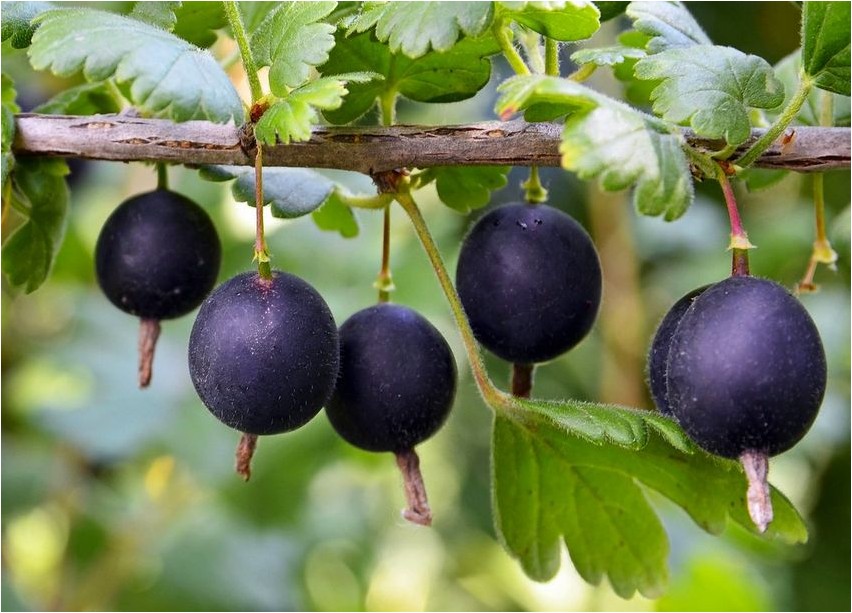
Yoshta (lat. Ribes nigrum * Ribes divaricatum * Ribes uva-crispa) is a hybrid of common gooseberry, spread gooseberry and black currant. The plant was bred by German breeder Rudolf Bauer in the 1970s.
About the hybrid
Yoshta is the result of many years of work by breeders of several generations who worked on crossing gooseberries and black currants. The breeders were faced with the task of improving black currants, in particular, increasing the size of the berries and yield in general, and also instilling resistance to terry, bud mites and other pests. At the same time, scientists tried to get rid of the thorns characteristic of gooseberries. The first scientist to study the theory of crossing various forms of cultivated plants was I. V. Michurin.
Unfortunately, the first attempts at crossing currants and gooseberries were unsuccessful: the hybrids were either sterile or nonviable. Only in 1970, researchers at the Max Planck Institute were able to develop the first fruit-bearing hybrid, and in 1989, yoshta was introduced into culture. In Russia, yoshta appeared in the early 1980s, but has been widely cultivated since 1986. To date, several more similar hybrids have been bred, which have much in common with yoshta and differ in the shape of the bush, the size and weight of the berries, their taste characteristics, as well as yield and cold-resistant properties.
Hybrid characteristics
Yoshta is an artificially bred, perennial, spreading, powerful shrub up to 2. 5 m high. The shoots are strong, have no thorns, and are characterized by rapid growth. On average, one bush consists of 13-20 branches of different ages. The root system is powerful, the bulk of the roots lie at a depth of 30-40 cm. The leaves are green, large, shiny, without a rich currant aroma, similar in appearance to gooseberry leaves. The flowers are medium-sized, greenish-yellow.
The berries are black with a purple tint, round, collected in clusters of 3-5 pieces, and stay on the branches for a long time. The weight of one berry is 2-5 g, the taste is sweet and sour with a nutmeg aftertaste. Yoshta berries ripen in early August. The plant is resistant to pests and diseases, as well as severe frosts. The average lifespan of a bush is 20-30 years. Good berry harvests can be obtained 3-4 years after planting. Yoshta is ideal as an ornamental plant and is often used to create hedges and border plantings.
Growing conditions
Yoshta is a light-loving plant, it develops poorly in shaded areas, the berries are formed too small, and their number becomes lower every year. The soils are desirable loose, moderately moist, with a rich mineral composition. It is not recommended to grow the crop in areas with close groundwater. Does not accept heavy clay, acidic, marshy soils, as well as places not protected from strong winds

Reproduction and planting
The crop is propagated by root suckers, lignified cuttings and grafting onto golden currants. The optimal time for planting yoshta is considered to be mid-autumn; in the northern regions — late August — early September. Before the onset of stable frosts, young plants must have time to take root, otherwise in winter they will freeze and die, never enjoying the long-awaited harvest of berries. The planting pit is prepared several weeks in advance. The distance between plants should be 1. 5 m, with standard formation — 0. 8-1 m.
If the planting of yoshta was postponed to spring, seedlings and other planting material are planted early, but in this case the hole is prepared in the fall. Propagation of yoshta by lignified cuttings is the most common and effective method. Cuttings are cut in the summer; their length should be about 13-15 cm. The upper cut is made above the bud, and the lower one — below it. Before planting, cuttings are treated with growth stimulants. The cuttings are planted in soft, loose, fertile soil. Important: when planting, the top bud should be located 1. 5 cm above the soil surface.
Care
Caring for yoshta is quite simple and can be done even by an inexperienced gardener. The plant needs systematic watering, especially during prolonged drought, as well as weeding, loosening the tree trunk area and fertilizing. Annual feeding rates: humus — 8 kg per bush, superphosphate — 50 g, potassium sulfate — 40 g. After three to four years, the amount of fertilizer is increased by 20-30%. In the first three years, yoshta requires sanitary pruning, and later also formative pruning. It is important to remove old non-fruiting branches, which will subsequently be replaced by growing new ones.