Hornbeam
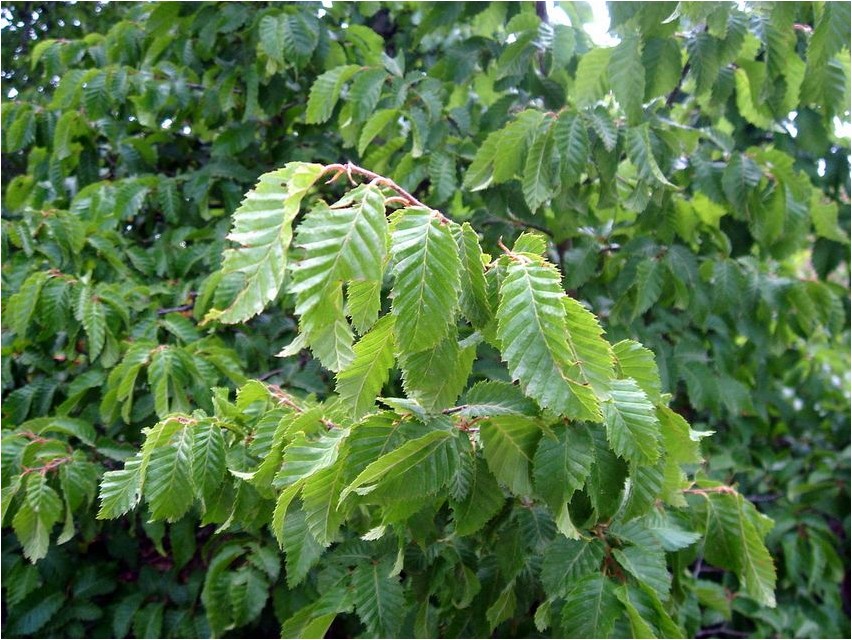
Hornbeam (Latin: Carpinus) is a large shrub or tree in the birch family (Betulaceae). Hornbeam is found in the temperate zone of the Northern Hemisphere, with most species distributed in Asia, particularly China.
Only two species grow in Europe. Currently, over 30 species are known.
Cultural Characteristics
Hornbeam is a deciduous shrub or tree with longitudinally ribbed trunks covered with slightly fissured or smooth bark and a dense, spreading crown, the framework of which consists of slender branches. The leaves are simple, dark green, deciduous, doubly serrated, with parallel-pinnate veins, elliptical or oval in shape, and 3-10 cm long. Leaf arrangement is alternate and distichous.
The flowers are dioecious, occurring in catkins that open simultaneously with the leaves. The staminate flowers lack a perianth. Pistillate flowers are borne in the axils of small integumentary scales. The fruit is a single-locular nutlet, often woody, longitudinally ribbed, located at the base of the leaf-like involucre (also known as cupule).
Growing Conditions

Hornbeam is a sun-loving plant, although most varieties thrive in partial shade. Hornbeam thrives in loose, moderately moist, fertile soils with a high lime content. Plants react negatively to flooding, salinization, acidification, and compaction. Hornbeams are wind- and frost-resistant, easily tolerating elevated temperatures provided the soil has sufficient moisture.
Propagation and Planting
Hornbeams are propagated by seeds, cuttings, and layering. In cultivation, hornbeam is most often propagated by seed. Seeds require staged stratification: the first stage lasts 15-16 days at a temperature of 20°C, the second stage lasts 90-120 days at a temperature of 1-10°C. Seed germination ranges from 35 to 40%. Sow seeds without prior stratification immediately after collection in open ground under cover with peat or humus. Plant seeds at a depth of 2-3 cm.
Store the remaining seeds in a tightly sealed container, paper, or plastic bag in the refrigerator or in a dry, unheated room with an air temperature of 3°C and a relative humidity of 9-19%. Under all storage conditions, seeds retain their germination capacity for 2-3 years.
When propagating by cuttings, the planting material is cut in the spring and treated with growth stimulants, then planted in greenhouses until rooting occurs. Rooted cuttings are transplanted to a permanent location. Care
Hornbeams can safely be considered unpretentious plants and do not require special care, which consists of procedures standard for all ornamental shrubs and trees. Hornbeams require regular and abundant watering, but overwatering should not be allowed.
Equally important is preventive treatment against pests and diseases, weeding and loosening of the tree trunk area, as well as sanitary and formative pruning. Sanitary pruning is carried out in early spring before the buds swell; frozen, diseased and broken branches are removed from plants. Young hornbeams need shelter for the winter.
Application
Almost all types of hornbeams are highly decorative, and they are grown not only in city parks, but also in summer cottages. Hornbeams look great in solitary and group plantings. Since plants tolerate formative pruning and shearing well, the crop is often used to create hedges, bersaults and various shapes.
Hornbeam wood is used to make billiard cues, piano keys, cutting boards, shovel and rake handles, some musical instruments, floor coverings, including parquet, machine tools and various furniture. The wood of the crop is quite capricious, it is difficult to process and polish, and is also susceptible to moisture. But with special treatment it is not subject to rotting.
Hornbeam. Its features. Hornbeam care. Hornbeam propagation.