Weeping willow
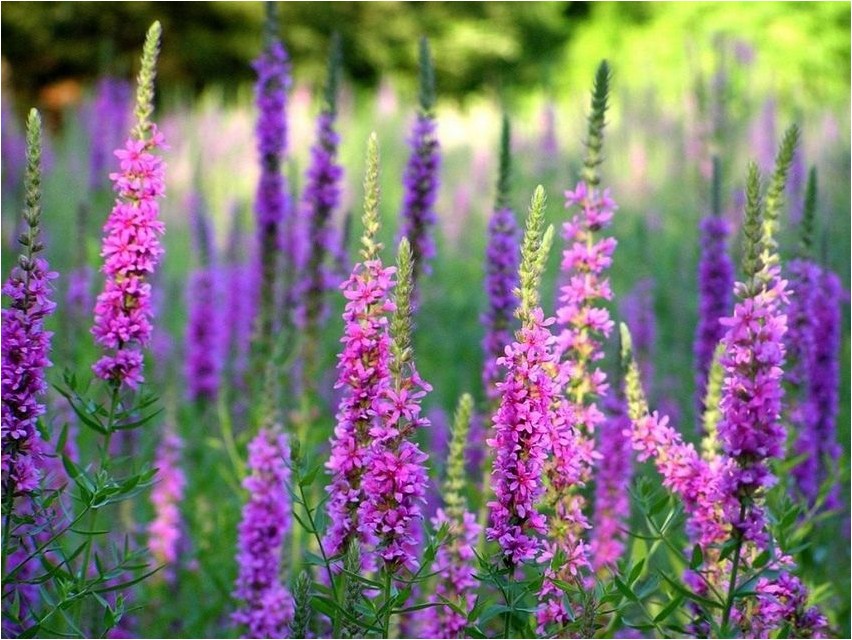
The willow weed is one of the plants of the family called loosestrife; in Latin the name of this plant will be as follows: Lythrum salicaria L.
As for the Latin name of the weeping willow family itself, in Latin it will be like this: Lythraceae Jaume.
Description of the weeping willow
The willow weed is a perennial herbaceous plant, endowed with straight stems, the height of which will be about sixty to ninety centimeters. Such stems, in turn, will be endowed with opposite and whorled, heart-lanceolate leaves. The flowers are quite small, they are painted in beautiful purple tones and are collected in a thick, spike-shaped panicle. The calyx of this plant is tubular, it will have twelve teeth, of which six pieces will be longer than all the others. The fruit of the willow weed is an oval bivalve capsule, which will be half as long as the calyx itself.
The flowering of the willow weed occurs during the period from June to August. For growth, this plant prefers the territory of the European part of Russia, as well as Ukraine and Belarus. As for the general distribution, this plant is found throughout Europe. Under natural conditions, the willow-leaved plakun is found in places along the banks of rivers and lakes, along ditches, swamps and in damp places. It is noteworthy that this plant is a very decorative and quite valuable honey plant.
Description of the medicinal properties of the willow weed
The willow leaf plant is endowed with very valuable healing properties, and it is recommended to use the leaves and grass of this plant for medicinal purposes. The concept of grass includes the leaves, flowers and stems of this plant. The presence of such valuable healing properties is explained by the content of tannins and saponins in this plant. The aerial part of this plant contains phenolcarboxylic acids and their derivatives, essential oil, resin, flavonoids, tannins, as well as anthocyanin 3, 5-diglucoside malvidin. The leaves contain vitamin C, phenolcarboxylic acids and their derivatives, while the seeds of this plant contain alkaloids.
It’s worth noting that the beneficial properties of this plant have become quite widespread in folk medicine. Remedies based on this plant have anti-inflammatory, analgesic, astringent, wound-healing, anticonvulsant, restorative, tonic, and hemostatic effects.

An infusion or decoction prepared from this plant is recommended for dysentery, chronic enterocolitis and colitis, intestinal and stomach pain, various types of bleeding, various nervous disorders, rabies, typhoid, hemorrhoids, rheumatism, laryngitis, bronchitis, and as an antidote for bites.
It’s worth noting that an infusion of willowherb is very effective for various illnesses accompanied by fever and general weakness. Decoctions of this plant’s herb are used for neuroses, and external use is possible for bathing children with various convulsions. Applying crushed fresh leaves of willowherb to various cuts and wounds can help stop bleeding and speed up wound healing. It’s worth noting that a decoction of the herb can be applied externally to eczema, fissures, and varicose wounds, and taken internally for dysenteric wounds and diarrhea, as well as fissures and eczema. It’s worth noting that in Tibetan medicine, this plant is used to treat nervous disorders.





