Ugni
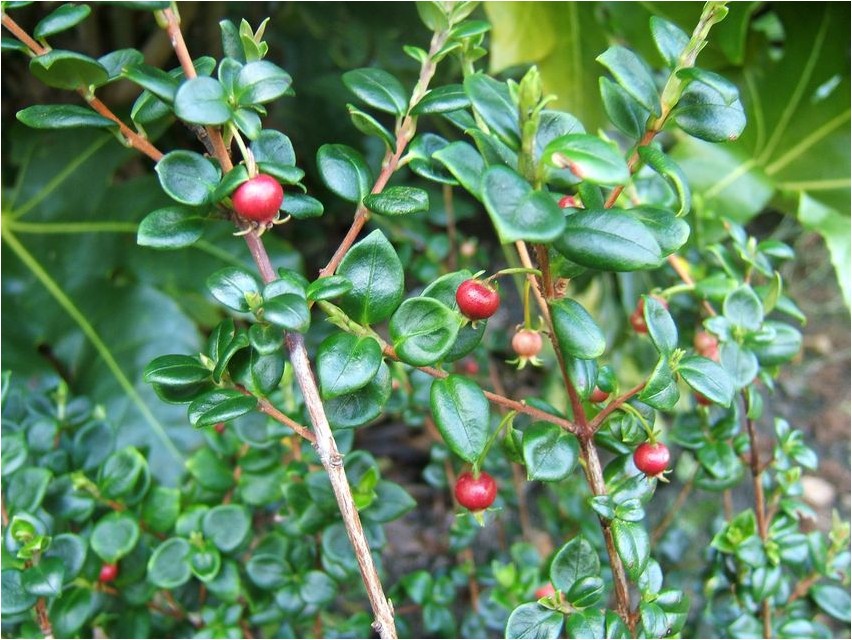
Ugni (lat. Ugni molinae) is a fruit shrub belonging to the Myrtaceae family. In science, this plant is called Chilean ugni or Molina ugni. And among the people they also call him uni.
History
The first description of Ugni appeared in 1782, and it was made by Juan Ignacio Molina (in fact, this is precisely what determines the full Latin name of this culture). And in 1844, William Lobb, a botanist and plant collector, first cultivated this plant in England and even presented the strange fruits to the royal court. By the way, these berries became Queen Victoria’s favorite treat.
Description
Ugni is a compact evergreen shrub whose height ranges from thirty to one hundred and seventy centimeters. Specimens about three meters high are extremely rare.
Glossy dark green lanceolate or oval leaves of ugni grow up to one to two centimeters in length and up to one and a half centimeters in width. If you rub the leaves of this plant a little in your hands, they will begin to emit a rather pleasant aroma.
Ugni flowers are formed by a corolla with a diameter of about one centimeter, many short stamens and pale pink or white petals in the amount of four to five pieces.
The fruits of ugni are red berries of relatively small size, reaching one centimeter in diameter and having a fairly strong strawberry smell. However, the color of the berries can vary — sometimes there are purple or even white fruits. In addition, all berries have a distinct sour taste. During the season, each bush can produce up to several kilograms of berries. Moreover, in the Southern Hemisphere, berries ripen from March to May, and in the Northern Hemisphere, from August to October.

Where does it grow
The homeland of ugni is considered to be South America (mainly Argentinean territories). In the wild, this plant grows in Chile, in temperate rain forests. In the last few decades, this crop has been actively grown for its edible berries, which exude a spicy strawberry smell. Now ugni can be found in New Zealand, Mexico or Japan.
Application
The edible ugni fruit is used to make traditional rich Chilean liqueurs and flavored jellies. However, jams, preserves and many other types of preserves made from ugni are also very good.
Ugni fruits are characterized by a fairly high content of polyphenols, which have powerful antioxidant properties.
Roasted ugni seeds are a very good substitute for coffee, and the leaves of this plant are often dried and brewed as tea.
The excellent decorative properties of ugni allow this plant to be used in landscaping — it makes luxurious hedges.
Contraindications
Since ugni berries contain substances that provoke allergic reactions, they may not be suitable for people with individual intolerance.
Growing and care
Ugni grows quite well indoors. However, it is important to take into account that for its full development, slightly acidic soils (without lime), good drainage and fairly intense lighting are required. However, this culture can grow in partial shade, but it will not survive complete shading. It can also withstand temperatures down to minus ten degrees.
Roots can be propagated either by cuttings or by seeds. This is usually done in the summer. And in the winter season, the bushes are formed — in order for all the bushes to have the correct shape and be quite compact, they are pruned.
A CURE FOR 9 DISEASES. HOW TO GROW elecampane
https://www. youtube. com/watch? v=6QyXflD7t1w