Kalmiya
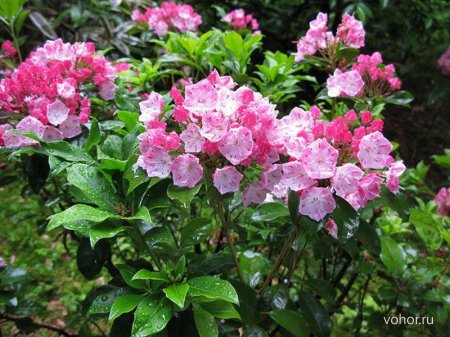
Kalmia is related to perennial plants and is distinguished by decorative flowering. Rich flowering continues throughout the month.
It reaches a height of 100-150 cm. There are small varieties up to 30-50 cm in height. The flowers are small (1-1. 5 cm in diameter), collected in inflorescences, and come in different colors. They differ in resistance to diseases and diseases.

types of Kalmia
Multifolia – blooms in May. It reaches a height of up to 150 cm. It is winter hardy.
Broad-leaved – the height of the bush is within 100 cm. Flowering occurs in May-June. Winter hardiness is low.
Narrow-leaved – reaches a height of up to 30-100 cm. Flowering occurs in June-July. Winter-hardy

Care and cultivation of Kalmia
Kalmia chooses to grow in light shade, particularly under trees. In order to grow, the location should be protected from the winds. Soils are preferably acidic, loose, well-drained, fertile. It grows poorly on heavy soils. The plant is provided with average watering in hot weather. It is worth noting that stagnation of moisture has a detrimental effect on potassium. After watering or rain, the soil around the bush is loosened. In the interests of retaining moisture, the ground around the plant is mulched with peat or sawdust.

mineral fertilizers are applied from April to June, monthly. Fertilizers for rhododendrons or heathers will be used in the form of fertilizing. Organic fertilizers are applied during planting or in the spring.
For the winter, Kalmiya is covered with spruce branches and dry leaves. With the onset of spring, the shelter is removed in due time in order to prevent rotting of the root collar.

reproduction
reproduction of Kalmia is quite a long and painstaking process, so it is easier to buy seedlings. Kalmia is propagated by cuttings, layering, root shoots, and seeds. Sowing of seeds is carried out in early December. The seeds are mixed with sand and distributed over the surface of a peat-based substrate. Until March, boxes with crops are stored in the fresh air. At the beginning of March, the boxes are moved indoors and covered with film. When germinating seeds and subsequently maintaining seedlings, the temperature regime must be followed. During the day, seedlings are kept at a temperature within 20-25 degrees, and at night – within 10 degrees. Seedlings do not dive, because replanting has a bad effect on growth. Of primary importance, fertilizing with mineral fertilizers (in not very high concentrations) is applied 2 years after sowing, monthly. Plants are planted in open ground 6 years after planting, in the spring. When propagated by seeds, flowering starts at 5-6 years.

semi-lignified cuttings are taken in the first half of summer. The cuttings are placed in a mixture of peat and sand, under a film. Before planting, the cuttings are treated with a root formation stimulator. Cuttings are rooted at a temperature of 20-25 degrees. Three-year-old plants are planted in open ground in the spring. Before planting, peat, sand, pine litter, as well as compost or complex mineral fertilizers are added to the soil. Plants are buried in such a way that the bark neck remains at soil level.
Basal shoots are planted on ridges. For the winter, plantings are covered. Beginning plants are transplanted to a stable place after 3 years.


