Ranunculaceae Anemone
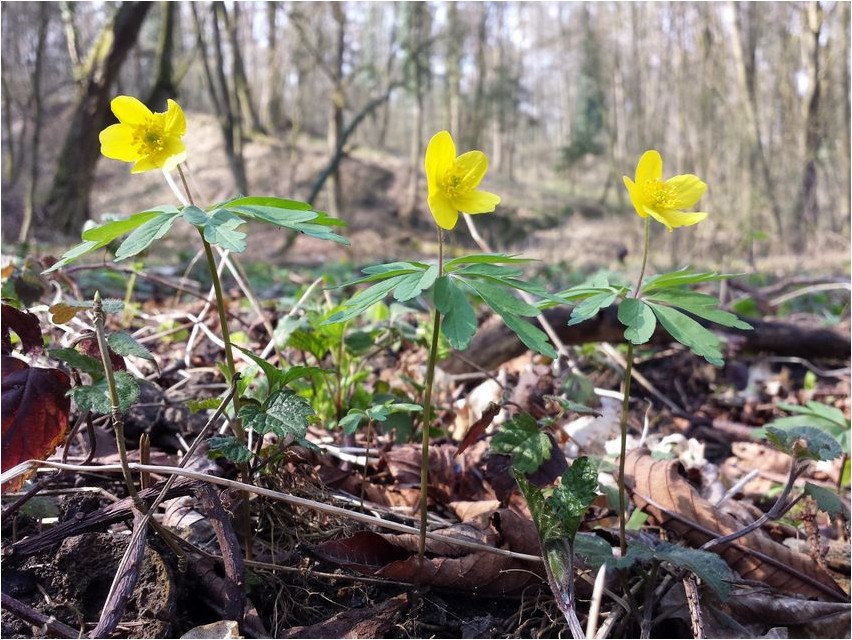
Ranunculaceae Anemone is a member of the buttercup family. The Latin name for this plant is Anemone ranunculoides L.
The Latin name for this family is Ranunculaceae Juss.
Description of Ranunculaceae Anemone
Ranunculaceae Anemone is a perennial herbaceous plant with a horizontal, fleshy rhizome. It should be noted that this plant most often lacks basal leaves or has a single, long-petioled leaf. The stems bear a bulb of three short-petioled leaves, which are dissected into three oblong, fairly large, and pubescent segments. Interestingly, these segments are sometimes bipartite, and the middle segment is most often divided into serrate-toothed lobes. Ranunculaceae Anemone flowers are solitary, but sometimes their number can range from two to five. These flowers are borne on long stalks and are approximately one and a half to three centimeters in diameter. These flowers typically have five or multiple bright yellow tepals.
This plant blooms in early spring. Anemone ranunculaceae is found throughout European Russia, with the exception of the Lower Don and Lower Volga regions, as well as in Belarus, the Caucasus, and Ukraine.
Anemone ranunculaceae prefers mixed and deciduous forests, as well as shrub thickets, shady lawns, and parks. In some cases, this plant can be found along riverbanks and in spruce forests. When handling this plant, it is very important to remember that it is poisonous.
Description of the medicinal properties of Anemone ranunculaceae
For medicinal purposes, it is recommended to use the herb of this plant: stems, leaves, and roots. In addition, the leaves and root sap of the buttercup anemone are also quite common. The plant contains anemonol, which, when broken down, produces anemonin. It’s worth noting that anemonin has both antispasmodic and analgesic properties. Among other things, this plant also contains saponins, tannins, and resin. When dried, ranunculin produces protoanemonin and glucose; protoanemonin has mitotic properties.

As for the juice of the roots of this plant, it is often used to treat warts. As for the infusion of the anemone herb, traditional medicine recommends its use for paralysis, jaundice and increased heart rate, as well as for dysmenorrhea. External use of this infusion is used as a skin irritant, as well as for scrofula, toothache, headache and rheumatism. Among other things, an infusion of anemone leaves will also be effective for various kidney diseases and edema, and also as an expectorant for bronchitis, gout, paralysis, whooping cough and stomach pain. As already noted, this plant is poisonous; for this reason, this plant can only be used with a certain degree of caution. When handling anemone buttercup, one should not forget that the leaves of this plant have a narcotic effect.
For whooping cough, the following remedy, prepared from anemone buttercup, is especially effective: you will need to take one teaspoon of dry crushed herb per two cups of boiling water. The resulting mixture should be infused for about thirty to forty minutes, and after that it is recommended to strain the mixture. This remedy should be taken three times a day, one tablespoon.