Commelina vulgaris
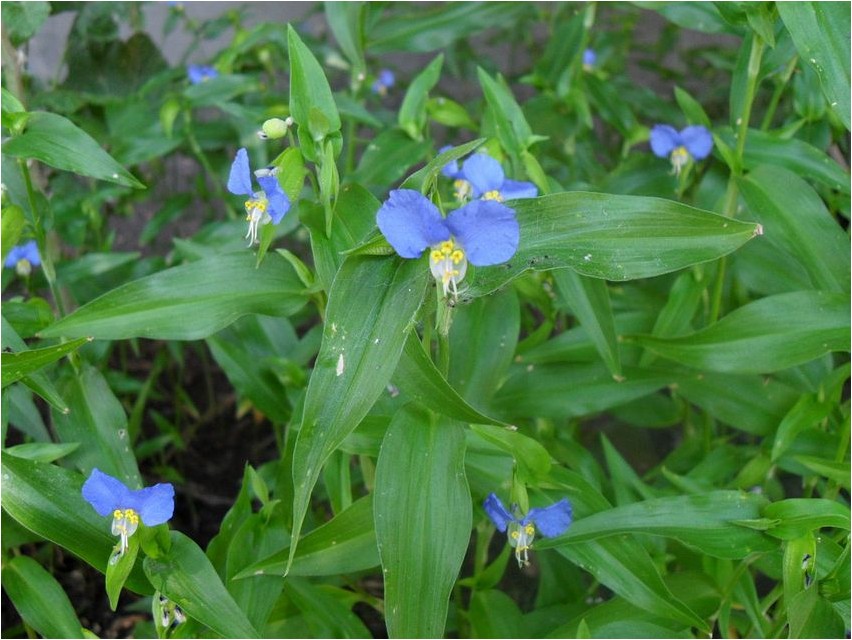
Commelina vulgaris is one of the plants of the family called Commelinaceae; in Latin the name of this plant will be as follows: Commelina communis L.
As for the name of the Commelina vulgaris family itself, in Latin it will be: Commelinaceae Reichb.
Description of Commelina vulgaris
Commelina vulgaris is an annual herbaceous plant with fibrous roots. The stem of this plant will mostly be branched, and it can also be either erect or ascending. Such a stem will be smooth, its height will fluctuate between fifteen and forty centimeters. The leaves of Commelina vulgaris are ovate-lanceolate, they are pointed, at the base such leaves will be endowed with membranous sheaths and sparse short hairs, which will mostly be located on the lower side.
The inflorescence of Commelina vulgaris is located on thin stalks in the very axils of the upper leaves; at the base, such an inflorescence will be endowed with a bract, clothed in a leaf-shaped and broad-heart-shaped form. It is noteworthy that such a bract will cover the inflorescence until it blooms. The flowers of Commelina vulgaris are somewhat irregular, the sepals are colored greenish, they are membranous and ovoid. In this case, the two sepals at the base are fused, and the corolla will consist of three unequal petals: two of them will be quite large and painted in dark blue tones, they are also rounded-obovate and endowed with a short claw at the very base. The third petal will be smaller in size, ovoid-lanceolate in shape and rather pale.
Flowering of Commelina vulgaris occurs from July to September. Under natural conditions, this plant is found in the Far East, in Batumi in Western Transcaucasia, as well as in the Altai region of Western Siberia and in the Daursky region of Eastern Siberia. As for its general distribution, this plant can be found in North America, China and Japan.
Description of the medicinal properties of Commelina vulgaris
Commelina vulgaris is endowed with very valuable healing properties, and it is recommended to use the herb of this plant for medicinal purposes. The term grass includes flowers, stems and leaves.

The presence of such valuable healing properties should be explained by the content of commelinine, dolphin glycosides and avobanin in the petals of the flower. In this case, the stems of this plant will contain mucous substances, and the seeds contain fatty oil.
Decoctions based on the herb of this plant have the ability to inhibit and suppress the development of Staphylococcus aureus, and in addition will also be endowed with a very effective diuretic effect.
As for traditional medicine, a decoction prepared from the herb of this plant is quite widespread. This decoction based on Commelina vulgaris is recommended for use for colds of an epidemic nature, dropsy, tracheitis, sore throat, dysentery, numerous heart diseases, enterocolitis and infectious inflammation of the urinary tract.
As a plaster, it is recommended to use externally the fresh herb of this plant, which must first be crushed to a pasty mass. This patch is used to treat festering wounds and styes. As for the juice of the herb Commelina vulgaris, it is used for tumors and snake bites: such a remedy is characterized by a fairly high degree of effectiveness when used.