Cashew
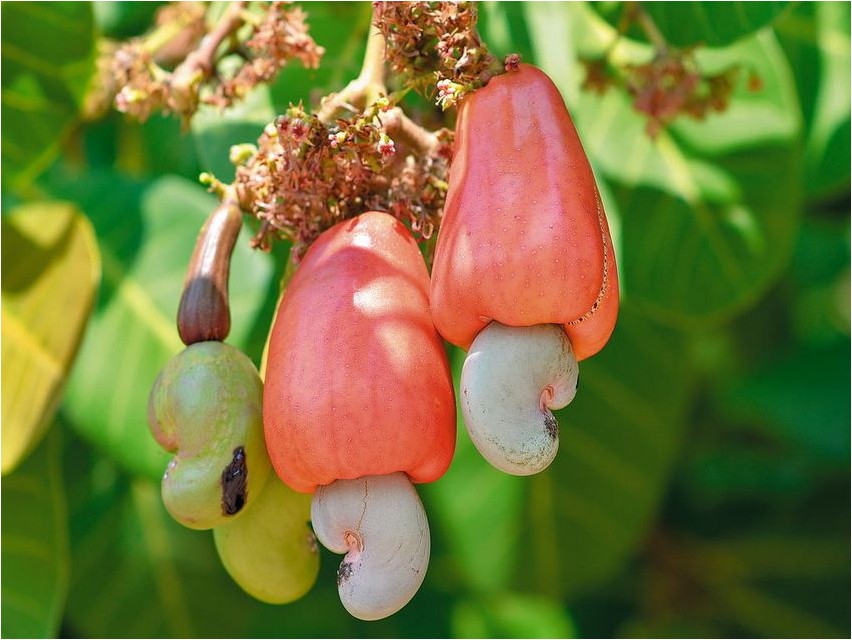
Cashew (lat. Anacardium occidentale) is a fruit plant belonging to the Sumacaceae family.
Description
Cashews are evergreen trees whose trunks most often branch irregularly. And their crowns are so widely spreading that their width is approximately equal to the height of the trees themselves. Alternately arranged entire leathery cashew leaves can be either ovoid or elliptical. Their width ranges from two to fifteen centimeters, and their length from four to twenty-two centimeters.
Cashew flowers are pale green, although in some places their color turns into colorful reddish shades. Each flower is endowed with five thin pointed petals, reaching a length of seven to fifteen millimeters. These flowers are collected either in attractive corymbs or in graceful panicles, the length of which can reach twenty-six centimeters.
Cashew fruits are colored reddish or yellow, their shape can be either diamond-oblong or pear-shaped, and they grow from five to eleven centimeters in length. Under the peels there is a slightly astringent yellow fibrous pulp. It is quite sour, but at the same time very juicy. And the nuts are located at the very tips of the stalks. Their shape resembles miniature boxing gloves, and their weight reaches one and a half grams. Each nut is covered on top with a double shell: the outer shell is always green and smooth, and the inner shell resembles a shell, covered with honeycomb-like cells. It is under it that the nucleoli used for food are hidden, the shape of which has a striking resemblance to the human kidney.
Where does it grow
The homeland of this culture is distant Brazil. However, due to its ability to easily lend itself to cultural cultivation and introduction, cashews are currently planted in almost all tropical countries. It is grown on an industrial scale in India and Iran, in a number of countries in Southeast Asia (in particular, in Vietnam, which ranks first in the world in terms of its cultivation), in the southeast and west of Africa, as well as in the south of Azerbaijan — it is from there that these nuts most often end up in our stores. At the same time, India is considered to be the most important consumer of healthy nuts.
Application
The nut-like cashew fruit is not only edible, but also extremely nutritious. It is noteworthy that not only nuts are used, but also their shells — from them a vegetable oil widely used in medicine and technology with the very unusual name caju is extracted. And the overgrown stalks and receptacle, very reminiscent of pears, are eaten as fruit (they are often called pseudofruits).

Cashew nuts are very rich in B vitamins, which help maintain a healthy nervous system and lower cholesterol levels. In addition, these nuts have the most beneficial effect on the cardiovascular system and are one of the most powerful immunostimulating and general strengthening agents. They will also serve well for toothache, anemia, various metabolic disorders, dystrophy and psoriasis.
Since ancient times, from the trunks of old and mature trees that have reached twelve meters in height, gum has been obtained, which is actively used in the food industry, as well as in technology and medicine.
Contraindications
It is not recommended to give cashews to small children, as it can cause allergies in them. Such nuts should also be consumed with extreme caution during pregnancy, while in the first half of pregnancy you should not eat more than thirty grams of cashews per day, and in the second half of pregnancy it is better to avoid eating them altogether. Other contraindications include bronchial asthma, diathesis and an increased tendency to allergies.
For healthy and adult people, the daily dose of cashews should ideally not exceed fifty grams.





