Calendula field
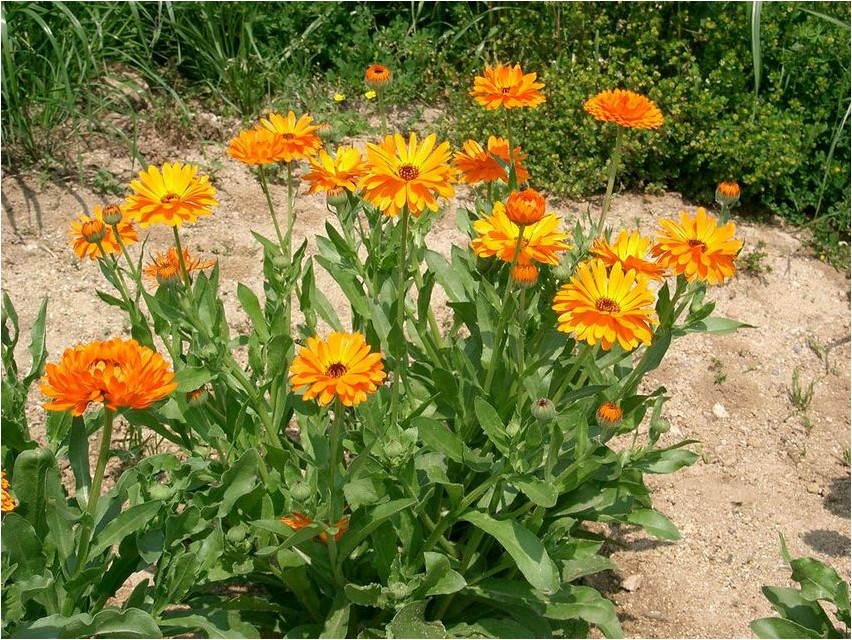
Field calendula is one of the plants of the family called Asteraceae or Asteraceae; in Latin the name of this plant will be as follows: Calendula arvensis L.
As for the name of the field calendula family itself, in Latin it will be like this: Asteraceae Dumort.
Description of field calendula
Field calendula is an annual herbaceous plant whose height will be about ten to thirty centimeters. The plant is fluffy-glandular, its stems can be either branched or simple. The basal leaves of this plant are oblong or oblong-obovate. The width of the baskets of field calendula will be about seven to nine millimeters, they will be apical and single. The reed flowers are twice as long as the involucre and they are colored gray-yellow. The outer achenes will be slightly bent, at the top they will be elongated, and along the back they will be long-spined.
Field calendula blooms from May to June. Under natural conditions, this plant can be found in the Crimea, Moldova, the Caucasus, as well as in the Black Sea region of Ukraine. For growth, the plant prefers places near roads, fields, and also garbage places.
Description of the medicinal properties of field calendula
Field calendula is endowed with very valuable healing properties, and it is recommended to use the inflorescences and grass of this plant for medicinal purposes. The term grass includes leaves, flowers and stems.
The presence of such valuable healing properties is explained by the content of steroids, flavonoids, coumarins, alkaloids, carotenoids and tannins in the plant. Field calendula seeds contain fatty oil, which also contains calendulic acid.

As for traditional medicine, the external use of this plant, as well as internal use, has become widespread. Externally, you should use herb juice, decoctions and oil ointment. Infusions and decoctions based on this plant should be taken for numerous diseases: for ulcers and malignant tumors, and also as a stimulant, diuretic, diaphoretic, anticonvulsant, wound healing agent and a regulatory stimulant.
Notably, Calendula arvensis inflorescences should be used as a natural food coloring for cheese and butter.
As a diuretic for hypertension, it is recommended to use the following quite effective remedy based on field calendula: to prepare such a remedy, take one tablespoon of crushed dry herb per glass of boiling water. The resulting mixture should be infused for two hours, and then this mixture is filtered very carefully. Take the resulting product three times a day, one or two tablespoons.
For malignant tumors, it is recommended to use the juice of the herb of this plant, which is taken one tablespoon two to three times a day. For rheumatism, it is recommended to use the following remedy based on this plant: to prepare this remedy, take three tablespoons of inflorescences per two glasses of water. The resulting mixture should be boiled for three to four minutes over low heat, and then this mixture is left to infuse for one hour, after which it is filtered very carefully. Take this remedy three times a day, one-third or one-fourth of a glass.
For pneumonia and flu, you should use an infusion prepared from crushed dry leaves of field calendula. This remedy should be drunk half a glass or one third of it three to four times a day.