Akmella
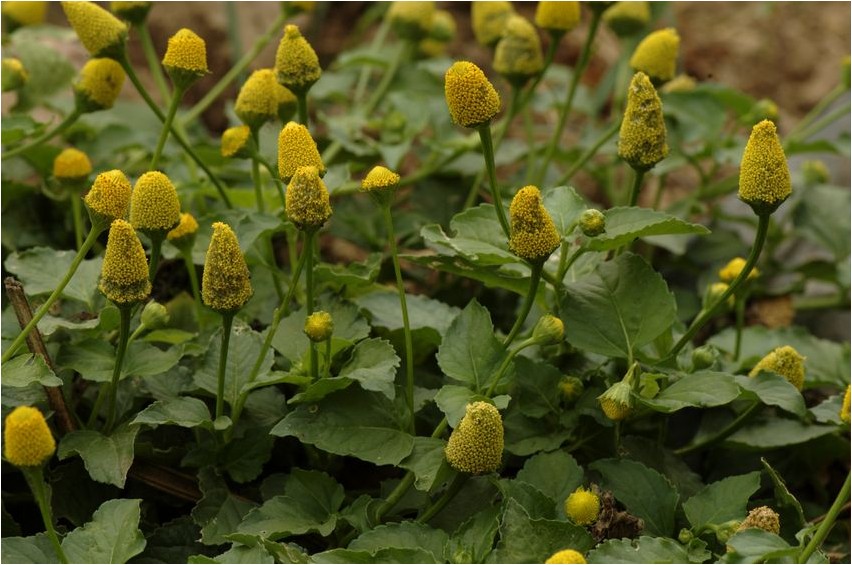
Previously, some representatives of this genus were classified as genus Spilantes. The most common species is Acmella oleracea (the old name is Spilanthes oleracea, or Paracress).
The birthplace of the culture is presumably Brazil, from where the plants spread to Africa, Australia and some Asian countries. In Russia it is considered a less widespread culture.
Characteristics of culture
Akmella is a perennial herbaceous plant, cultivated as an annual. Akmella is characterized by rapid growth; as the plants grow, they form a beautiful dark green carpet, which acquires a reddish tint in the sun. The leaves are oval or broadly ovate, with a truncated base, and sit on long petioles. The stems are creeping. The flowers are small, yellow, collected in spherical-conical or conical inflorescences with a red-brown “cap”. Acmella blooms long and abundantly. Akmella is cold-resistant, can withstand frosts down t o-4C.
Subtleties of cultivation
Akmella prefers light, fertile soils with a pH of 6. 1-7. 5. The location is sunny. Shade is undesirable; in such areas, plants develop poorly and are affected by various pests and diseases. Sowing is carried out in late May – early June directly into open ground. The seedling method is not prohibited; in this case, akmella is sown in April. Acmella seeds are small, so they are sown on the surface of the soil, lightly dusted with soil.
When two true leaves appear on the seedlings, thinning is carried out; the distance between plants in a row should be about 20 cm, between rows – 30-35 cm. Young plants need regular watering. Overmoistening and drying out should not be allowed. Feeding is not necessary, but is encouraged, for this the akmella will thank you for its rapid growth and lush green mass.
Usage
Akmella is perfect for landscaping a garden/summer cottage. It is used to create borders, alpine slides, rockeries and other types of flower beds. Akmella looks great as an hanging plant; it can be grown in hanging flowerpots and decorative containers. It is not forbidden to grow the crop on the lawn in combination with other herbaceous and flowering plants.

In European countries, akmella is used in cooking. It has a pungent taste and piquant aroma, so it is used for preparing vegetable salads, sauces for meat and fish, and seasonings.
Acmella leaves contain spilanthol, this substance has a strong analgesic effect. Various tinctures are prepared from the leaves, which are useful for toothache, bruises, sprains, arthrosis, arthritis and rheumatism (as an external remedy). In India, akmella is added to chewing tobacco; in Asian countries it is widely used in homeopathy.
https://www. youtube. com/watch? v=I10Afe953OI





