Buttercup caustic
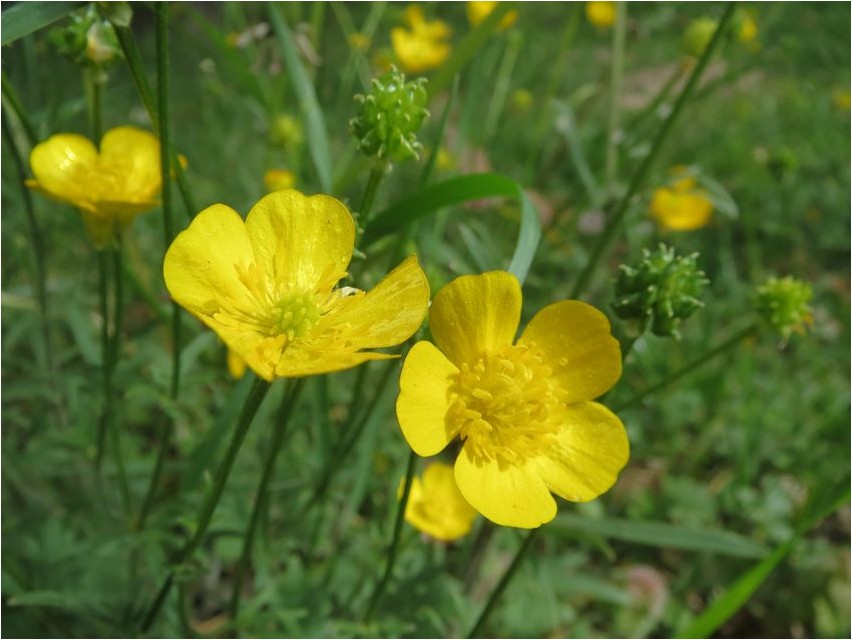
Acrid buttercup is one of the plants of the family called Ranunculaceae; in Latin the name of this plant will be as follows: Ranunculus acris (L.) (R. aceranct. CR. Stevenii Andrz.).
As for the name of the caustic buttercup family itself, in Latin it will be: Ranunculaceae Juss.
Description of buttercup
The caustic buttercup is a perennial herbaceous plant that is adpressed, it is endowed with fibrous roots and a straight branched stem. The lower leaves of this plant are long-petiolate, the blade in their outline will be pentagonal, as well as palmate with rhombic and serrated lobes. The upper leaves of the caustic buttercup will be almost sessile, they are tripartite and endowed with linear-toothed stalks. The diameter of the flowers of this plant is about one and a half to two centimeters, they are endowed with five appressed sepals and five golden-yellow petals. The fruit of the caustic buttercup is a spherical multi-nut. Such nuts are oblique-shaped, they will be endowed with a curved or straight nose.
This plant blooms at the end of spring and summer. Under natural conditions, caustic buttercup is found in Ukraine, Western Siberia, Belarus, as well as the European part of Russia, with the exception of only the south and the Far North.
Description of the medicinal properties of buttercup
Acrid buttercup is endowed with very valuable healing properties, and it is recommended to use the herb of this plant for medicinal purposes. The concept of grass includes the flowers, stems and leaves of this plant. Such medicinal raw materials should be harvested throughout the entire flowering period of caustic buttercup.
The presence of such valuable healing properties should be explained by the content of the glycoside ranunculin in the fresh herb of this plant, which, upon hydrolysis, will be broken down into glucose and proteanemonin lactone-hydroxyvinylacrylic acid. Actually, this glycoside, ranunculin, is an oily liquid that will be endowed with a very characteristic and rather pungent odor. It should be noted that such a compound is unstable and over time will be converted into anemonin, and then into inactive anemonic acid.

Also in the fresh grass of this plant there are tannins, alkaloids, saponins, glycosides, carotene, vitamin C and the following flavonoids: kaempferol, quercetin and their glycosides.
As for traditional medicine, ranunculus has become quite widespread here as a very effective vesicant and local irritant. This plant is also used for headaches, gout, rheumatism, burns, wounds, furunculosis and as a tonic. A decoction prepared from ranunculus flowers is recommended for use against tuberculosis, hernia and various gastric diseases.
It is noteworthy that previously a decoction of the flowers of this plant was used for malaria. It is recommended to rub yourself with ointment from the flowers when you have a cold, and in addition, cotton wool, which has been previously moistened with ranunculus juice, should be applied to sore teeth. For liver diseases, a decoction of flowers in small doses is quite effective. In homeopathy, fresh herbs of this plant are used for neuralgia, gout and various skin diseases. In Mongolian medicine, this plant is considered a stimulant, and Tibetan medicine uses ranunculus as a wound-healing agent. In addition, Tibetan medicine uses the fresh herb of this plant in the treatment of purulent processes.





