Asteriscus
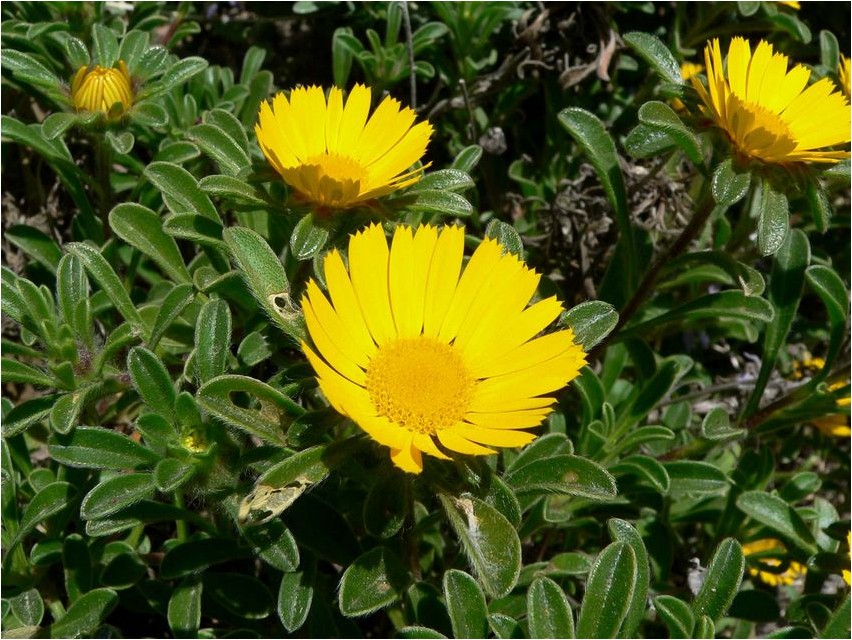
Asteriscus is a genus of herbaceous plants belonging to the Asteraceae family. This genus comprises approximately fifteen different species.
The plant’s name itself can be translated as “little star,” a translation easily explained by the plant’s beautiful, small, bright yellow flowers, which look extremely attractive against a backdrop of dense foliage.
Description
This genus includes both annual and perennial plants. The plant’s inflorescences are small, reaching a diameter of several centimeters, although some species can reach a diameter of up to fifteen centimeters. The flowers are golden-yellow, with yellow petals and a yellow center.
The fruit of the plant is an achene, a nut with either a leathery or woody shell. The hairs or bristles that previously surrounded the base of the corolla become a pappus, which allows the achenes to be dispersed by the wind. However, some species may develop several so-called spines at the end of the achene, with the teeth facing backward. The seeds are dispersed via these spines, which can cling to either human clothing or animal fur. However, some species of Asteraceae lack such adaptations for plant dispersal.
Care

Asteriscus is a cold-hardy and easy-to-care-for plant, attracting flower lovers with its striking appearance and long-lasting decorative qualities. Asteriscus ideally thrives in clay-sandy soil, fertilized with humus. It is crucial that the plant receives sufficient sunlight and a constant supply of water, but stagnant water should be avoided under any circumstances. Stagnant water can cause the plant to develop gray mold. As for fertilizing, mineral flower mixes should be added periodically. It’s also important to remember that faded flowers are very unattractive and have an unsightly brown hue, so it’s recommended to remove them immediately. You can also periodically pinch the shoots; this will allow the plant to grow as quickly as possible and encourage the appearance of beautiful new buds. However, there are varieties that don’t require pinching.
Reproduction occurs both through seeds and cuttings. Propagation by seeds is used for the main species, which can be grown as an annual. But to propagate varietal plants, cuttings will be required; in addition, you can purchase new seedlings every year. It is important to remember that this plant will not be able to survive winter in open ground.
Cuttings are carried out in the summer; the optimal solution would be the very beginning of summer, because then the plant has the most strength. For this purpose, apical shoots are used, the length of which will be approximately five to eight centimeters. These shoots should be rooted at a distance of at least twenty centimeters from each other in nutritious soil, which is constantly kept moist. In winter, plants should not be watered as abundantly. The apical cuttings should be rooted in the soil at a temperature of about twenty degrees, in which case new roots will appear within a week. And after two weeks, these cuttings will acquire a completely powerful root system. After ten weeks, such seedlings will already bloom.
The plant is incredibly beautiful; you can use it to create amazing compositions or use it solo.
Telephony based on Asterisk