Cupressocyparis
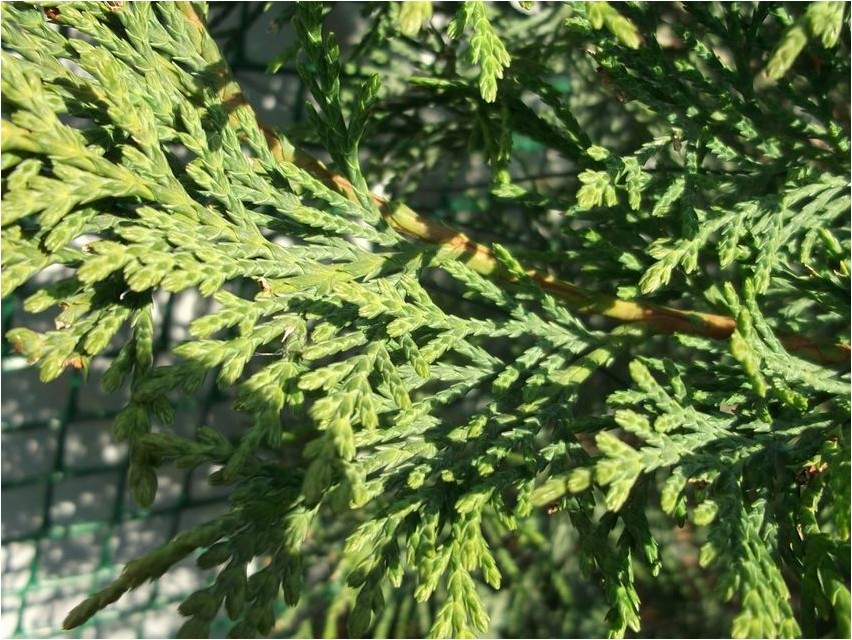
Cupressocyparis (Latin: Cupressocyparis) is a hybrid tree obtained by crossing a cypress and a cypress, belonging to the Cupressaceae family.
It is currently widely cultivated in England. It appeared in Russia relatively recently and is grown primarily in regions with a warm-temperate climate. One of the most common hybrids is considered to be the Leyland cypress (Latin: Cupressocyparis leylandii). This variety was obtained by crossing Nootka cypress and large-fruited cypress (Latin: Cupressus macrocarpa x Chamaecyparis nootkatensis).
The resulting hybrids and their characteristics
Leyland cypress is an evergreen columnar tree up to 20 m tall with a symmetrical, dense crown and drooping shoots. It is characterized by rapid growth, increasing up to 1. 5 m per year. The leaves are similar in shape and color to those of the Chamaecyparis cypress, but emit a less intense aroma when crushed. The branches are thin, long, and relatively delicate. The cones are small, covered with scales. The seeds have tiny protrusions.
Cupressocyparis has twelve clones. The most common are:
*Robinson”s Gold — a hybrid created entirely by accident. It boasts a squat, broadly conical, green crown and a tall growth habit. The leaves are bronze-yellow when young, but with age they acquire a yellow-golden hue.
*Castlewellan Gold — is winter-hardy and wind-resistant. It has reddish-yellow shoots. It was developed back in 1963. It has no special growing conditions.

*Leithon green — characterized by loosely arranged trees with a clearly visible main shoot and irregularly spaced, flat-lying branches. Leaves are yellowish-green or light green.
*Green spire — characterized by slightly columnar trees with light yellow leaves and branches spaced at varying distances.
*Haggerston grey — widely cultivated in England. It has loosely arranged branches of a gray-green or green color.
Growing Tips
Cupressocyparis is shade-tolerant and undemanding of growing conditions. However, it thrives and produces fruit vigorously in fresh, moderately moist, mineral-rich soils. Acidity is unimportant; both acidic and alkaline soils are tolerated. It tolerates drought well, but requires infrequent watering, especially young specimens. It is resistant to diseases and pests. Temperature fluctuations also do not affect the growth of the crop.
It is not recommended to grow cupressociparis on dry, waterlogged and carbonate soils. It is grown mainly by planting seedlings; they should be purchased only from trusted nurseries. Less commonly, the crop is propagated by cuttings, which are cut in September and planted in containers filled with a mixture of coarse sand and peat. Planting in open ground is carried out after the plants have formed a well-developed root system.
HOW TO PLANT CYPRESS. Cypress cupressioparis Leylanda Gold Ryder