Lentils
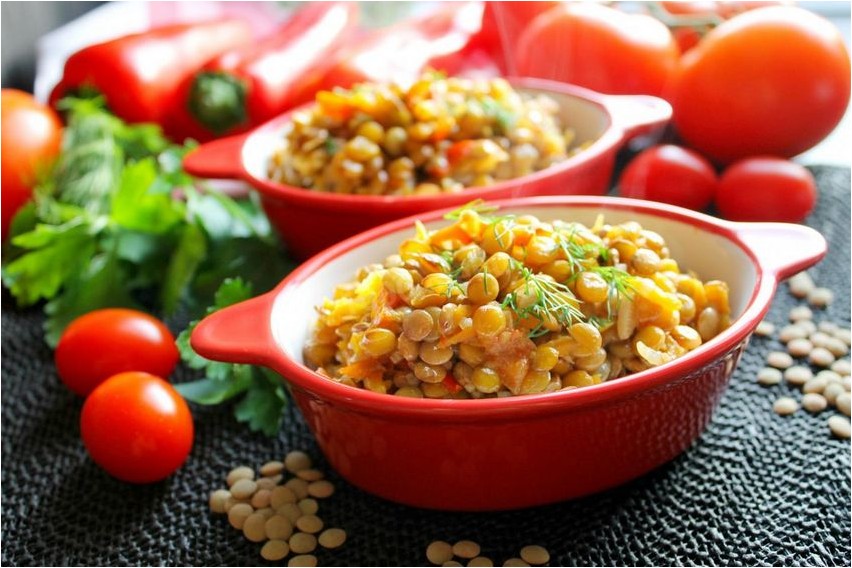
Lentils are a herbaceous plant belonging to the legume family; drought-resistant valuable food and feed crop. By the way, this is one of the very first plants domesticated by humans, along with peas, barley and wheat.
Description
Lentil is a rather low-growing herbaceous plant, endowed with strongly branching stems and alternate pinnate leaves. The roots of the plant are small and very thin, and the erect, pubescent stems grow from fifteen to seventy-five centimeters in height. All lentil leaves end in slightly branched or simple tendrils.
The small flowers formed on lentils are colored bluish or white. And the short fruits of this crop have the shape of flattened beans and contain from one to three seeds. By the way, the color of the seeds can be completely different depending on the variety.
Where does it grow
Western Asia and Southern Europe are considered the homeland of lentils — they have been cultivated there since the Neolithic era. Repeated mentions of this leguminous crop can be found even in the Old Testament.
Currently, the largest areas of lentil cultivation can be found in Iran, Nepal, Turkey, Canada and India.
Usage
For a number of Asian peoples, lentils are a valuable source of protein that can replace meat, cereals and bread. Lentil grains are eaten almost everywhere.

In addition, lentils have long been valued as a medicinal plant. Even ancient Roman doctors actively used this culture to treat nervous disorders and gastric diseases. And in old Russian herbalists you can find recommendations for using lentil infusion for smallpox. Thick lentil decoction is an excellent astringent for a variety of gastrointestinal diseases, and a liquid decoction is the best assistant in the fight against constipation. Lentil decoction is also good to drink for kidney stones.
Growing and care
Germination of lentil seeds begins already at a temperature of four degrees — the seedlings of this plant are not at all afraid of even minor frosts. However, in order for both plants and beans to form properly, it is desirable that the temperature be between eighteen and twenty-two degrees.
Despite the fact that lentils are considered a fairly drought-resistant crop, it is important for them to try to ensure sufficient soil moisture. And the yield of this crop is directly dependent on the absence of weeds on the site and on the quality of the soil. The best soils for growing lentils are sandy or loamy soils. If it is cultivated on heavy or acidic soils, the yields will definitely not be satisfactory. In addition, lentils grow excellently in areas where row crops or winter crops were previously grown.
They begin to sow lentils as soon as the soil temperature reaches five to six degrees, planting the seeds to a depth of five to six centimeters. It is advisable to maintain a distance of about ten to fifteen centimeters between the rows. As soon as all the seeds are in the soil, the soil must be lightly rolled on top — this measure will contribute to better germination of the seeds. And after the emergence of seedlings, the soil should be harrowed — this will eliminate weeds that impede plant growth. Ideally, harrowing is carried out during midday hours.
Pests and diseases
Among the most active pests of lentils are the cutworm, meadow moth and lentil weevil. As for diseases, the most common diseases that attack lentils are rust, ascochyta blight and fusarium blight.