Quince
Quince (lat. Cydonia) — belongs to the category of fruit crops; genus of plants in the Rosaceae family. In nature, quince grows in flat areas, as well as in forest areas, less often in the mountains.
Natural range — Turkmenistan, Uzbekistan, Tajikistan, Armenia, Azerbaijan. Currently, the plant is actively cultivated in European countries, Crete, Cyprus, as well as in Russia and some Asian countries.
Description
Quince is represented by tall trees up to 4-5 m high with a spreading crown. Young shoots are equipped with brown bark with felt pubescence; The trunk and perennial branches are covered with rather thin, non-wrinkled bark.
The foliage is entire, petiolate, alternate, green on the outside, grayish on the inside because it has felt pubescence, can be oval or ellipsodial in shape, there are specimens with rounded leaves, pointed or blunt ends. The leaves are equipped with small lanceolate stipules.
Quince flowers are solitary, with a five-part, non-falling calyx and a snow-white or pinkish corolla, located on shortened pedicels. The petals of the corolla are ovoid. Quince blooms in mid-May — early June.
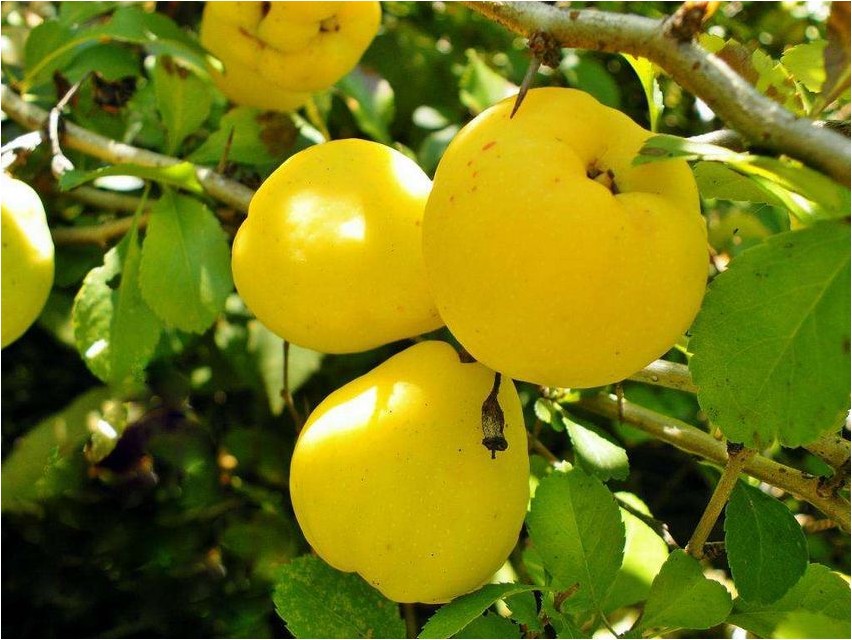
The fruits are presented in the form of false apples, they are pear-shaped or spherical (which depends on the variety), may have obvious ribs, may have a light yellow or deep yellow color, sometimes with a red side. At first the fruit is covered with felt, later it becomes very smooth. The diameter of the fruits varies from 5 to 16 cm.

The quince pulp is somewhat harsh and cannot be called juicy, but it has a pleasant and sweet aroma. The taste is fresh, sweet, tart, slightly astringent in the mouth. The seeds have an obovate shape, the color is brown with a reddish tint. The fruits are suitable for consumption in the second ten days of September — the first ten days of October.
Location
Quince cannot be called unpretentious; it is demanding both in terms of location and soil conditions. She loves well-lit or moderately shaded areas. Protection from cold and squally winds is welcome. Soils for quince need to be moderately moist, nutritious, loose, sandy, well-drained, water- and breathable. Quince boasts winter-hardy properties; in harsh and snowless winters, only young shoots are damaged by frost.
Subtleties of cultivation
The crop in question is propagated, like most fruit crops, by seed and vegetatively (by suckers, cuttings and layering). The most common methods of quince propagation include cuttings. Cuttings are taken from strong annual shoots located in the lower part of the tree. Cuttings are planted for rooting immediately after cutting; treatment with growth stimulants is encouraged. The cuttings are placed obliquely. It is advisable to cover the bud with a small layer of fertile soil. After three weeks, a root system forms on the cuttings. They are transplanted to a permanent location next spring. It is important to provide the rooted cuttings with shelter for the winter in the form of a thick layer of fallen leaves or any other natural material.
Features of care
Plant care is simple, it consists of procedures standard for all fruit crops, namely moderate watering, fertilizing with mineral and organic fertilizers, weeding and loosening as necessary, as well as pruning (sanitary and formative, it should be noted that both types are important for quince). With proper and regular care, quince will delight you with a good harvest of fruits. The first few years, quince requires special pruning; the shape of the tree and further development will depend on it.
The main branches of the quince are shortened by a third; they should not be heavily pruned, because this approach can provoke rapid growth of shoots, subsequently the fruits will set slowly and in small quantities, and they will ripen for a very long time. Sanitary pruning involves removing damaged and dry branches. It is recommended to carry out both sanitary and formative pruning in early spring (before the onset of sap flow).
An important feature in care: when planting young seedlings, they provide reliable support. At the moment when the plants first begin to bear fruit, the support is removed. Watering is very important for quince; six waterings need to be done during the gardening season. Quince is good at feeding: the first feeding involves the application of organic matter and a complex of fertilizers (it is carried out in early spring), the second feeding — only complex mineral fertilizers (during fruit set), the third — repeats the first (it is carried out in the fall).