Leucophyllum frutescens
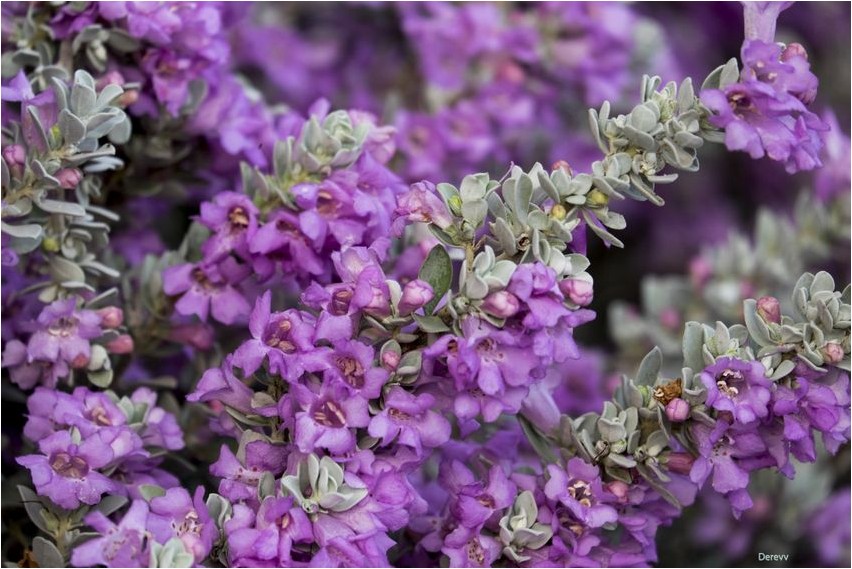
Leucophyllum frutescens is an evergreen, compact shrub of the genus Leucophyllum, which belongs to the Scrophulariaceae family.
It is the most common species of the genus Leucophyllum, native to the arid lands of southwestern North America. The shrubs are distinguished by dense hairs, turning the plant into a striking, silvery-velvety creation of nature. Single flowers with pink or violet-purple corollas appear year-round in the leaf axils. What”s in a name?
The plant owes its difficult-to-pronounce generic name, “Leucophyllum,” to the French botanist Aimé Bonpland (August 22, 1773 — May 4, 1858), who was captivated by the lush and powerful nature of the tropical regions of the New World. He believed that the inexhaustible wonders of this soft, cheerful, and light nature would drive him crazy with their diversity and beauty.
During his five years of travel across the American continent, Aimé Bonpland collected a herbarium of 6, 000 plants. He described more than 3, 500 plants, including species and genera unknown to European scientists at the time. Therefore, they had to be named.
Thus, the name for the picturesque plant genus “Leucophyllum” was born. Using two Greek words meaning “white” and “leaf,” it reflects the silvery-white color of the leaves of these spectacular plants. The specific epithet “frutescens” (“shrubby”) describes the appearance of the plant”s above-ground parts.
Description
Leucophyllum frutescens is typically a compact shrub, ranging in height from 0. 6 to 1. 5 meters, sometimes reaching 2. 5 meters.

Its evergreen, soft-to-the-touch leaves are densely covered with silvery hairs that radiate like stars. The simple leaves are obovate or elliptical, with a smooth margin. The leaves are no more than 2. 5 centimeters long. The hairy covering of the leaves gives them a silvery-gray color with a greenish tint.
Leucophyllum frutescens is a monoecious plant with unisexual flowers. The solitary flowers, borne in the leaf axils almost 12 months a year with brief breaks, are almost bell-shaped and colored white, pink, pink-lilac, or violet-purple. The flower”s dimensions in length and width are equal and reach the 2. 5 centimeter mark on a ruler.
Interestingly, the reappearance of flowers in some varieties of this plant is associated with rainfall, leading them to choose spring and autumn as their time of birth. This reaction to rain has led to one of its common names: “Texas barometer bush.”
The fruit is a small capsule.
Cultivation
Leucophyllum fruticosa is a drought- and heat-resistant plant. The shrub tolerates low temperatures equally well, but prolonged cold winters can cause it to lose some of its evergreen leaves.
Good soil drainage is essential for Leucophyllum fruticosa to thrive. It tolerates dry soil better than excessive moisture. If the soil remains wet for a long time without good drainage, the shrub”s roots begin to rot, ultimately killing the plant.
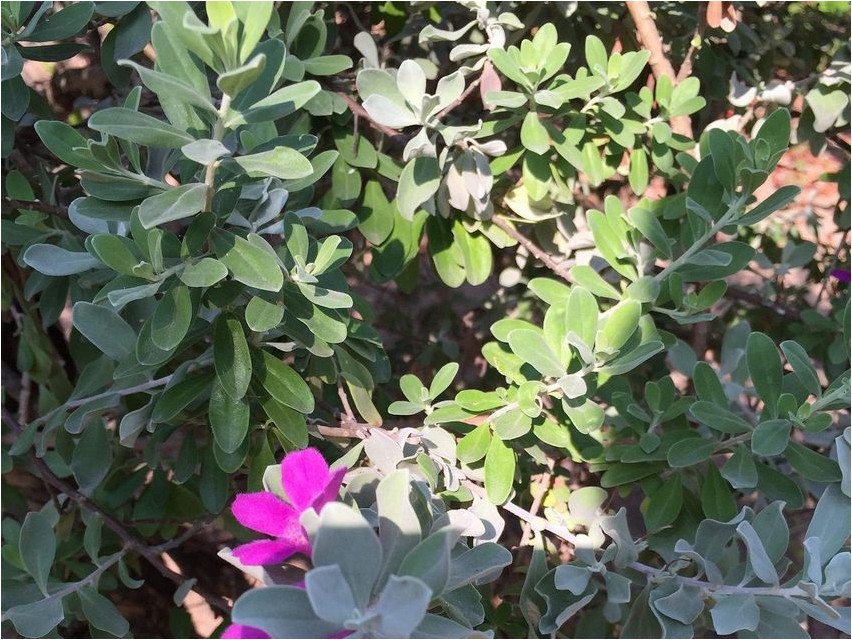
However, during the first year of life, the plant requires deep watering to develop its root system. Subsequently, it requires no further watering. Provided there is good drainage, the shrub thrives in medium loams, sandy limestone soils, and even clay soils.
A sunny or lightly shaded location is preferred.
Uses
The flowers of the fruticose Leucophyllum are rich in nectar, attracting beneficial insects.
This is a very striking compact shrub that looks great planted alone or can serve as a natural silvery-green hedge. It is easily pruned to form a compact bush.
LEUCOPHYLLUM FRUSTRA LEUCOPHYLLUM IS IN BLOOM!!! KIRYAT YAM, ISRAEL.
Leucophyllum fruticosa Leucophyllum
Leucophyllum fruticosa Leucophyllum