Prince
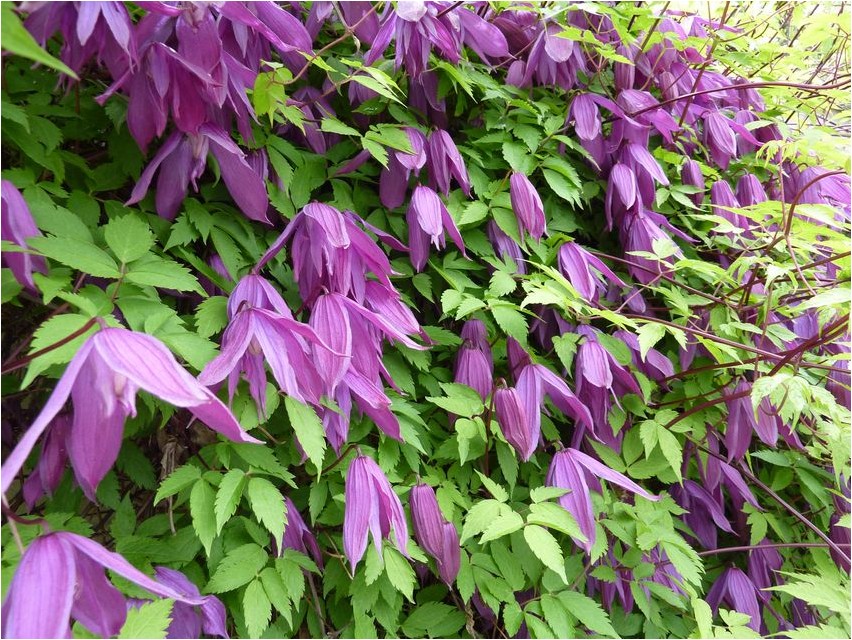
Prince (lat. Atragene) is a genus of shrubby vines of the Ranunculaceae family. The genus includes eight species. Natural range: Northern Hemisphere.
In Russia, only three species are found — the Siberian princeling, the large-petalled princeling and the Okhotsk princeling. Among the European species in Russia, the most common is the Alpine princeling.
Characteristics of culture
Knyazhik is a woody shrubby vine with twice or thrice odd-pinnate leaves that cling to the support with their petioles. Flowers are solitary, axillary, broadly bell-shaped, up to 10 cm in diameter. Sepals are petal-shaped. The fruits are small, numerous, pubescent. Externally, the prince is similar to clematis, the differences between the plants are minor. Many gardeners note that princelings are more graceful than clematis, but so far the first genus has not received proper distribution. In many European countries, as well as in Canada, active selection of princelings is currently underway. Over the course of several years, many varieties have been developed that are distinguished by increased winter-hardy properties.
Common types
*Prince of Okhotsk (lat. Atragene ochotensis) — the species is represented by shrubby vines with three-triple leaves equipped with long petioles. The flowers are large, broadly bell-shaped, azure or violet-blue, pubescent with soft hairs, up to 8 cm in diameter. Prince of Okhotsk blooms in June, the fruits ripen in August-September. The climate of the Urals, Siberia and the Far East is acceptable. Plants are used not only for ornamental gardening, but also in folk medicine. It grows well in semi-shaded areas with well-moistened, fertile and loose soil.
*Alpine prince (lat. Atragene alpina) — the genus is represented by vines up to 3 m long with trifoliate or double-triple leaves, the petioles of which are attached to the support and hang in beautiful thick garlands. The flowers are blue-blue or violet-blue, broadly bell-shaped, consisting of 4 large sepals and small petals. Alpine princeling blooms in May-June (depending on the climate zone). The fruits ripen in late August — early September. Currently, forms with white and pink flowers are presented on the shelves of garden outlets. The species is thermophilic and does not tolerate cold winds. In Russia it is grown in the southern regions and the Moscow region. Suitable for vertical gardening, it develops well in both sunny and shaded areas.
* Large-petaled prince (lat. Atragene macropetala) — the species is represented by vines up to 2. 5-3 m long with flowers of brightly expressed rich color. The sepals are blue-purple or black-violet, pubescent with thin soft hairs. The leaves are purple, linear. The large-petaled prince blooms in May-June, the fruits ripen in late July-mid-August. It has quite a few abundantly flowering varieties, bred mainly in Canada. It grows well both in the southern regions of Russia and in the Urals. Plants are actively used for landscaping gardens and summer cottages.

Growing conditions
The prince is light-loving, although he has a negative attitude towards the effects of direct sunlight. Semi-shaded areas, as well as eastern, south-eastern or south-western slopes, are optimal. The crop does not make any special demands on soil conditions; it develops normally on almost all types of soil. Light, loose, fertile, drainage, permeable soils are welcome. Larger flowers are formed on plants growing on loamy, neutral or slightly alkaline, fertile soils.
Subtleties of reproduction
Princes are propagated by seeds and cuttings. Before sowing, the seeds are mixed with fine-grained sand in a ratio of 1:3, after which they are thoroughly moistened and placed in snow or in the refrigerator. This procedure promotes rapid germination. Seeds are sown in seedling containers filled with fertile soil mixed with sand. After sowing, the seeds are rolled, moistened and covered with glass. Picking of seedlings is carried out in the phase of 3-4 true leaves. Young princelings are planted in open ground next spring. The beds for the crop are prepared in advance: the soil is dug up, humus, sand and peat are added. After planting, the soil between the rows is regularly loosened, freed from weeds and watered. For winter, plants are pruned and mulched with a thick layer of fallen leaves or peat.
The most promising method of propagation for princelings is the vegetative method of propagation. Divide the bushes in early spring. Princes aged 5-6 years are dug up together with a lump of earth, divided into parts, trying not to damage the root system. The cuttings are planted in moistened holes, deepening the first node of the shoot by 7-10 cm. The crop is often propagated by layering. This procedure is carried out in the spring. The lower shoots of the bushes are placed in shallow trenches, covered and watered abundantly. Layers planted in the soil are systematically moistened and fed with mineral and organic fertilizers. The cuttings are separated from the mother plant after a year, after which they are planted in a permanent place.