Arhat
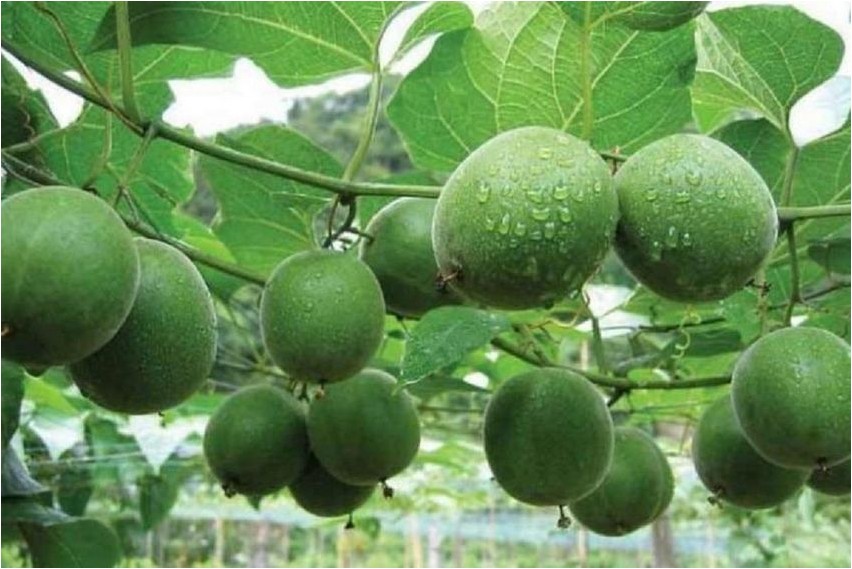
Arhat (lat. Siraitia grosvenorii) is a fruit plant representing the well-known Cucurbitaceae family.
Description
Arhat is a magnificent herbaceous vine that wraps its tendrils around a great variety of other plants and can grow from three to five meters in length.
Arhat fruits are quite small — they are characterized by an oval or spherical shape, and their length ranges from five to seven centimeters. In Europe during the Middle Ages, these fruits were politely called “the fruit of Buddha” or “the fruit of monarchs.”
Unripe fruits boast extremely fleshy and surprisingly juicy pulp, in the middle of which numerous small seeds are nestled. Arhat has a sweet taste, somewhat reminiscent of melon. And the darker the fruit, the sweeter it will be. And as these amazing fruits ripen, their flesh becomes very dry.
As soon as the arhat fruits ripen, their pulp begins to ferment and gradually deteriorate, making it almost impossible to export them to other countries.
Where does it grow
The homeland of this culture is considered to be practical Southern China and colorful Northern Thailand — where arhat is grown mainly for its fruits. But in other parts of the world, arhat has not received proper distribution — this is due to the fact that even under the most favorable conditions, its capricious seeds will take several months to sprout.

However, in recent years, many amateur flower growers have begun to willingly grow arhat — both in heated greenhouses or in country houses, and on apartment window sills or in winter gardens. Moreover, the seeds of this strange crop can be found even in Russian stores!
Application
Arhat can be eaten fresh, but in this form its taste may seem rather cloying, so most often it is dried or a wide variety of drinks and decoctions are prepared from it. In Chinese medicine, tea with dried arhat is considered the best help against heat stroke and a real cure for cough. And in order to say goodbye to constipation, monk fruit is sometimes added to some sauces.
When consumed regularly, this fruit has a powerful tonic and pronounced immunostimulating effect; moreover, it greatly contributes to the normalization of the entire gastrointestinal tract.
In several Chinese provinces, monk fruit is a favorite tea additive—tea made with it boasts a surprisingly pleasant, fresh, and delicate flavor, as well as antipyretic and powerful tonic properties. These fruits are also beneficial for office workers—in conditions where fresh air is scarce, they are excellent for strengthening the lungs. They also help minimize the harmful effects of alcohol or smoking (monk fruit is excellent for strengthening the liver and cleansing the lungs), and quickly relieve constipation. In these same provinces, this fruit is also a sought-after gift, which has long symbolized a wish for the best of health. Monk fruit is also recommended for those in public service positions who sing or speak a lot: announcers, teachers, tradespeople, singers, and so on. Its ability to accumulate fluid in the body makes it indispensable for athletes, as well as for anyone working under the scorching sun or in very hot climates.
It”s also worth mentioning that monk fruit has an extremely beneficial effect on the nervous system—it”s a great companion for those with vegetative-vascular dystonia, excessive irritability, chronic sleep deprivation, and frequent fatigue.
Ripe fruits are widely used to make an extract that”s three hundred times sweeter than sucrose. Monk fruit owes its unusual sweetness to antioxidants with the amusing name mogrosides. In China, this extract has served as an excellent natural sweetener for several thousand years! Moreover, its caloric content is only 2. 3 kcal per gram, which is half that of cane or beet sugar.
Contraindications
Too high a sugar content makes monk fruit completely unsuitable for diabetics. It can also trigger allergies.
“Arhat”
https://www. youtube. com/watch? v=VZsB8AgjT18
Arhat monk fruit