Cuff
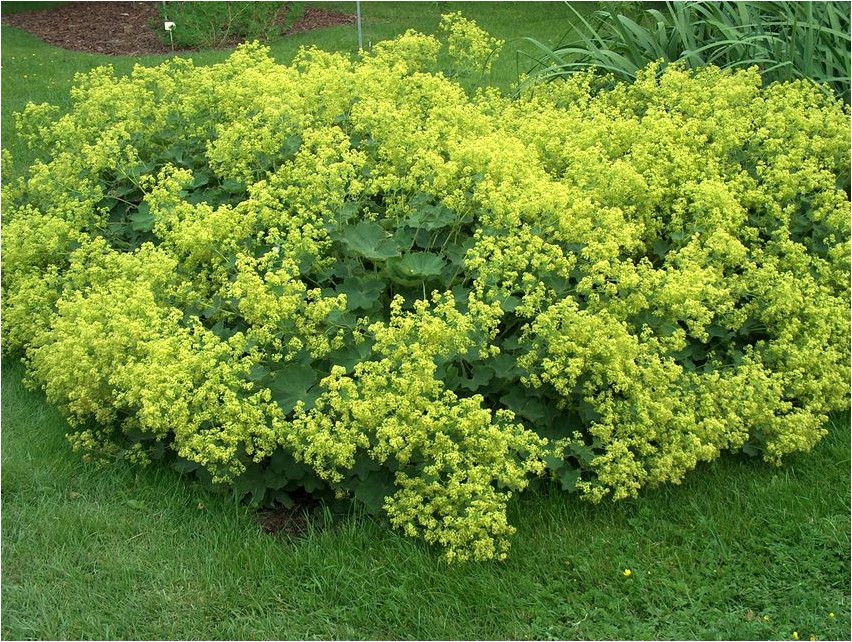
Mantle (lat. Alchemilla) – flower crop; perennial plant of the Rosaceae or Rosaceae family. In nature, the cuff is found in North America, Greenland, East Africa and Eurasia, except for the tropical regions of Asia and the Far North.
Currently there are about 300 species.
Characteristics of culture
Cuff is a herbaceous bushy erect plant 15-60 cm high. The root system is superficial and powerful. The leaves are palmately dissected or palmately lobed, pubescent over the entire surface, rounded, located on petioles, and are highly decorative. The flowers are small, inconspicuous, collected in paniculate inflorescences, and can be yellow, greenish-green or white. The mantle blooms profusely from June to July. The culture is fast-growing and can cover large areas in a short period of time.
Growing conditions
The cuff prefers well-lit areas, protected from cold winds. Some forms of culture grow freely in partial shade. They do not develop well under the canopy of shrubs and trees. The soils for growing mantle are preferably slightly acidic or neutral, fertile, and loamy. Poor soils are not suitable for the plant.

Reproduction and planting
Cuffs are propagated by seeds, cuttings and dividing the bush. The seed method is the simplest and most effective. Sowing is carried out in late autumn under cover. The seedlings that appear the following spring are transplanted to a permanent location.
When growing cuffs at home, the seeds are sown in special boxes and kept in a cool room until germination. When 2-3 true leaves appear on the seedlings, the plants are transplanted into separate containers. It is important to provide the cuffs with good drainage; the bottom of the pots can be covered with a thick layer of pebbles.
Cuffs are often propagated by dividing the bush. Overgrown healthy bushes are carefully divided into several parts and planted in soil pre-fertilized with peat. Well-rooted cuttings are transplanted to a permanent place. The distance between plants should be 25-30 cm.
Care
Manzhetka is an unpretentious crop that requires rare but abundant watering, especially during periods of prolonged drought. Also, caring for the mantle consists of weeding, fertilizing and loosening the soil in the near-stem zone. Many gardeners say that the plant does not require fertilizing, but in this case, when planting, the soil must be thoroughly fertilized with compost or humus.
Due to the fact that the cuffs grow very quickly, their growth should be limited. After the crop blooms, the inflorescences are cut off, this procedure allows the plant to bloom again. For the winter, the cuffs are mulched with peat or humus. It is believed that a plant can grow in one place for more than ten years without losing its attractiveness.
Application
Despite the fact that the cuff is not a flowering crop, it is very decorative. The crop looks most impressive in the early morning: in the center of each leaf, large drops of dew shimmer with all the colors of the rainbow. Gardeners often use the plant in group and mixed plantings; they are often grown in rocky gardens – rockeries and rock gardens, as well as in ridges and mixborders. The plant goes well with heucheras, sedum, thyme, lilies, delphiniums, peonies, cornflowers, carnations, hostas and roses.
Cuffs are often used when arranging live and dry bouquets. The fragrant and airy inflorescences of the cuffs add volume to absolutely any bouquet. To dry, plants are tied into bunches and hung with inflorescences down in a shaded, well-ventilated area. Cuffs are also used in folk medicine. All parts of the plant contain a huge amount of vitamins, microelements and tannins.