Russian Lycium
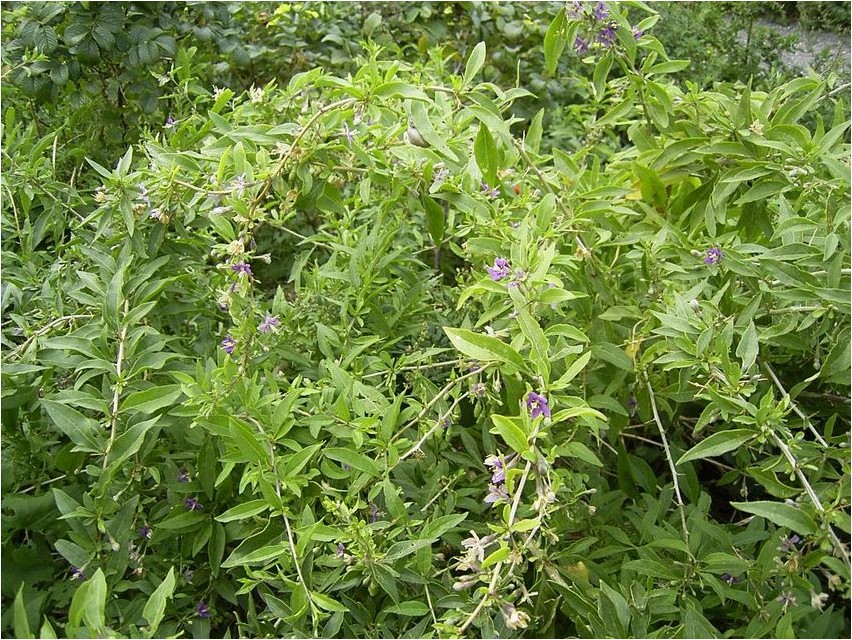
Russian Lycium is a member of the Solanaceae family. Its Latin name is Lycium ruthenicum Murr.
The family name of Russian Lycium is Solanaceae Juss.
Description of Russian Lycium
Russian Lycium is a shrub that can reach two centimeters in height. This shrub is very thorny, bare, and branched, with strong, sinuous shoots covered with thorns three to twenty millimeters long. The branches are spreading, and the shoots are knobby. The leaves are sessile and glaucous, no more than three and a half centimeters long and three centimeters wide. The flowers of the Russian wolfberry grow on stalks approximately four to eight millimeters long. They can be single or in groups of two or three. The calyx of this plant is approximately two and a half to four and a half millimeters long, and the corolla is eight to thirteen millimeters long. The diameter of the fruits of the Russian wolfberry is four to eight millimeters, and they are black in color.
This plant blooms from April to June. The fruits ripen from June to November. In the wild, this plant can be found in the Caucasus, Central Asia, and the Lower Volga region of European Russia. It prefers areas along irrigation ditches, river valleys, and alkaline, clayey, and sandy slopes. It can also be found as a weed in cotton fields. Description of the Medicinal Properties of Russian Wolfberry
Russian wolfberry possesses quite valuable medicinal properties, and its fruits and seeds are recommended for medicinal purposes. It should be noted that the chemical composition of this plant has not yet been fully studied, so new uses for the medicinal properties of Russian wolfberry can be expected. The fruits of this plant are used medicinally to treat stomach cramps, jaundice, and difficulty breathing. Furthermore, the fruits are also used as a choleretic and laxative. Remarkably, the fruits of Russian wolfberry are edible.
For stomach colitis and jaundice, as well as difficulty breathing and as a choleretic, the following remedy based on Russian wolfberry is recommended: Take one teaspoon of wolfberry seeds per glass of water. Boil the mixture for three to four minutes over low heat, then let it steep for one hour, then strain thoroughly. Take this wolfberry-based remedy, one to two tablespoons three times daily.
Interestingly, the medicinal properties of this plant also make it a fairly effective laxative. To prepare this remedy, take one tablespoon of wolfberry seeds per glass of water. Simmer the mixture over low heat for three to four minutes, then let it steep for one hour, and finally strain thoroughly. Take this Russian wolfberry-based remedy, two to four tablespoons, either in the morning or before bed. It’s worth noting that to achieve the desired effectiveness, it’s recommended to not only follow all the instructions for preparation but also strictly adhere to all the directions for use.

https://www. youtube. com/watch? v=3lmE0apBszE
Russian wolfberry





