Rutabaga
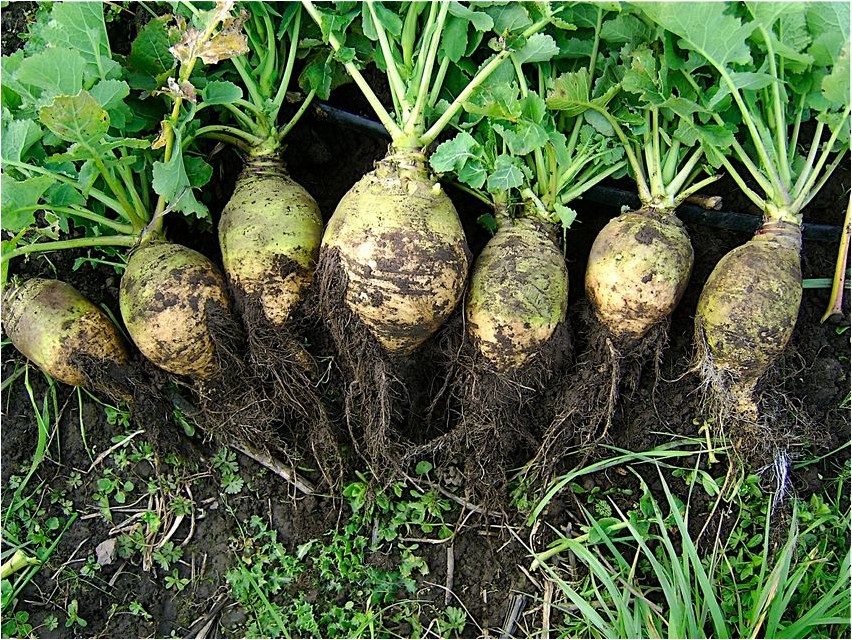
Rutabaga (lat. Brassica napobrassica) is a vegetable crop; biennial plant of the Cruciferous or Brassica family. The plant is often called kalega, bukhva or Swedish turnip.
It is known that rutabaga was bred back in the 17th century in Sweden and is a hybrid of one of the wild species of cabbage and turnip. Today, rutabaga is not as popular among gardeners as it was in the old days. Although on the territory of the Russian Federation it is cultivated as a fodder and food crop mainly in the northwestern and northern regions. In the southern regions the plant is rarely cultivated due to low soil moisture.
Characteristics of culture
Rutabaga is a biennial plant; in the first year of life it forms a fleshy root and a rosette of leaves, and in the second year it produces flowers and seeds. The stem of rutabaga is tall, straight, leafy. The lower leaves are bare or pubescent, lyre-shaped, pinnately incised. The upper leaves are entire, sessile, with a bluish coating. The flowers are small, collected in racemes. The petals of flowers with obovate bends, turning into a short nail, have a golden-yellow color.
The fruit is a multi-seeded pod, 5-10 cm long, tuberculate or smooth, horizontal or ascending, with a thinly drawn-conical nose, located on a short peduncle. The seeds are dark brown, slightly cellular, spherical, up to 1. 8 mm in diameter, and release a sticky substance when soaked. The root crop is round, oval, rounded-flat or cylindrical, and can be gray-green or purple-red in color. The pulp is white or yellow.
Rutabaga is a cold-resistant and moisture-loving crop; its seeds germinate at a temperature of 2-3C. Shoots appear on days 3-5, easily tolerate frosts down t o-3C, and adult plants — down t o-6C. The optimal temperature for growing crops is 15-18C. The growing season is 110-120 days.

Growing conditions
The soils for cultivation are loamy or sandy loam, rich in humus, with a slightly acidic or neutral pH. Soils with high acidity significantly reduce the quality and quantity of the crop. The best crop predecessors are tomatoes, carrots, cucumbers and legumes. You should not grow rutabaga after cruciferous plants.
Reproduction and planting
Rutabaga is propagated by seeds. In the southern regions, seeds are sown directly into the ground, in the northern regions — through seedlings. The site for rutabaga is prepared in advance: the soil is dug up, compost, urea, superphosphate and potassium salt are added. For summer consumption, rutabaga is sown in early spring, for winter storage — in mid-summer. Sowing is carried out according to a one-, two- or three-line scheme. The seeding depth is 1-2 cm. When growing a crop with seedlings, seedlings are planted in holes in late May — early June. The distance between plants should be 16-18 cm, between rows — 60-70 cm. With the appearance of 2-3 true leaves on the seedlings, the crops are thinned out.
Care
Caring for rutabaga consists of systematic feeding, watering, weeding, loosening the rows and preventive treatments against pests and diseases. During the growing season, two feedings are carried out: the first — with slurry diluted with water in a ratio of 1:10, the second — with mineral fertilizers (urea, potassium salt and superphosphate).
Rutabaga is often affected by pests and diseases. Cruciferous flea beetles, cabbage flies, cabbage aphids and garden cutworms cause particular damage to crops. To repel pests, plants are dusted with wood ash and tobacco dust. A decoction of tops, garlic, tomatoes or celandine with the addition of a soap solution is also effective in combating them.
Harvest and storage
For summer consumption, rutabaga is harvested many times as the root crops reach technical ripeness. For storage, collection is carried out once, but before the onset of stable frosts. The root crop is pulled out and the leaves are cut off at the level of the head. Store rutabaga in boxes filled with sand in a cool room. Small root vegetables are used for forcing greens, because partially bleached shoots are also edible.