Chicory
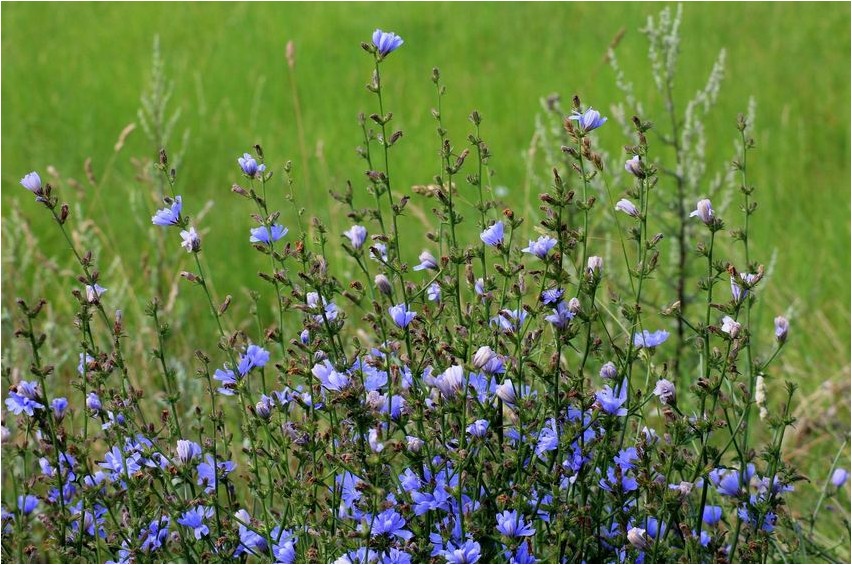
Chicory (lat. Cichorium) is a genus of biennial and perennial herbaceous plants of the Compositae, or Asteraceae, family. The genus includes twelve species, of which only two are cultivated — leaf chicory (or Witloof) and common chicory.
Distribution
The natural range is Europe, Asia and North Africa, some wild species can be found in South America, Australia and New Zealand. Typical places of growth are roadsides, forest edges, meadows, wastelands, field edges, country paths.
Currently, chicory is cultivated in many countries around the world; large chicory plantations are cultivated in Europe, more precisely in Belgium, France, Italy, Spain and the Netherlands. In Russia, chicory is grown mainly in the Novgorod, Ivanovo and Yaroslavl regions.
Characteristics of culture
Chicory is a perennial herb with a thick spindle-shaped root. In Russia and other countries, the plant is cultivated as an annual or biennial. The root system is taprooted, strong, and deeply penetrating. The stem is hard, erect, weakly leafy, covered with short hairs over the entire surface. The leaves are oblong, rounded or narrowed at the ends, equipped with a pronounced central vein, and arranged alternately.
The flowers are blue, less often pinkish or white, collected in baskets with a double wrapper. The outer leaves of the involucre are shortened, bent, the inner ones are erect. The fruit is a prismatic achene with a filmy tuft. From one chicory bush you can collect about 25 thousand seeds. Chicory blooms in early summer, the fruits ripen in August-September, sometimes in October.
Growing conditions
Cultivated chicory species do not have any special requirements for soil conditions. However, to obtain better yields, it is advisable to grow plants in areas with fertile, breathable, moderately moist, slightly acidic or neutral soil. Optimal light loamy and sandy loam soils. Chicory does not accept acidic, heavy clayey, swampy and waterlogged soils.

Chicory is a cold-resistant plant, seeds germinate at a temperature of 7-8C, seedlings can withstand short-term frosts down t o-5C, and root crops — up t o-20C. Good predecessors are cucumbers, all types of cabbage, onions and legumes. You cannot plant chicory after carrots, Jerusalem artichoke, lettuce, parsley, artichoke and tarragon. Intense lighting of the area is preferable; complete shade can lead to rotting of the root system, and subsequently to death.
Soil preparation and sowing
The preparation of the site for chicory is carried out in the fall, immediately after harvesting the predecessor. First, fine loosening is carried out with a rake, rotted manure is added, and after two weeks they are dug to a depth of 25-30 cm. In the spring, the ridges are loosened again and fed with complex mineral fertilizer and wood ash. The time for sowing chicory depends on the growing method and the selected variety. Sowing of seedlings is carried out in March-April, and in open ground — in May.
In the seedling method, chicory seeds are sown in special containers. In the phase of 2-3 true leaves, seedlings dive into peat-humus pots. Seedlings are planted in open ground at the age of 30-35 days. The distance between plants in a row should be about 20-30 cm, between rows — 30-40 cm. When sowing a crop directly into the ground, thinning is carried out as entrances appear; if necessary, in the phase of 5-6 true leaves, this procedure is repeated.
Care
Basic procedures for caring for chicory: loosening the rows, watering, weeding and fertilizing. Primary fertilizing is carried out during planting, secondary fertilizing is carried out after 2-3 weeks. Perfect for this purpose: potassium sulfate, ammonium nitrate and superphosphate. Water the crop as the soil dries out. You can mulch the stem area, this will prevent the appearance of weeds and reduce the amount of watering.
Application
Chicory is widely used in cooking. The root of the plant is used as a coffee substitute, and the leaves are used to make salads and side dishes. Some varieties, such as Express, Blanca, Tardivo or Productive, are good for growing leafy heads, which have excellent taste characteristics, they contain large amounts of vitamin B and carotene. Chicory is useful for people suffering from diseases of the cardiovascular system, digestive organs and liver. Decoctions and extracts from root vegetables increase appetite, help with anemia and treat diabetes.
https://www. youtube. com/watch? v=vgFjvmUbOh4