Badan
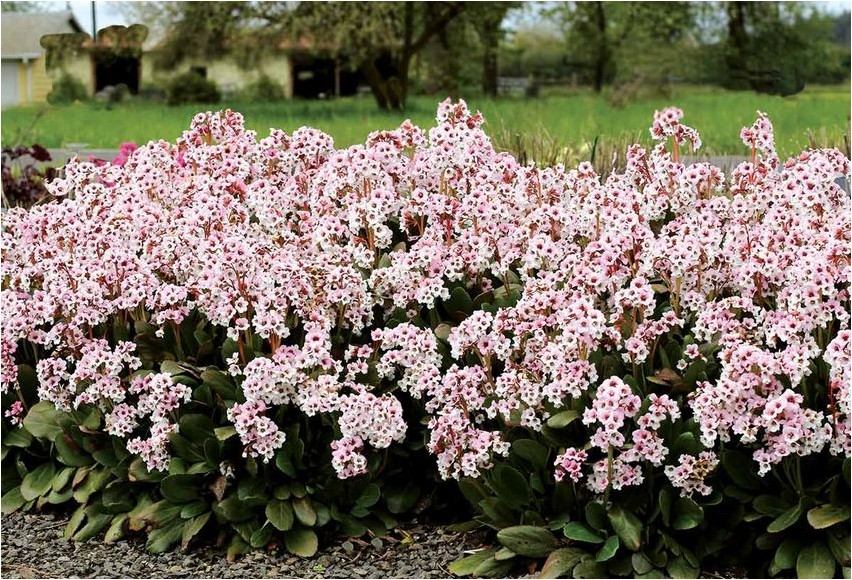
Bergenia (lat. Bergenia) is an annual or perennial plant of the Saxifragaceae family. Other names are Bergenia or Mongolian tea.
In nature, bergenia grows in Asia (from Afghanistan to Korea and China). Six species are found in Russia. The plant received its name in honor of the famous German botanist Carl August von Bergen.
Characteristics of culture
Bergenia is a herbaceous plant 6-60 cm high. The rhizomes are horizontal and quite thick. The leaves are large, leathery with a shine, dark green in color, located on petioles, forming a voluminous basal rosette. The peduncles are long, and when they appear, the flowers bloom simultaneously. The flowers are goblet-shaped, collected in dense paniculate inflorescences, depending on the variety and can be white, pink, red, purple or dark purple. The fruit is a capsule. Bergenia blooms for two months; there are remontant varieties that bloom several times per season. Early bergenias bloom in early April.
Growing conditions
Bergenia is a light-loving crop, but it also grows easily in shaded areas. In partial shade it forms rather dense and long-lived thickets. The soils for growing bergenia are preferably loose, well-drained, moderately moist, rich in organic matter with a neutral pH. Saline and acidic soils are not suitable, as are lowlands with stagnant cold air.

Reproduction and planting
Bergenia is propagated by seeds and by dividing the bush. The seed method is used extremely rarely, since seedlings develop slowly and require a lot of attention. Sowing is carried out in March in seedling boxes. The seeding depth is 0. 5 cm. After sowing, the soil is watered, and the boxes are covered with film and placed in a warm room. The first shoots appear after 3-4 weeks.
Seedlings are planted in open ground in early June. The area for bergenia is prepared in advance, the soil is dug up, fed with humus and mineral fertilizers, holes 5-6 cm deep are formed, and a little river sand is poured into the bottom. Then the seedlings are lowered into the hole, sprinkled with fertile soil and watered with watering cans. For wintering, young plants should leave with 2-3 leaves of shoots. With the seed propagation method, bergenia blooms in 3-4 years.
Propagation by division is not particularly difficult. As bergenia grows, it forms new roots that lie close to the soil surface and are easy to dig up without damaging the roots. This method is used for propagation in May-June. Each division should have 3-4 root buds and 2-3 leaves. The divisions are planted in open ground, spaced 30-50 cm apart. This procedure should be carried out no more than once every 4-5 years.
Care
Caring for bergenia is quite simple. The plant requires regular and moderate watering, avoiding overwatering. It responds well to fertilizing with complex mineral fertilizers. Fertilizer is applied twice during the growing season: in early spring and in the fall before the onset of persistent frosts.
In the first year, immediately after planting, the soil around the plants is mulched with peat. The plant doesn’t respond well to replanting; it can grow in the same location for 8-10 years. Since bergenia is resistant to diseases and pests, it doesn’t require preventative treatments; it’s more important to follow all agricultural practices.
Application
Bergenia is widely used in landscape design for gardens and parks. The plant is used to decorate lawns, borders, group compositions, and flower beds. Bergenia looks good in mixed compositions designed in a landscape style, combined with shrubs and low-growing trees (junipers, dogwoods, euonymus, and rhododendrons). The plant fits harmoniously into rock gardens, such as rockeries and alpine gardens. Spring bulbous plants such as crocuses and scillas are ideal partners for bergenia.
The plant is also used in many other areas, for example, in folk medicine. Bergenia leaves are used to make tonic teas with beneficial properties. Bergenia is rich in arbutin, which is why it’s used to treat bladder problems. A water bath made from the plant’s leaves is excellent for cystitis. Bergenia also has anti-inflammatory properties, which is why it’s used in cosmetics to treat dandruff, seborrhea, and acne.





