Emleria
Emleria (Latin: Oemleria) is a monotypic genus of shrubs in the Rosaceae family. The genus includes a single species, Emleria cerise.
The plant received its name in honor of the German botanist A. G. Emleria, who brought it to Europe from America in the mid-19th century. The plant is often called fragrant bush, nutallia, osmaronia, and Indian plum. In the wild, Emleria grows in hidden places, more specifically, in bays, floodplains, and coves from Washington to California. It is also found in moist broadleaf forests in western North America. It has been cultivated since 1848.
Growing Conditions
Emleria is a large deciduous shrub or tree up to 7 m tall with lilac-colored, bare branches. The leaves are bright green, elliptical, with a pointed tip, 5-12 cm long, with a slightly pubescent lower blade. They lack stipules and emit a distinctive odor when crushed or ground. The buds are green and have three scales.
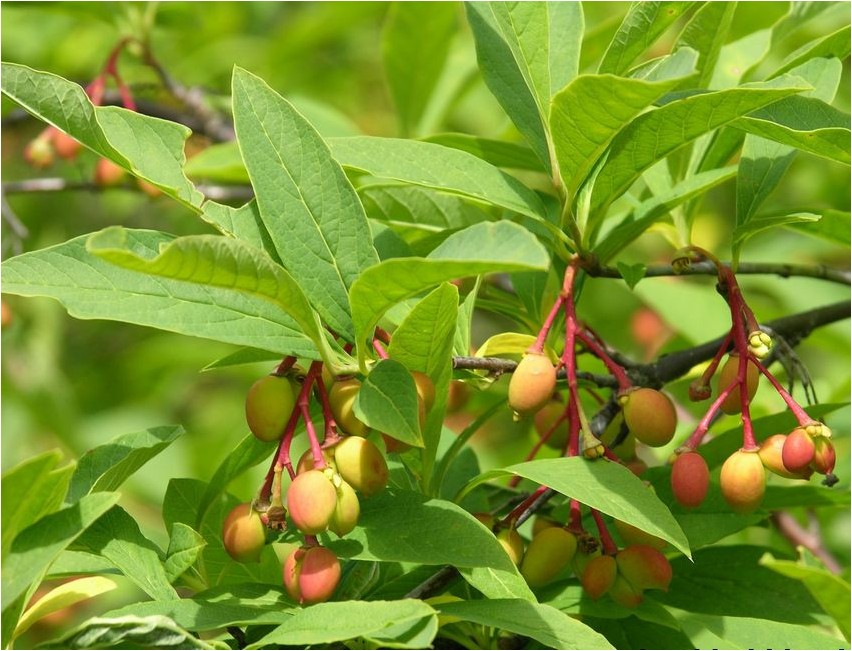
The flowers are small, inconspicuous, and white, similar in appearance to cherry blossoms. They are borne in small clusters at the ends of young branches and have a pleasant aroma. The calyx has five petals with twisted lobes. The fruit is a juicy drupe, reddish-yellow when immature, turning dark blue when ripe. It is edible, although it has a sour-bitter taste. The fruits set in July and ripen in August. They are believed to contain derivatives of hydrocyanic acid, which makes them readily eaten by birds.
Growing Conditions

Well-lit areas protected from cold winds are preferred for growing emleria. Some shade is welcome. If growing conditions are not met, plants develop poorly and sometimes die altogether. Moderately moist, fertile, loamy or sandy loam soils with a slightly alkaline or neutral pH and good drainage are preferred.
Propagation and Planting
Emleria is propagated by seeds and green cuttings. Seeds are sown in the fall under cover, and in the spring, after preliminary seed stratification for 3-4 months.
Green cuttings are taken in the summer; they do not require treatment with growth stimulants. Until rooting occurs, they are planted in greenhouses with fertile and fertilized soil. Once the cuttings have developed roots, they are transplanted to their permanent location.
Emmeria seedlings are planted in the spring, approximately in late April or early May (this depends entirely on the region”s climate). Planting holes are prepared in the fall, and organic matter is added at that time. Fertilization is postponed until spring.
Care
The most important component of caring for this plant is choosing the right growing conditions. It”s crucial to consider lighting, soil characteristics, and wind conditions. If planted in the right location, emleria will thrive without problems and require little care. Water the plants only during prolonged droughts.
Sanitary pruning is performed annually in early spring: broken, diseased, and frost-damaged branches are removed, and they are shortened to the third bud. By early summer, the shrubs recover, and any traces of damage disappear before your eyes. Formative pruning is also necessary to maintain dense foliage and a decorative crown. Uses
Emleria is rarely used in landscape design, despite the fact that it fits perfectly into almost any stylistic style. The plant looks magnificent in solitary and group plantings, and is also suitable for creating dense hedges. Planting emleria on lawns is also acceptable, especially in groups of 3-5 shrubs.
Emleria fruits are edible, although in small quantities, as they do not have a pleasant taste; they are, one might say, an acquired taste. The only contraindication for eating the fruits is individual intolerance. The bark of the plant is used to brew tea.
EMLERIA (OEMLERIA) Rosaceae family