River maple
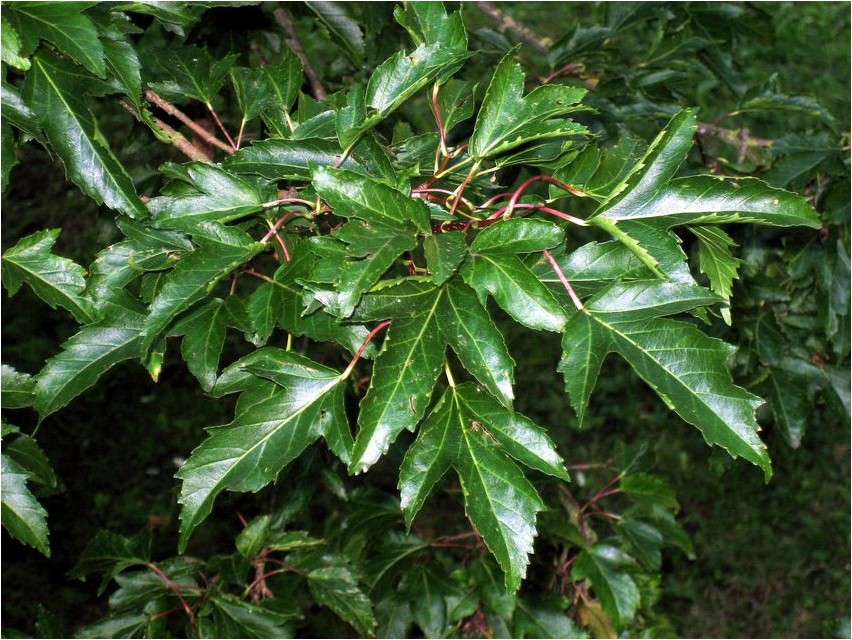
River maple is one of the plants of the family called Mapleaceae; in Latin the name of this plant will be as follows: Acer ginnala Maxim.
As for the name of the river maple family itself, in Latin it will be: Aceraceae Juss.
Description of riverine maple
River maple is a tree whose height can reach four meters, and sometimes even six meters. The diameter of such a plant will be ten to fifteen centimeters. The bark of the riverine maple is very smooth, but in older specimens it will be gray in color, sometimes it can be brown and will be fissured. The young shoots of this plant are bare. The leaves of the riverine maple are shiny, and on top they are colored yellow-green, while below they will be lighter. The leaves of this plant will be bare, or when young they may be hairy along the veins. Such leaves are three-lobed, they are endowed with a sharply protruding large lobe; their shape will be oblong-oval or oval. The length of the leaves of this plant is three to eight centimeters; they are found on growth shoots and shoots up to twelve to fourteen centimeters long. The leaf edges of this plant are unevenly serrated, and sometimes they can also be double-toothed. The flowers of this plant are in a dense and oval-corymbose-shaped panicle in the amount of about twenty to sixty pieces. Such flowers are painted in yellowish tones, their diameter will reach six millimeters. It is noteworthy that the flowers of this plant are endowed with a very noticeable smell. River maple seeds are lionfish, the length of which is approximately two to three centimeters. Such lionfish will be endowed with wings that will diverge at a very acute angle. River maple blooms in the second half of May, and the seeds will ripen in mid-September. Under natural conditions, this plant is found in the Far East. As for the general distribution, this plant is found in Korea and the northern regions of China.
For growth, the plant prefers mountain valleys, places along river banks, damp ridges and sandy-stony soil. It should be noted that riverine maple can grow either singly or in groups. It is noteworthy that this plant is a very valuable honey plant, which has the ability to flower during the most critical period.
Description of the medicinal properties of river maple
River maple is endowed with very valuable healing properties, and it is recommended to use the leaves of this plant for medicinal purposes. The presence of such valuable healing properties should be explained by the content of tannins in the bark of this plant, while the branches of river maple contain ginnalin A or the wake-up substance aceritanin, quebrachite, phenolcarboxylic and gallic acids. River maple leaves contain vitamin C, tannins, aceritanin, cyclitol polyhalite and the following phenolcarboxylic acids in the hydrolyzate: sinapic and p-coumaric. The buds and flowers of this plant contain tannins, and the seeds also contain tannins and fatty oil.
For dysentery and tonsillitis, it is recommended to use an alcoholic extract of the leaves of this plant. It should be noted that aqueous extracts from riverine maple leaves have the ability to exhibit astringent properties. Technical tannin and medicinal tannin can be obtained from the leaves. It is noteworthy that in China black paint is made from the leaves of this plant.

Actually, the medicinal properties of river maple have not yet been widely studied and therefore, perhaps, the use of medicinal products based on this plant is incomplete.





