Dieffenbachia spotted
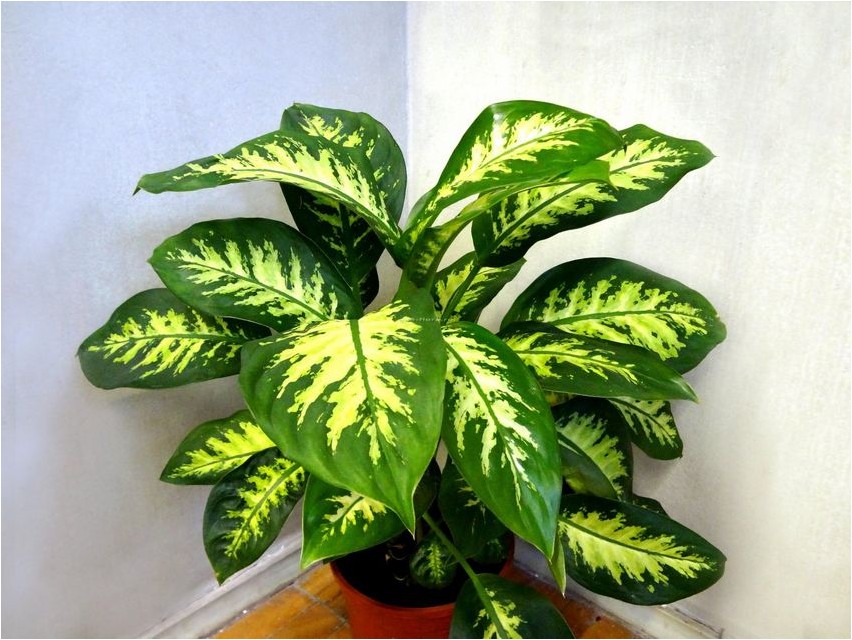
Dieffenbachia maculata is one of the plants of the family called araceae; in Latin the name of this plant is as follows: Dieffenbachia maculata.
As for the name of the family itself, in Latin it will be like this: Araceae.
Features of care and cultivation of Dieffenbachia spotted
It should be noted that two light modes are suitable for this plant: both sun and partial shade. In the summer, the plant will need to be provided with abundant watering, but the air humidity at this time should be kept at an average level. The life form of Dieffenbachia spotted is a herbaceous plant.
It should be noted that when handling the plant, it is important to exercise some caution and accuracy: this is due to the fact that the juice of Dieffenbachia spotted is poisonous. This juice can cause skin irritation, so experts recommend that all work with this plant be carried out exclusively with gloves.
Dieffenbachia spotted should be grown indoors on south-eastern windows. Also, this plant can often be found in outdoor culture, as well as as part of compositions of tropical plants, in winter gardens and even in general purpose premises. For example, this plant looks great in hallways and offices. As for the maximum regimes in culture, this plant can reach a size ranging from twenty centimeters to two and a half meters.
The plant will need to be replanted approximately once every year or two; replanting should be done in the spring and summer as the plant grows. For replanting, you should choose spacious containers, weighted with drainage, which is due to the fact that the root system of Dieffenbachia spotted is quite powerful. For replanting, it is recommended to prepare the following soil composition of the mixture: two parts of humus, leaf soil and peat to one part of sand. The acidity of such soil should be slightly acidic.

It’s important to note that if the soil is overwatered or the temperature is low, the base of the stem may rot, and the leaf edges may turn brown. If all growing standards are not followed, and as the plant matures, the lower leaves will fall off, and the stem itself will become bare. For this reason, if you want to maintain the decorative appearance of the spotted dieffenbachia, the plants should be rejuvenated. If the air humidity falls below sixty centimeters, the plant may be susceptible to spider mites.
During the entire dormant period, maintain a temperature range of between sixteen and twenty-two degrees Celsius. The plant will require moderate watering, and the air humidity should be medium. The dormant period may be forced due to low air humidity and insufficient light.
The plant can propagate throughout the year. For this purpose, you can root young shoots of the spotted dieffenbachia that form on the stem in water. Propagation can also be done by rooting stem cuttings in a mixture of peat and coarse sand; this rooting should occur at a temperature of approximately twenty to twenty-five degrees Celsius.
For successful cultivation of the spotted dieffenbachia, the plant needs to be kept at a humidity level of less than sixty percent. In addition, it also requires regular misting with soft, room-temperature water. Drying out the soil can have a severely negative impact on the plant’s development.