Babaco
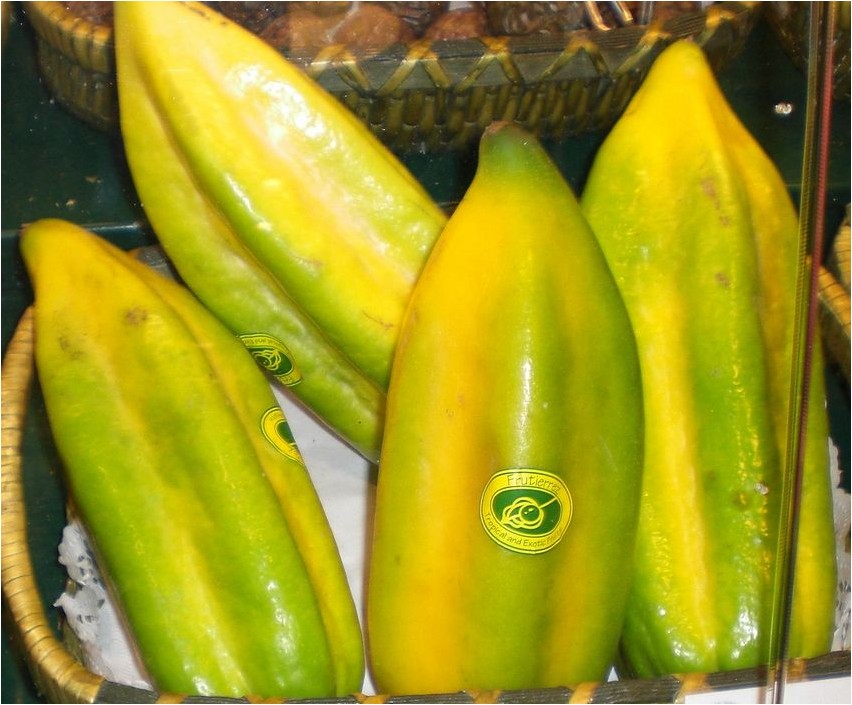
Babaco (Latin: Carica pentagona) is a fruit tree belonging to the Caricaceae family and closely related to the papaya (more precisely, it is a hybrid of two varieties).
Description
Babaco is a relatively small, weakly branched or single-stemmed tree, whose height can vary from five to eight meters. However, cultivated varieties almost never exceed two to three meters in height—this feature significantly simplifies harvesting. The cylindrical trunk of the babaco never fully woody—the trunks of young trees are always green, while mature trees boast spectacular grayish-brown trunks.
The palmately lobed leaves of the babaco extend directly from the trunks, attached to them by fairly long petioles. At the tops, they form whimsical and incredibly striking umbels. Babaco”s solitary flowers, with graceful white corollas, form in the leaf axils throughout the year. The sepals can range in color from dark green to yellowish-green. Unlike papaya, this plant produces exclusively female flowers, which are pollinated by certain papaya varieties.
Babaco fruits resemble unripe melons, and these striking S-shaped fruits often reach up to thirty centimeters in length. A single fruit can easily weigh up to two kilograms, and a single tree can produce between twenty and sixty fruits per season.
Babaco is renowned for its excellent flavor, for which it is cultivated. Incidentally, the flavor of these fruits is significantly different from that of papaya—it”s reminiscent of a combination of oranges, kiwis, pineapples, and strawberries. Where it grows
The main habitat for babaco is currently the Ecuadorian mountain valleys—it was first cultivated there several thousand years ago, long before the arrival of the conquistadors. Small plantings of this plant have long been found in distant New Zealand and picturesque Australia. However, babaco has only recently been cultivated in Peru, Italy, Greece, Brazil, and Spain. It is also cultivated in Israel, but there it only thrives in greenhouses.

Applications
Babaco produces excellent juice, and its delicate pulp is a valuable raw material for preparing all kinds of desserts. These fruits are also used to make wonderful preserves, delicious jellies and jams, rich syrups and excellent yoghurts. However, they are no less good in ice cream. These fruits can also be used as a side dish for any meat dish.
Just like all other plants of the Papaya genus, this crop boasts a fairly impressive papain content. This enzyme is often called plant pepsin — because it actively promotes the absorption of protein (from seafood, fish or meat) and for its ability to stimulate digestion. This substance works equally well both in the acidic environment of the stomach and in the alkaline and neutral environments of both the small and large intestines. This is an indispensable assistant for almost any digestive problem (especially enterocolitis and colitis)!
Babaco fruits are also recommended for consumption by people suffering from anemia (they contain a lot of iron), various cardiovascular ailments or diseases of the musculoskeletal system. They are also necessary for strengthening teeth and are an excellent tonic.
Contraindications
When consuming babaco, it makes sense to focus only on its individual intolerance.
Growing and care
Babaco is a fairly hardy crop that can grow at an altitude of up to two thousand meters above sea level. It is very resistant to the slightest fluctuations in both air humidity and temperature, which distinguishes it favorably from papaya, which begins to shed its leaves when the thermometer drops below twenty-eight degrees Celsius.
Mikhail Babako
Babaco babaco