Yellow mignonette
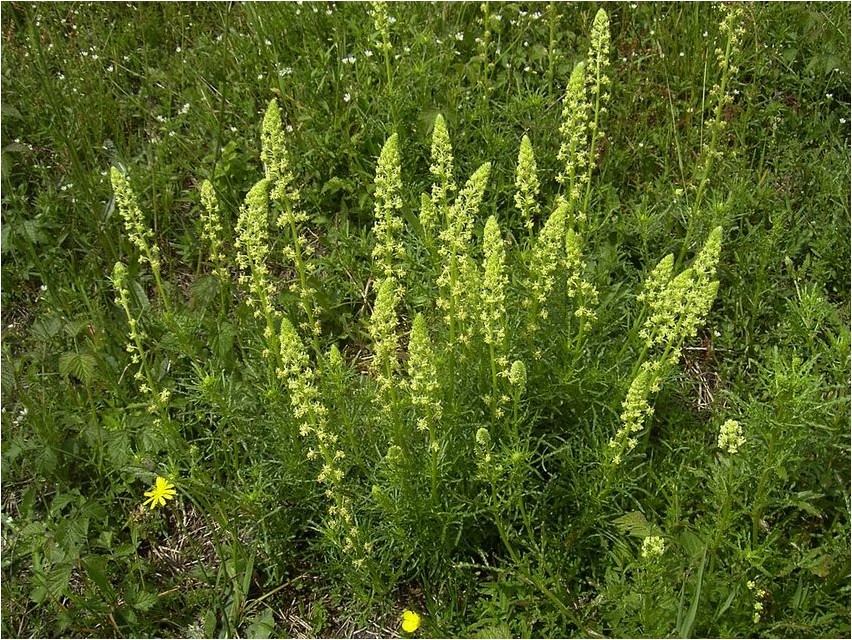
Yellow mignonette is one of the plants of the family called mignonette, in Latin the name of this plant will be as follows: Reseda lutea L.
As for the name of the yellow mignonette family itself, in Latin it will be: Resedaceae S. F. Gray.
Description of yellow mignonette
Yellow mignonette is an annual herbaceous plant whose height will vary between thirty and fifty centimeters. The stem of such a plant is prostrate and endowed with ascending branches. Yellow mignonette leaves will be alternate, rough at the edges, and the middle stem leaves will be bipartite and the upper leaves will be tripartite. The flowers of this plant are collected in long racemes, and they are painted in greenish-yellow tones. There are only six sepals and petals, while the sepals of this plant are almost linear, and the upper petals will be separate. There are only ten to twenty-four stamens of yellow mignonette, they are attached to the subpistil stalk, which on the upper side expands into a glandular disk, and there are three to four columns. The fruit of the yellow mignonette is a triangular oblong capsule, which is upright and three-lobed.
Yellow mignonette blooms in the summer. Under natural conditions, this plant is found in the Caucasus, the Gorno-Turkmen region of Central Asia, the Verkhnetobolsk region of Western Siberia, Belarus, Crimea, Ukraine, as well as the following regions of the European part of Russia: Lower Don, Volga-Don and Black Sea. As for the general distribution, this plant is found in North Africa, the Balkan Peninsula, Asia Minor, Iran, Central and Southern Europe. For growth, yellow mignonette prefers crops, garbage areas, dry hill and mountain slopes, fields, clay and sandy soil.
Description of the medicinal properties of yellow mignonette
Yellow mignonette is endowed with very valuable healing properties, and it is recommended to use the roots and herbs of this plant for medicinal purposes. The term grass includes flowers, stems and leaves. The stems and leaves of this plant should be harvested from May to September, while the roots are harvested in spring and autumn.
The presence of such valuable medicinal properties is believed to be attributed to the alkaloids benziteenevol and isothiocyanate found in the roots of yellow mignonette, while the herb contains nitrogen-containing compounds and alkaloids. The leaves of this plant contain flavonoids, carotene, vitamin C, and phenolic carboxylic acids, and flavonoids are also found in the inflorescences of this plant. Yellow mignonette seeds contain fatty oil, tannins, alkaloids, the flavonoid luteolin, and the glycosides glucocapparin and glucobarbarin.

It should be noted that the glucobarbarin glucoside has antithyroid properties. This plant is widely used in folk medicine. An infusion made from the leaves and herb of yellow mignonette is used as a highly effective diuretic and diaphoretic. An infusion made from the fresh roots of this plant is recommended as an anthelmintic. This remedy is also used for various heart conditions. Interestingly, yellow mignonette flowers have the ability to dye silk yellow. Furthermore, the fatty oil of this plant is very suitable for making various paints and varnishes.
Fragrant mignonette





