Luffa
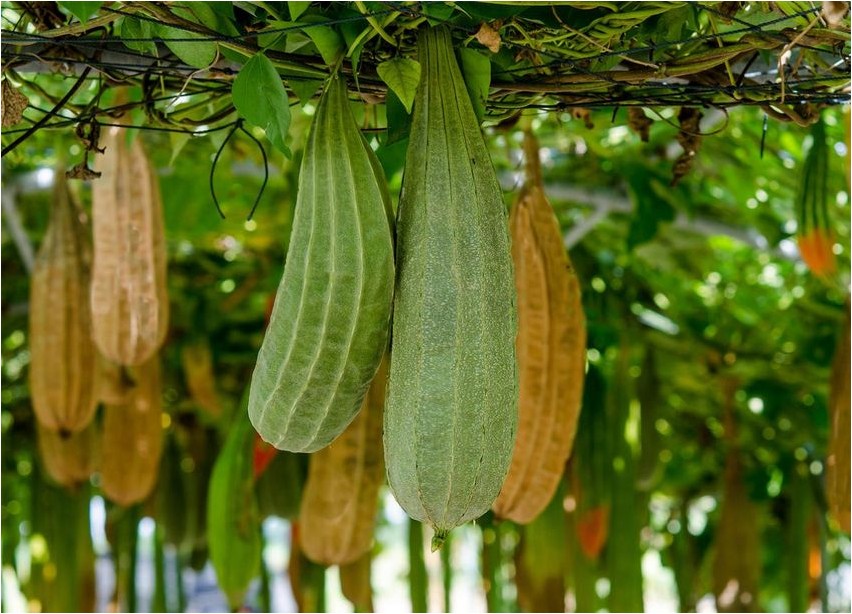
Luffa (lat. Luffa) is a genus of herbaceous vine-like plants of the Cucurbitaceae family. Another name is loofah gourd. In nature, luffa is found in tropical and subtropical regions of Africa and Asia.
Currently, more than 50 species have been identified.
Characteristics of culture
Luffa is an annual plant cultivated primarily to produce a plant sponge (loofah). Only young, underdeveloped fruits are eaten. Of all the existing species, only two have become widespread in culture: the sharp-toothed luffa (lat. Luffa acutangula) and the cylindrical luffa (lat. Luffa cylindrica). The remaining species produce too small fruits, which prevents their cultivation as food and technical products. Luffa flowers are large, white or yellow, female and male flowers develop in the axils of the same leaves, only male flowers are collected in racemose inflorescences.
The leaves are entire, five or seven-lobed. The fruits are cylindrical, elongated, fibrous and dry inside, containing a large number of seeds. Cylindrical luffa has larger fruits than sharp-toothed luffa, but the second type is distinguished by its rapid growth and cold-resistant properties. Luffa blooms from July to September. In the middle zone, 7-12 fruits are harvested from one plant. The weight of one fruit varies from 0. 2 to 3 kg. As the luffa fruits ripen, they dry out from the inside, and the weight decreases accordingly.
Growing conditions

Luffa is a heat-loving and delicate crop; it prefers well-warmed areas, illuminated throughout the day, protected from northern winds. Soils are desirable loose, rich in nutrients. In its mature state, luffa does not tolerate temperatures below 10C; as a result of their action, the fruits are affected by anthracnose and become unsuitable for use.
Soil preparation and sowing
In the southern regions, luffa is grown by sowing seeds in open ground, in the northern regions – through seedlings. The ridges are prepared in the fall: the soil is dug up, manure (5-6 kg per 1 sq. m), nitrogen (20-40 g), phosphorus (40-60 g) and potassium fertilizers (20-30 g) are applied. Seeds for seedlings are sown at the end of April. The seeds are first subjected to pre-sowing treatment: they are kept in water for three days. Shoots appear on the 5-6th day. Seedlings are planted in the ground after the threat of frost has passed. Planting pattern 1*1 or 1*1. 5 m.
Care
Since luffa forms very long lashes (up to 5-6 m), they are hung on trellises or chain-link mesh. You can also use several pegs and a strong wire stretched between them for support. Luffa should not be tied to trees, since when it comes into contact with branches, its young ovaries are injured and subsequently rot altogether. An important step in luffa care is watering. It is necessary to monitor the soil moisture; under no circumstances should it be allowed to dry out.
During the period of active growth, the crop responds positively to the application of fertilizers. During the season, 5-6 fertilizing with liquid mineral fertilizers is carried out. Two weeks after planting the seedlings in the ground, the plants are fed with an ammophos solution; in the future, a urea solution can be used. By the end of the growing season, the application of any complex fertilizer is not prohibited.
At the initial stage of growth, the main stem is pinched above the 4-5 leaf; this procedure causes active growth of side shoots. Late-set fruits are removed so that the plant can devote all its energy to the growth of other more developed fruits. As soon as the shell of the fruit turns yellow, it is removed. The shell and seeds of the fruit are removed, the “skeleton” of hard fibers is washed and dried. Thus, a washcloth is obtained.
Application
Not so long ago, luffa was used to make bath sponges, but modern polymer materials have replaced it. And this is despite the fact that luffa helps cleanse the skin and massage the muscles of the body. Technical parts were also made from luffa: air and fuel filters, seals for various mechanisms, etc. Luffa is used in cooking and folk medicine. The fruits are used to season soups and are often served as an independent dish, or rather, as a side dish for meat. The juice from luffa stems is used as a cosmetic to help get rid of conjunctivitis.





