Caustic sedum
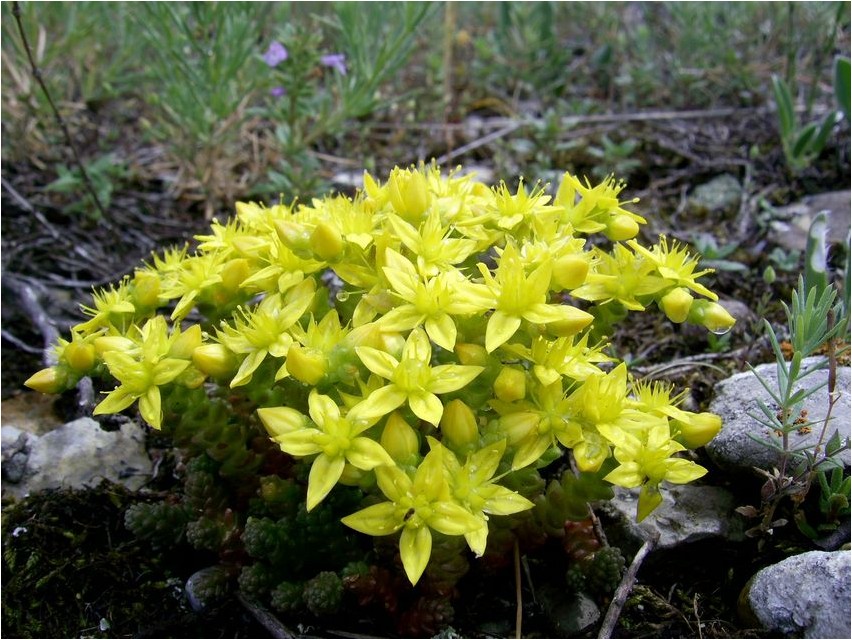
Sedum sedum is one of the plants of the family called Crassulaceae; in Latin the name of this plant will be as follows: Sedum acre L.
As for the name of the sedum family itself, in Latin it will be: Crassulaceae DC.
Description of sedum
Sedum is a perennial herbaceous plant whose height will vary between five and fifteen centimeters. Such a plant will be endowed with a thin creeping rhizome and quite numerous ascending stems. The stems of sedum will be covered with rather small, thick leaves. The leaves of this plant will be fleshy, imbricated, alternate, rounded or ovate, and at the base such leaves are thickened. The inflorescences of sedum consist of shortened branches, which will be endowed with almost sessile flowers. The flowers of this plant are endowed with sharp petals, they are painted in yellow tones and are collected in spreading inflorescences.
This plant blooms from June to September. Under natural conditions, this plant is found in Western Siberia, Belarus, the Caucasus, Ukraine and the European part of Russia. For growth, sedum prefers dry slopes, sandy places, clearings and rocky calcareous soils. It should be noted that the juice of fresh grass of this plant is very poisonous.
Description of the medicinal properties of sedum
Sedum is endowed with very valuable healing properties, and it is recommended to use the herb of this plant for medicinal purposes. Such healing raw materials should be harvested throughout the entire flowering period of this plant. Such raw materials should be dried in the shade in the air or in dryers. In addition, quite often it is acceptable to use the juice of fresh grass of this plant.
The presence of such valuable healing properties is recommended to be explained by the content of the herb of this plant of sugar, little-studied glycosides, alkaloids nicotine, sedinine, isopelthyrine and sedamine, as well as the following organic acids: malic, oxalic, lactic and succinic. The flowers and leaves, in turn, will contain vitamin C.

It should be noted that through experimental studies it has been proven that the herb of this plant can have a stimulating effect on the respiration, will tone and excite the intestines, and also increase blood pressure and relax the uterine muscles.
Preparations based on this plant can be used as a diuretic and analgesic for irritation of the rectal mucosa and hemorrhoids, and is also used for hyperkeratosis and infectious hepatitis. The juice of the sedum herb should be used to lubricate purulent ulcers, calluses, warts and age spots.
As for traditional medicine, here this plant is quite widespread. Sedum is recommended for use against malaria and epilepsy, and also as a laxative and emetic. Externally, this plant is used to treat burns and wounds. It is recommended to use caustic sedum internally for childhood eczema, diathesis, and various diseases of the liver, stomach and heart. It is permissible to bathe small children in an infusion prepared from the herb sedum.
In addition, this infusion of the herb of this plant is used for atherosclerosis, scurvy and epilepsy. It is used externally in the form of poultices for various neoplasms, as well as for lotions for skin diseases that will be accompanied by painful itching. It should be noted that this remedy turns out to be very effective.





