Yew
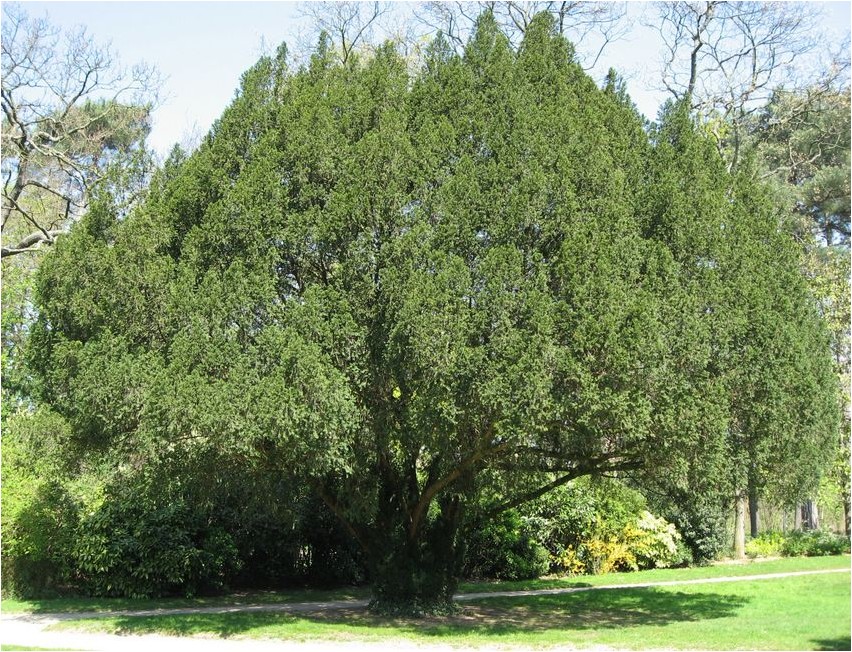
Yew (lat. Taxus) is a genus of coniferous evergreen shrubs and trees of the Yew family. In nature, yews are found in the coniferous forests of the Caucasus and Europe. Only seven species grow under natural conditions.
Characteristics
Yew is a shrub or tree with a dense crown, a smooth trunk when young and a longitudinally furrowed and whorled arrangement of branches when mature. The bark of most members of the genus is reddish-brown or reddish. The needles are arranged spirally, directed upward; on horizontal shoots the needles are two-row, linear, almost comb-shaped, often crescent-shaped. On the outside of the needles there is a longitudinal vein, on the inside there are two grayish or yellowish-green stomatal stripes. There are no resin channels in the needles.
The cones are male, spherical, sit on short stalks, and are covered with scales over the entire surface. Since yews are gymnosperm plants, they do not produce flowers and, accordingly, fruits. The mature seed is oval-ovoid, surrounded by a peculiar glass-shaped roof that does not grow together with it. The seeds and all parts of the plant contain toxins, making them extremely poisonous. Yews are characterized by slow growth, but the average age of plants is 1500-2000 years. There are specimens that live up to 3500-4000 years.
Growing conditions
Yews prefer moist, nutritious, slightly alkaline or neutral soils. Limestone is not prohibited. The groundwater level is at least 1. 5 m. All species put forward their own requirements for growing conditions, for example, pointed yew develops best on loamy and slightly podzolized soils, berry yew — on slightly acidic, non-marsh soils.
Most representatives of the genus have a negative attitude towards waterlogged soils; plants are especially negative towards the presence of toxic substances and heavy metals in the soil. Saline soils have a detrimental effect on the quality of needles; they become yellow in color. If we talk about location, then in this regard yews are unpretentious. They can develop normally in both sunny and heavily shaded areas.
Landing

The yew takes root within three months. Planting material is planted in cold greenhouses or open ground. The period for growing yew by planting cuttings is 6-7 years. Planting holes are prepared in advance; one third of them are filled with a special soil mixture consisting of peat, sand and turf soil in a ratio of 2:2:3.
During planting, add 50-70 g of nitroammophoska or 100 g of Kemira-Universal fertilizer. Drainage is also essential; a 10 cm layer of broken brick or gravel can be used. After planting, water the soil around the trunk and mulch with sawdust, pine needles, or peat.
Care
Yew care involves infrequent watering (once a month, 9-10 liters per tree) and regular sprinkling (at least once every two weeks). Loosening and weeding the area around the trunk is also necessary. Ideally, loosening the soil to a depth of 10-15 cm. Yew responds well to pruning and trimming, and the crown can be shaped into any desired shape. For the winter, the trunk area of young plants is covered with a 5-7 cm layer of peat or humus, and the plants themselves are covered with kraft paper or spruce branches. These materials will protect the plants from sunburn. Fertilizers are applied annually. Nitrophoska, complex mineral fertilizers, and Florovit are ideal for this purpose.
Yew