Stapelia
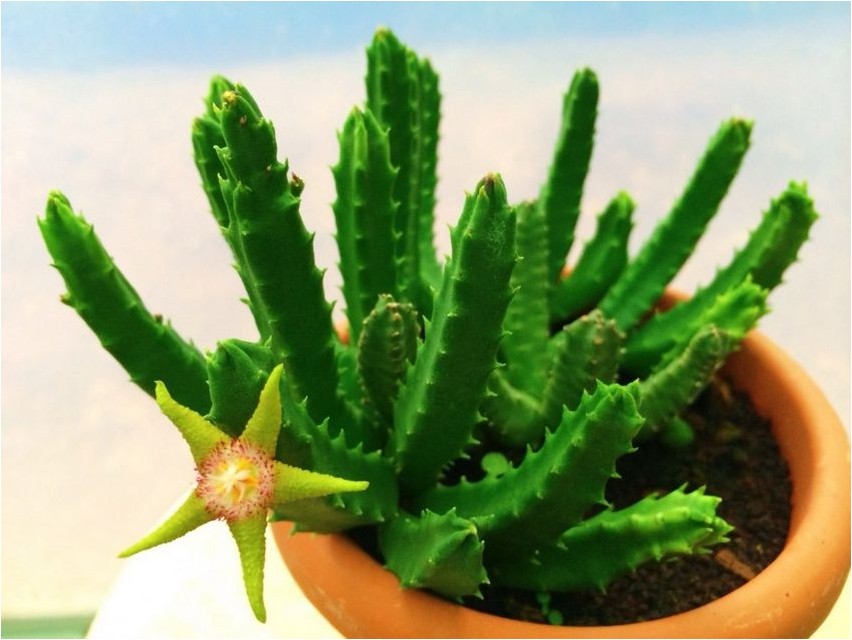
Stapelia (lat. Stapelia) is a perennial succulent plant of the Lastovnevye family. Under natural conditions, slipway is found on mountain slopes and near bodies of water in South and South-West Africa.
Characteristics of culture
Stapelia is a low-growing plant with numerous, succulent, tetrahedral stems branching at the base. The stems are green, less often with a reddish-violet tint, with protruding and non-prickly teeth along the edges, the side shoots are creeping. There are no leaves, in some ways the slipways are close to cacti.
The flowers are paired or single, reaching 0. 5-30 cm in diameter, located on bent pedicels that extend from the base of young shoots. The corolla is five-rayed or broadly bell-shaped, the crown is convex, rising above the petals.
Despite the aesthetic appearance of the flowers, they have a rather unpleasant smell of rot, and this does not bother modern gardeners at all, since the plant has been very popular for many years.
Growing conditions

Stapelia is a light-loving plant, prefers bright, diffused lighting, and tolerates direct sunlight only in cold autumn and winter, so the crop should be placed on window sills facing east or west.
In spring and summer, the optimal growing temperature is 22-26C, in autumn and winter – 14-15C. The crop is neutral to air humidity and tolerates both dry and waterlogged air.
The soil for slipways requires sandy soil with a pH of 5. 5-7. A mixture consisting of turf soil and washed coarse sand (2:1) is ideal for the culture. You can add charcoal to the substrate.
Reproduction, planting, transplanting
Slipways are propagated by seeds and cuttings. Plant seeds set quickly, but ripen within a year. Sowing is done in low containers filled with light sandy soil. As a rule, seeds sprout within 3-4 weeks. Strong seedlings dive into pots 5-6 cm high. After about 9-12 months, the plants are transplanted into pots 9-10 cm high. Important: slipways are prone to crossing, so the resulting plants may differ from the parent ones.
Vegetative propagation is carried out by cuttings from old shoots. Before planting, the cuttings are planted in a soil substrate consisting of soil, peat chips and sand. The cuttings take root quickly enough, after which they are transplanted into pots 7-8 cm high.
Plants are replanted in the spring, young slipways – once a year, adults – once every 2-3 years. In adult specimens, the old shoots that are located in the center are removed, as they will no longer bloom. The root system of slipways is poorly developed, so planting is carried out in shallow pots.
Care
In spring and summer, slipways need moderate watering, only as the top layer of soil substrate dries out. In autumn, watering is reduced, and in winter it is limited as much as possible, preventing shoots from shrinking.
Slipways are fertilized only in spring and summer every two weeks. The crop is especially in dire need of fertilizing with potassium fertilizers, thanks to which the plants’ resistance to diseases is significantly enhanced.
Common types
*Star-shaped Stapelia (lat. Stapelia asterias Masson) – the species is represented by low-growing succulent plants up to 20 cm high. The shoots are green, less often reddish, with small teeth and blunt edges. The flowers are brown-red, located on long stalks. The corolla is flat, reaches 5-8 cm in diameter, the petals are pointed, covered with white hairs, triangular in shape, bent at the edges.
*Stapelia variegata (lat. Stapelia variegata) – the species is represented by low-growing plants 5-10 cm high. The shoots are green, with a reddish tint, blunt edges with erect teeth. The flowers are light yellow, the corolla is flat, reaches 5-8 cm in diameter. The petals are ovoid or triangular, pointed, smooth on the outside, slightly wrinkled on the inside. Flowering occurs in summer, immediately after flowering fruits with seeds are formed.
*Giant Stapelia (lat. Stapelia gigantea) – the species is represented by perennial plants with strong, erect shoots up to 20 cm tall. The flowers are light yellow with numerous red hairs, located on long stalks of 1-2 pieces. The corolla is large, flat, dissected, reaching 25-35 cm in diameter. The petals are triangular in shape, pointed at the ends, bent down at the edges.