Scotch Ligusticum
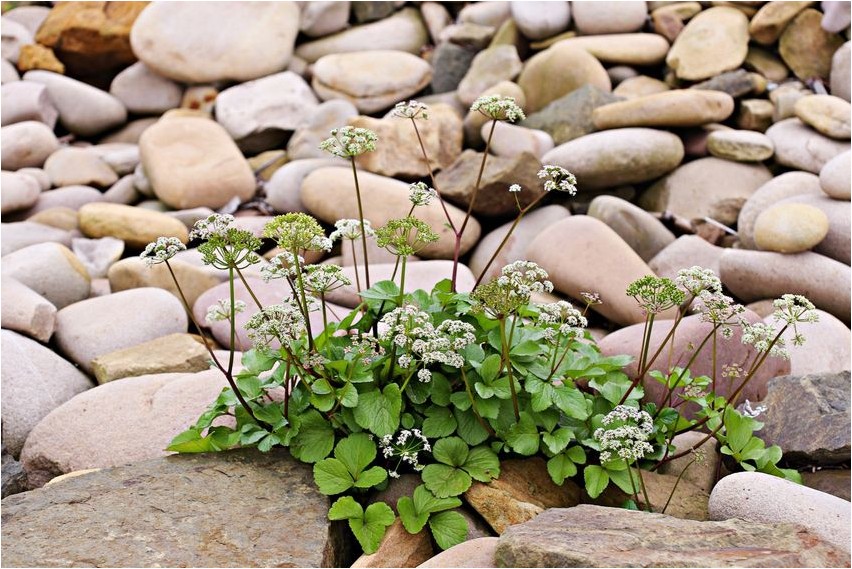
Scotch Ligusticum is a member of the Apiaceae family. Its Latin name is Ligusticum scoticum L. (L. hultenii Tern.).
The family name of Scotch Ligusticum itself is Apiaceae Lindl. (Umbelliforae Juss.).
Description of Scotch Ligusticum
Scotch Ligusticum is a perennial herbaceous plant, reaching a height of between fifteen and seventy centimeters. The stem is branched at the top, and is also glabrous and finely ribbed. Scotch Ligusticum’s leaves have long petioles, and the leaf blade itself is twice tripartite. The umbels of this plant are seven to eleven-rayed, with rays of unequal length, and are approximately four to ten millimeters in diameter. During flowering, the Scotch lily’s umbels are flattened at the top, and the petals are white. The fruits of this plant are approximately six and a half to eight and a half millimeters long and two and a half to four millimeters wide.
Scotch lily blooms in July. In the wild, this plant is found throughout the Far East, with the exception of the Amur region, as well as in the following regions of European Russia: the Dvina-Pechora, Karelo-Murmansk, and the European Arctic. This plant prefers coastal meadows, cliff foothills, pebbly areas, and sandy-clayey seashores.
Description of the medicinal properties of Scotch lily
Scotch lily is endowed with very valuable medicinal properties, and the herb and roots of this plant are recommended for medicinal purposes. The presence of such valuable medicinal properties can be attributed to the presence of polyacetylene compounds, phenol, myristic and crocatone derivatives, 3-methoxy-4, 5-methylenedioxycinnamic acid, and coumarins in the roots of this plant. The leaves also contain coumarins and the flavonoid luteolin, while the fruits contain essential oil and coumarins.
A decoction prepared from the roots of Ligusticum scotch is recommended for use as an analgesic and lactogenic agent, and is also used for paralysis and asthenia. The infusion can also relieve headaches. The herb powder of this plant is used for dizziness and anemia three times a day, one gram. It should be noted that coumarins from Ligusticum scotch are endowed with antitumor activity. It is noteworthy that in Scotland and Kamchatka this plant is even eaten.

To prepare a very effective remedy based on this plant, you will need to take ten grams of crushed dry roots of Ligusticum Scotch per two hundred milliliters of water. The resulting mixture should be boiled over fairly low heat for about six to eight minutes, and then this mixture should be infused for at least two hours, after which this healing agent is very carefully filtered and topped up with boiled water up to the original amount. The resulting healing agent based on this plant is taken three times a day, one third of a glass.
For headaches, the following remedy is effective: to prepare such a remedy, you will need to take twelve grams of crushed dry roots of this plant per two hundred milliliters of boiling water. This mixture is infused for two to three hours and carefully filtered, and the resulting healing remedy is taken before meals, two to three tablespoons two to three times a day.





