Sedum tenacious
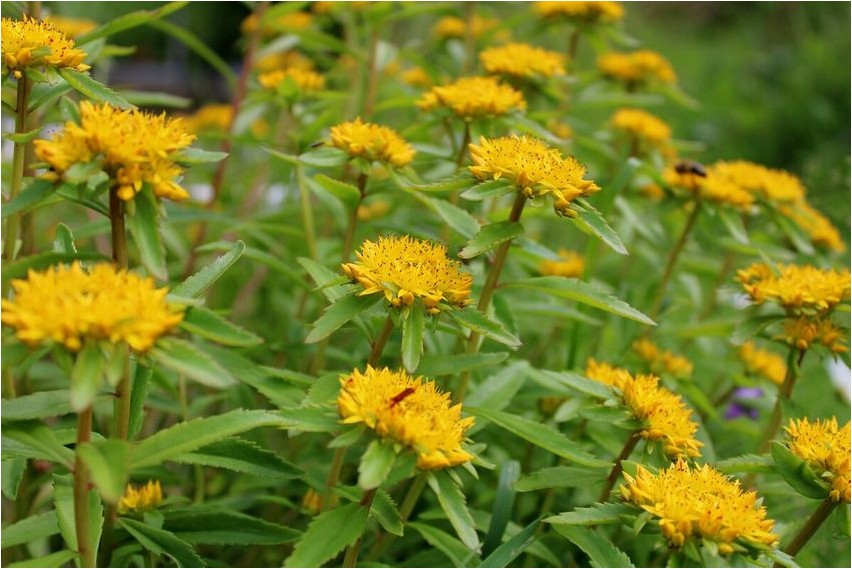
Sedum tenacious is one of the plants of the family called Crassulaceae; in Latin the name of this plant will be as follows: Sedum aizoon L.
As for the name of the tenacious sedum family itself, in Latin it will be: Crassulaceae DC.
Description of sedum tenacious
Sedum tenacious is a perennial herbaceous plant, the height of which will fluctuate between twenty-five and forty-five centimeters. The rhizome of this plant is short and thick. The stems of this plant will be strong and straight, the leaves are oblong-rhombic in shape, and they will be finely serrated along the edges. The flowers of this plant are yellow in color. Under natural conditions, the tenacious sedum is found in all regions of the Far East, Western and Eastern Siberia. For growth, this plant prefers dry meadows, dry grassy slopes, edges of pine forests, places among bushes, rocky, sandy and coastal cliffs. It is noteworthy that this plant is also poisonous.
Description of the medicinal properties of sedum tenacious
Sedum is endowed with very valuable healing properties, and it is recommended to use the grass and roots of this plant for medicinal purposes. The term grass includes flowers, stems and leaves.
The presence of such valuable healing properties is recommended to be explained by the content of tannins, anthraquinones, phenols and their derivatives, oleanoic acid, beta-sitosterol, as well as the following carbohydrates in the roots of this plant: sucrose, glucose and fructose. The aerial part of this plant, in turn, will contain alkaloids, glucose, fructose, sucrose, essential oil, gallic acid, flavonoids, tannins, coumarins, vitamin C and the following organic acids: malic, oxalic and citric.
It is noteworthy that the experiment proved that the aqueous extract of this plant will have antipyretic and anticonvulsant effects, and will also inhibit the development of leukocytosis. This extract is endowed with hypotensive, tranquilizing and detoxifying properties.

As for traditional medicine, here this plant is very widespread. A decoction prepared from the roots of sedum tenacious is recommended for use for diarrhea, dysentery and septicopyemia, as well as diseases of the blood vessels. This product is also antiseptic, hemostatic, antipyretic and antibacterial.
An infusion and decoction prepared from the herb sedum tenacious should be used for anorexia, pulmonary tuberculosis, hepatitis, pneumonia and various kidney diseases. Also, such products are used as wound healing agents. Externally, an infusion and decoction of the herb of this plant is used for bruises and arthralgia in the form of baths and poultices with water and milk.
It should be noted that the juice of this plant is endowed with very extensive antiviral activity. Fresh leaves of sedum tenacious should be used as a very effective wound healing agent, and is also used for ulcers, wounds and calluses. In addition, the experiment proved that an infusion based on the leaves of this plant will have the ability to increase the tone and amplitude of contractions of the intestines and isolated heart, and will also help to slow down the rhythm of contractions. For diarrhea, take a teaspoon of crushed dry herbs of this plant in a glass of boiling water. This mixture is infused for one hour and then filtered very carefully. Take this remedy three times a day, one tablespoon.





