Prinsepia
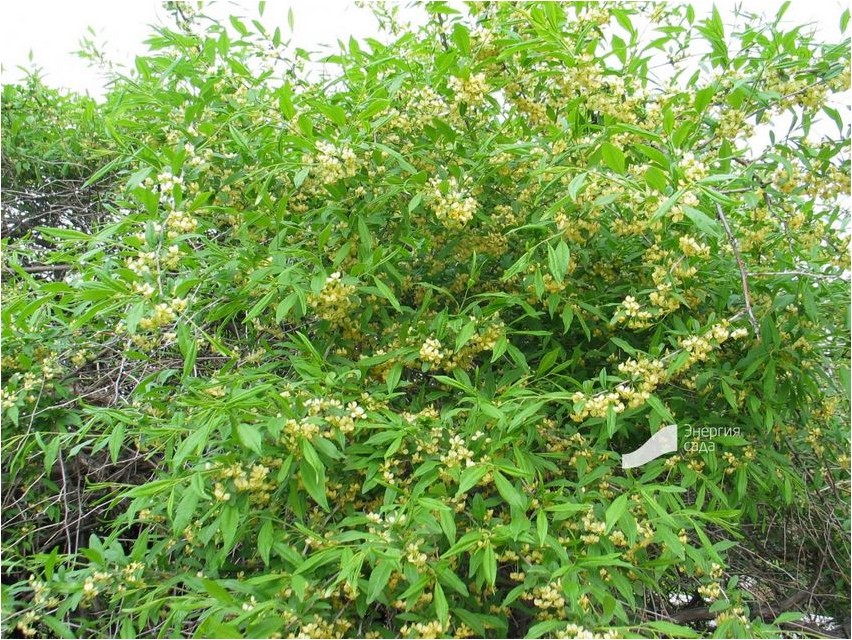
Prinsepia (Latin: Prinsepia) is a genus of ornamental and fruit-bearing shrubs in the Rosaceae family. The genus is named after James Prinsep, Secretary of the Asiatic Society of Bengal.
The genus includes three species, native to the Himalayas, China, Mongolia, and the Far East. Currently, prinsepia is widely cultivated in South and North America and Europe.
Cultivation Characteristics
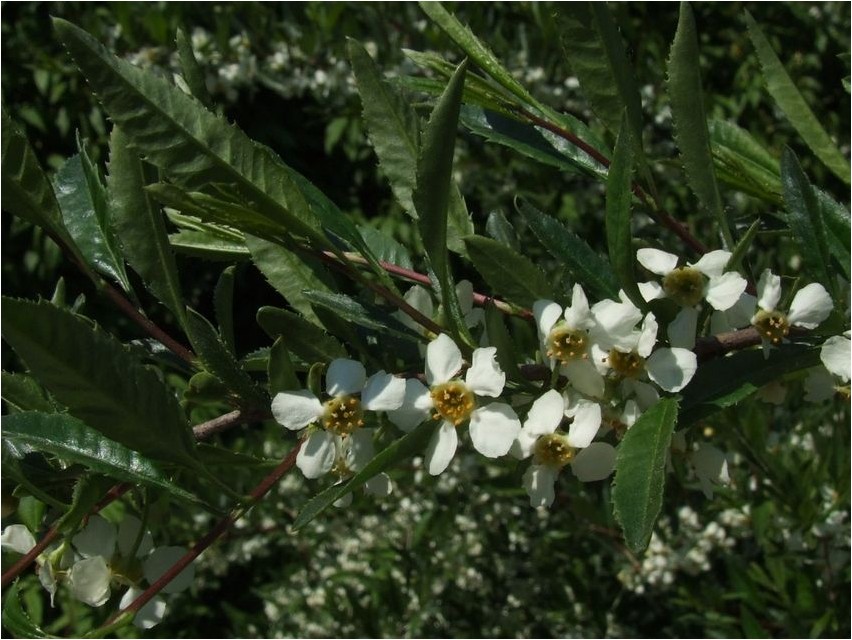
Prinsepia is a deciduous shrub with spines arranged in clusters above the leaves. The bark of prinsepia is rough and flaky. The branches are light gray or greenish-gray. The leaves are simple, matte, green, membranous or leathery, alternate, with a smooth or slightly serrated edge. In autumn, the foliage turns yellowish-brown. The stipules are small, sometimes absent. The bisexual, fragrant flowers are gathered in racemes of 1-13 flowers, located at the ends of two-year-old shoots. The calyx is five-partite, the lobes are broad, short, and often unequal. The corolla is five-petaled; the petals are white or light yellow, free, equal, and rounded.
The fruit is a juicy drupe, reaching 1. 3-1. 8 cm in diameter, containing a single elliptical seed. The fruits are edible, and the seeds are also used in cooking and folk medicine. The fruits ripen in August. The flesh has a slightly tart flavor, somewhat similar to cherries. The average lifespan is 40-50 years. Princepia is highly frost-resistant, but in severe winters, the tips of one-year-old shoots may freeze.
Growing Conditions

Princepia is demanding in terms of growing conditions. Fresh, loose, light, fertile, well-drained, and moderately moist soils are preferred. A sunny location is preferred; light shade is acceptable. In open, sunny areas, prinsepia blooms more profusely, and the fruit is juicier and tastier.
Propagation and Planting
Prinsepia is propagated by seeds, layering, and green cuttings. Freshly harvested seeds are sown. Germination rates are approximately 85-90%. Spring sowing is also acceptable, but the seeds must undergo preliminary cold stratification for approximately 3-4 months at 2-3°C (47-33°F).
Propagation by green cuttings is equally effective, although the rooting rate is only 50-60%. To increase the yield, the cuttings should be treated with growth stimulants, such as Heteroauxin or Kornevin.
Propagation by layering is the simplest method, often used by gardeners in their personal plots. Healthy and strong shoots are bent to the ground, placed in grooves, pinned with wooden brackets, minor cuts are made, covered with soil and watered abundantly.
Rooted cuttings are separated from the mother bush next spring and planted in a greenhouse or any container for growing. Young plants obtained using this method are planted in a permanent place after 2 years. Planting of seedlings purchased from specialized nurseries is carried out in April-May, but planting holes are prepared in advance. The distance between plants should be at least 2 m.
Care
Even a novice gardener can take care of the prinsea. It consists of regular loosening and weeding of the tree trunk area, rare and abundant watering, fertilizing and, of course, pruning. It is important to systematically carry out thinning pruning, which boils down to removing old and thickening branches. Sanitary pruning is carried out in the spring before the onset of sap flow. Prinsepia are fed twice per season — in spring and autumn. You can additionally feed the plants immediately after flowering.
Usage
Prinsepia is used as an ornamental and fruit crop. It looks great in group and single plantings. Prinsepia is suitable for creating hedges and securing slopes.
Chinese prinsepia (Prinsepia sinensis) in the Southern Urals
Propagation by layering is the simplest method, often used by gardeners in their personal plots. Healthy and strong shoots are bent to the ground, placed in grooves, pinned with wooden brackets, minor cuts are made, covered with soil and watered abundantly.
Prinsepia
Prinsepia (Latin: Prinsepia) is a genus of ornamental and fruit-bearing shrubs in the Rosaceae family. The genus is named after James Prinsep, Secretary of the Asiatic Society of Bengal.
The genus includes three species, native to the Himalayas, China, Mongolia, and the Far East. Currently, prinsepia is widely cultivated in South and North America and Europe.
Cultivation Characteristics
Prinsepia is a deciduous shrub with spines arranged in clusters above the leaves. The bark of prinsepia is rough and flaky. The branches are light gray or greenish-gray. The leaves are simple, matte, green, membranous or leathery, alternate, with a smooth or slightly serrated edge. In autumn, the foliage turns yellowish-brown. The stipules are small, sometimes absent. The bisexual, fragrant flowers are gathered in racemes of 1-13 flowers, located at the ends of two-year-old shoots. The calyx is five-partite, the lobes are broad, short, and often unequal. The corolla is five-petaled; the petals are white or light yellow, free, equal, and rounded.
The fruit is a juicy drupe, reaching 1. 3-1. 8 cm in diameter, containing a single elliptical seed. The fruits are edible, and the seeds are also used in cooking and folk medicine. The fruits ripen in August. The flesh has a slightly tart flavor, somewhat similar to cherries. The average lifespan is 40-50 years. Princepia is highly frost-resistant, but in severe winters, the tips of one-year-old shoots may freeze.
Growing Conditions
Princepia is demanding in terms of growing conditions. Fresh, loose, light, fertile, well-drained, and moderately moist soils are preferred. A sunny location is preferred; light shade is acceptable. In open, sunny areas, prinsepia blooms more profusely, and the fruit is juicier and tastier.
Propagation and Planting
Prinsepia is propagated by seeds, layering, and green cuttings. Freshly harvested seeds are sown. Germination rates are approximately 85-90%. Spring sowing is also acceptable, but the seeds must undergo preliminary cold stratification for approximately 3-4 months at 2-3°C (47-33°F).
Propagation by green cuttings is equally effective, although the rooting rate is only 50-60%. To increase the yield, the cuttings should be treated with growth stimulants, such as Heteroauxin or Kornevin.
Propagation by layering is the simplest method, often used by gardeners in their personal plots. Healthy and strong shoots are bent to the ground, placed in grooves, pinned with wooden brackets, minor cuts are made, covered with soil and watered abundantly.
Rooted cuttings are separated from the mother bush next spring and planted in a greenhouse or any container for growing. Young plants obtained using this method are planted in a permanent place after 2 years. Planting of seedlings purchased from specialized nurseries is carried out in April-May, but planting holes are prepared in advance. The distance between plants should be at least 2 m.
Care
Even a novice gardener can take care of the prinsea. It consists of regular loosening and weeding of the tree trunk area, rare and abundant watering, fertilizing and, of course, pruning. It is important to systematically carry out thinning pruning, which boils down to removing old and thickening branches. Sanitary pruning is carried out in the spring before the onset of sap flow. Prinsepia are fed twice per season — in spring and autumn. You can additionally feed the plants immediately after flowering.
Usage
Prinsepia is used as an ornamental and fruit crop. It looks great in group and single plantings. Prinsepia is suitable for creating hedges and securing slopes.
Chinese prinsepia (Prinsepia sinensis) in the Southern Urals