Zhoster laxative
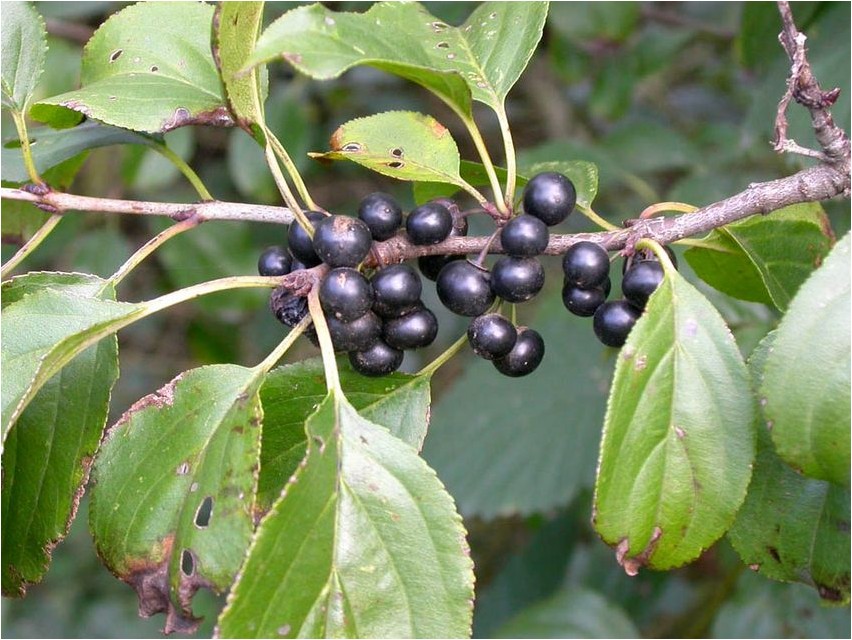
Zhoster laxative is one of the plants of the buckthorn family; in Latin the name of this plant will be as follows: Rhamnus cathartica L.
As for the name of the laxative family, in Latin it will be: Rhamnaceae Juss.
Description of joster laxative
Zhoster laxative is known under various popular names: tin, zhoster, lady-berry, zheret, zherit, zhestor, zhostir, zastrir, travel needle, bergatica, privet, korushatnik, teres, hrobost, blackberry, dog berries and buckthorn. Zhoster laxative is a highly branched shrub or tree whose height reaches eight meters. The branches of this plant end in spines. The leaves are opposite, serrate-crenate, round-ovate and endowed with three pairs of arcuate veins. The flowers of Joster laxative will be quadruple, bisexual or unisexual, small in size, they are collected in bunches and colored greenish-yellow. The fruit of this plant will be quite juicy, gymnospermous, spherical in shape and black in color.
The flowering of the laxative zoster occurs in the period from May to June. The ripening of the fruits of this plant occurs in August-September: at this time the raw materials should be prepared. Under natural conditions, this plant grows on the territory of the European part of Russia in all regions with the exception of the Dvina-Pechersk and Karelo-Murmansk regions, the plant is also found in all regions of Western Siberia except the Ob region, all regions of the Caucasus except the Transcaucasian region. The plant grows in Moldova, Belarus, Ukraine and the following regions of Central Asia: with the exception of Karakum, Kyzylkum, Gorno-Turkmen and Amudarya. As for its general distribution, the plant grows in the northern part of Turkish Armenia, North Africa, Asia Minor, Scandinavia, Atlantic and Southern Europe.
For growth, the plant prefers shrubs, hillsides, steppe ridges, places along high river banks, on pebbles, on gravelly and rocky slopes. The plant sometimes grows in thickets, is also decorative, but at the same time remains a honey plant.
Description of the medicinal properties of zhoster laxative
Zhoster laxative is endowed with very valuable healing properties, and for medicinal purposes it is recommended to use the bark, roots, branches, leaves and fruits of this plant.

The plant’s bark’s valuable medicinal properties are explained by its content of malic acid, carbohydrates and related compounds, tannins, alkaloids, essential oil, alpha-carotene, flavonoids, higher fatty acids, and their triacylglycerols. The leaves also contain vitamin C. The fruits contain flavonoids, malic acid, and carbohydrates. The seeds contain anthraquinones, fatty oil, paraffin, and the following glycerides: stearic, palmitic, butyric, oleic, linoleic, and isolinoic.
It should be noted that this plant is an ancient Russian anticancer remedy, used as early as the sixteenth century. A decoction made from the roots, bark, branches, and fruits of this plant is used for peptic ulcers, intestinal colic, and gastralgia, and also as a laxative. It should be noted that a decoction and infusion of the fruits of this plant is a mild laxative.
Infusion of the bark of the buckthorn is used as a laxative for anal fissures, hemorrhoids, and spastic and atonic constipation during menopause and postoperative periods. In homeopathy, the root essence of this plant is used as an abortive remedy and for chronic constipation.